





 Email this article


INDONESIAN UNIVERSITY STUDENTS’ PERCEPTIONS AND EXPERIENCES IN STUDYING AMERICAN CULTURE THROUGH ZOOM AND ONLINE INTERVIEW
(1) Universitas Kristen Maranatha, Indonesia
(*) Corresponding Author
Abstract
Studying American culture can be challenging for Indonesian university students due to the geographical distance that limits opportunities for direct cultural experiences. This study explored students’ reactions to and perceived benefits of learning American culture through Zoom meetings and email interviews. Using a qualitative approach, the study was conducted from September 2023 to January 2024. 25 university students participated in two Zoom meetings (60–80 minutes each). Each meeting featured one American speaker who discussed American business conditions or politics. Afterwards, students completed a four-question open-ended questionnaire. They also conducted group email interviews with Americans about education, ethnic and racial diversity, or leisure activities. At the end of the semester, students completed a five-question open-ended questionnaire about the email interviews. Data were analysed using descriptive statistics and thematic analysis. The findings showed generally positive reactions to the Zoom meetings. All students reported new knowledge about American business and politics. By doing the email interviews, students experienced two benefits: gaining new knowledge (88%) and communicating with Americans (12%). Challenges included unstable internet connections and delayed email replies. The findings highlight the potential of combining synchronous and asynchronous digital communication to complement classroom materials with first-hand cultural perspectives.
Keywords
Full Text:
PDFReferences
Aji, G. P. (2022). Students’ reflection on the experience in online school internship program based on experiential learning. International Journal of Indonesian Education and Teaching, 6(2), 204–225. https://doi.org/10.24071/ijiet.v6i2.4820
Alghasab, M., & Alvarez-Ayure, C. P. (2023). Towards the promotion of intercultural competences: Telecollaborative conversations between Kuwaiti and Colombian English as a foreign language university students. Computer Assisted Language Learning, 36(4), 555–583. https://doi.org/10.1080/09588221.2021.1934483
Alizadeh, M., & Cowie, N. (2025). Technology-enhanced intercultural exchange in language learning and teaching: A scoping review. ASCILITE Publications, 487–492. https://doi.org/10.65106/apubs.2025.2698
Amiti, F. (2020). Synchronous and asynchronous e-learning. European Journal of Open Education and E-learning Studies, 5(2), 60–70. https://doi.org/10.46827/ejoe.v5i2.3313
Amri, M., Angelakis, C., & Logan, D. (2021). Utilizing asynchronous email interviews for health research: Overview of benefits and drawbacks. BMC Research Notes, 14, Article 148. https://doi.org/10.1186/s13104-021-05547-2
Braun, V., & Clarke, V. (2023). Toward good practice in thematic analysis: Avoiding common problems and be(com)ing a knowing researcher. International Journal of Transgender Health, 24(1), 1–6. https://doi.org/10.1080/26895269.2022.2129597
Dahlin, E. (2021). Email interviews: A guide to research design and implementation. International Journal of Qualitative Methods, 20, 1–10. https://doi.org/10.1177/16094069211025453
Gustine, G. G., Jones, B., Rachmawati, S. S., Kusrini, D., & Yakin, H. (2025). Developing EFL students’ intercultural competence and communication through the collaborative online international learning (COIL) approach. TEFLIN Journal, 36(1), 61–76. https://doi.org/10.15639/teflinjournal.v36i1/61-76
Harris, S. L., Shaw, M., & Green, J. F. (2024). Utilizing asynchronous email interviewing for qualitative research among multiple participant groups: Perspectives on met and unmet needs from chaplain staffing. International Journal of Qualitative Methods, 23, 1–12. https://doi.org/10.1177/16094069241257943
Hung, C.-T., Wu, S.-E., Chen, Y.-H., Soong, C.-Y., Chiang, C.-P., & Wang, W.-M. (2024). The evaluation of synchronous and asynchronous online learning: Student experience, learning outcomes, and cognitive load. BMC Medical Education, 24, Article 326. https://doi.org/10.1186/s12909-024-05311-7
Kohnke, L., & Moorhouse, B. L. (2022). Facilitating synchronous online language learning through Zoom. RELC Journal, 53(1), 296–301. https://doi.org/10.1177/0033688220937235
Laili, R. N., & Nashir, M. (2020). The use of Zoom meeting for distance learning in teaching English to nursing students during Covid-19 pandemic. UICELL Conference Proceedings, 235–244. https://journal.uhamka.ac.id/index.php/uicell/article/view/6290
Lee, T.-Y., Ho, Y.-C., & Chen, C.-H. (2023). Integrating intercultural communicative competence into an online EFL classroom: An empirical study of a secondary school in Thailand. Asian-Pacific Journal of Second and Foreign Language Education, 8, Article 4. https://doi.org/10.1186/s40862-022-00174-1
Natalie, R. Y., & Purnamaningwulan, R. A. (2024). Investigating EFL students’ online engagement in Zoom main room and breakout rooms. International Journal of Indonesian Education and Teaching, 8(1), 35–49. https://e-journal.usd.ac.id/index.php/IJIET/article/view/6152
Naranjo-Toro, M., Basantes-Andrade, A., Meneses, M., & Guerra, J. (2026). Digital approaches to intercultural competence in higher education—A PRISMA systematic review with bibliometric and SWiM evidence. Frontiers in Education, 11, Article 1725080. https://doi.org/10.3389/feduc.2026.1725080
Nguyen, N. D.-N., Leung, A. H.-C., Hien, H.-T., & Thiet, N.-T. (2024). The impact of virtual exchanges using English as a lingua franca on students’ linguistic and intercultural competence. TESL-EJ, 28(3), 1–29. https://doi.org/10.55593/ej.28111a1
Nurieva, G. R., & Garaeva, L. M. (2020). Zoom-based distance learning of English as a foreign language. Journal of Research in Applied Linguistics, 11, 439–448. https://doi.org/10.22055/rals.2020.16344
Oates, M., Crichton, K., Cranor, L., Budwig, S., Weston, E. J. L., Bernagozzi, B. M., & Pagaduan, J. (2022). Audio, video, chat, email, or survey: How much does online interview mode matter? PLOS One, 17(2), e0263876. https://doi.org/10.1371/journal.pone.0263876
Prasetya, R. E. (2024). Exploring English language instruction through synchronous virtual meetings in Indonesian EFL context: Pedagogical approaches, opportunities and challenges, and multimedia integration. Journal on English as a Foreign Language, 14(1), 179–208. https://doi.org/10.23971/jefl.v14i1.7532
Qilin, Y., Mahfoodh, O. H. A., & Pérez Rubiano, P. A. (2025). Building intercultural bridges: Chinese EFL learners’ intercultural communicative competence through telecollaboration with Colombian peers. SAGE Open, 15(4). https://doi.org/10.1177/21582440251403241
Rojabi, A. R., & Femilia, P. S. (2023). EFL learners’ perception and attitude in synchronous meetings through Zoom videoconferencing. JEES (Journal of English Educators Society), 8(1), 11–23. https://doi.org/10.21070/jees.v8i1.1722
Saarijärvi, M., & Bratt, E. (2021). When face-to-face interviews are not possible: Tips and tricks for video, telephone, online chat, and email interviews in qualitative research. European Journal of Cardiovascular Nursing, 20(4), 392–396. https://doi.org/10.1093/eurjcn/zvab038
Satar, M., & Çimenli Olcars, B. (2025). Online intercultural exchange in language teacher education: Interactional resources for topic transition. Classroom Discourse, 16(3), 361–389. https://doi.org/10.1080/19463014.2025.2449920
Serhan, D. (2020). Transitioning from face-to-face to remote learning: Students’ attitudes and perceptions of using Zoom during COVID-19 pandemic. International Journal of Technology in Education and Science, 4(4), 335–342. https://doi.org/10.46328/ijtes.v4i4.148
Yang, P., & Yang, Z. (2025). Mobile-assisted intercultural competence development: The role of HelloTalk in Chinese EFL education. PLOS One, 20(7), Article e0328660. https://doi.org/10.1371/journal.pone.0328660
Yeh, H.-C., Qi, G. Y., Lin, M.-W., & Chen, N.-S. (2024). Oral translanguaging in telecollaboration: Effects on EFL learner intercultural awareness, learning and communicative competence. System, 124, Article 103357. https://doi.org/10.1016/j.system.2024.103357
Zeng, H., & Luo, J. (2024). Effectiveness of synchronous and asynchronous online learning: A meta-analysis. Interactive Learning Environments, 32(8), 4297–4313. https://doi.org/10.1080/10494820.2023.2197953
DOI: https://doi.org/10.24071/ijiet.v10i2.9424
Refbacks
- There are currently no refbacks.
Copyright (c) 2026 Maryani Maryani

This work is licensed under a Creative Commons Attribution-ShareAlike 4.0 International License.
Indexed and abstracted in:








IJIET Sinta 2 Certificate (S2 = Level 2)
We would like to inform you that IJIET (International Journal of Indonesian Education and Teaching):has been nationally re-accredited Sinta 2 by the Ministry of Higher Education, Science and Technology of the Republic of Indonesia based on the decree No. Surat Keputusan 355/DST/D.D1/HM.01.01/2026. Validity for 5 years: Vol 9 No 2, 2025 until Vol 14 No 1, 2030.
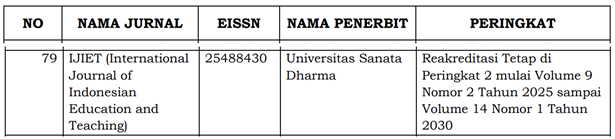
The new certificate is to upload when it is available. Thank you

IJIET Sinta 2 Certificate (please click here)

This work is licensed under CC BY-SA.
This work is licensed under a Creative Commons Attribution-ShareAlike 4.0 International License.

IJIET DOI: https://doi.org/10.24071/ijiet
p-ISSN: 2548-8422 (since 5 January 2017); e-ISSN: 2548-8430 (since 5 January 2017)
IJIET (International Journal of Indonesian Education and Teaching) is published twice a year, namely in January and July, by the Faculty of Teacher Training and Education of Sanata Dharma University, Yogyakarta, Indonesia.