



 Email this article
ROLE OF SOCIAL STUDIES INSTRUCTIONS IN CURBING TRUANCY AMONG UPPER BASIC STUDENTS IN KWARA STATE, NIGERIA
(1) University of Ilorin, Nigeria
(2) University of Ilorin, Nigeria
(3) University of Ilorin, Nigeria
(*) Corresponding Author
Abstract
Truancy is an anti-social behaviour and its prevalence in upper basic schools in Nigeria is alarming. Social Studies as a problem-solving discipline is one of the best ways of curbing truancy. The study therefore assessed role of Social Studies instructions for curbing truancy among upper basic students in Kwara State in Nigeria. The specific objectives were to investigate the forms, causes, consequences and ways of curbing truancy. A descriptive survey research design was employed. A self-structured questionnaire entitled “Assessment of Social Studies Instructions for Curbing Truancy” with 0.73 reliability index obtained through test-retest method was employed. Four research questions were raised and answered using mean ranking. The findings of the study revealed that the forms of truancy among upper basic students included truant behaviour resulting from dislike of subject teacher and repeated absence from school for a complete term among others. The causes of truancy were peer pressure and overpopulation among others. Consequences of truancy were found to include poor academic performance, student drop out and cultism among others. The discipline inculcated in students’ obedience to rules of school, attendance, punctuality and participation in school activities. It was recommended that parents should collaborate with schools on truancy prevention and intervention programs as it is clear that home factors contribute significantly to truant behavior exhibited by students.
Keywords
Full Text:
PDFReferences
Adebisi, K.S. (2015). Moral decadence among Nigerian youths as future leaders: A socio-cultural regeneration. Advances in Social Sciences Research Journal, 5 (20), 190-199. http://dx.doi.org/10.14738/assrj.52.3179
Adedigba, T. O., & Wahab, E. I. (2015). Degenerated moral values in Nigeria: Challenges of social studies education. Nigerian Journal of Social Studies, 18(1), 246-261.
Adediran, A. A., Atanda, J. O., & Oguntayo, M. F. (2020). Assessing civic education as instrument for building true democratic structures among students of tertiary institutions in Ogun State. Learning Community: An International Journal on Educational and Social Development, 11(1), 41–52, https://doi.org/10.3095414/2231458x.01.2020.5
Akaneme, I.N., Nwosu, E.N., Sunday, E.G., Uloh-Bethels, A.C., Nwosu, P.O., Robinson, A., & Ekwealor, F.N. (2016). Parents’ and teachers’ perceived strategies for reducing truancy among secondary school students: Implication for students’ behaviour modification. Medwell Journals of Social Sciences, 11(14), 3426-3433. http://dx.doi.org/10.3923/sscience.2016.3426.3433
Akubuilo, D. U., Ugo, A. C., Ugo, D. C., Ugochukwu, J. I., & Ikehi, M. E. (2019). Extent of implementation of social studies curriculum in secondary schools in Enugu State. Creative Education, 10(1), 2386-2399 https://doi.org//0.42361/ce.2019.1011170
Ampofo, E. T., Opoku, K., & Opoku-Manu, M. (2022). Truancy as predictor of poor academic performance among junior high school students in Ashanti Mampong Municipality of Ghana. European Journal of Education and Pedagogy, 3(2), 70-78. https://dx.doi.org/10.24018/ejedu.2022.3.2.164
Atubi, O. F. (2012). Appraisal of social studies theme in national value education curriculum for transformation in Nigeria. River State University Journal of Education, 24(1), 104-113.
Ayo-Vaughan, A. F. (2010). Effect of case study and puzzle based learning on students’ achievements, attitudes and civic competence in social studies and civic education (Unpublished doctoral thesis, University of Ibadan, Nigeria).
Bajon, R. H. (2022). Causes, effects and remedies of truancy among secondary school students in Jalingo, Taraba state, Nigeria. Journal of Educational Research in Developing Areas, 3(2), 159-167. https://doi.org/10.47434/JEREDA.3.2.2022.159
Bauer, L., Liu, P., Schanzenbach, D. W., & Shambaugh, J. (2018). Reducing chronic absenteeism under the every student succeeds act. Strategy paper for the Hamilton Project, Brookings Institute. https://www.brookings.edu/wpcontent/uploads/2018/04/reducing_chronic_absenteeism_under_the_every_student_succeeds_act2.pdf
Bello, M. B. (2020). Teachers’ assessment of the adequacy of social studies curriculum content in curbing moral problems among upper basic school students in Ilorin Metropolis. Kaduna Journal of Educational Studies, 1(2), 94-102.
Eremie, M. D. (2015). Counsellors and teachers ranking of factors causing truancy among secondary school students in Rivers State Nigeria. Arabian Journal of Business and Management Review, 5(6), 1000163. http://dx.doi.org/10.4172/2223-5833.1000163
Fareo, D. O. (2013). Truancy and academic performance of secondary school students in Southwestern Nigeria: Implications for counselling. International Journal for Cross-disciplinary Subjects in Education, Special Issue, 3(2), 1424-1428. http://dx.doi.org/10.20533/ijcdse.2042.6364.2013.0198
Fareo, D. O. (2019). Influence of truancy on academic achievements of secondary school students in Maiha Local Government Area of Adamawa State. East African Scholars Journal of Education, Humanities and Literature, 2(8), 430-438.
Gerth, M. (2020). Does truancy make the delinquent? A situational and longitudinal
analysis of the truancy–delinquency relationship. European Journal of
Criminology, 19(5), 1205-1224. https://doi.org/10.1177/1477370820952681
Isiaku, W. B, Adama, G. N., Nwankwo, B. C., Abida, A. B., Ali, T. M., & Nweke, B. O. (2020). Effect of bibliotherapy on truant behaviour of schooling adolescents in Northwest Nigeria. The Journal of Social Sciences Research, 1(1), 1-20. https://doi.org//0.32861/jssr
Jimoh, K. I. (2014). Social studies education as mega-force in promoting good governance in Nigeria. Paper Presented at 14th Biennial National Conference Ado-Ekiti.
Kanga, B. M., & Jagero, N. (2015). Effects and the possible remedies of students’ truancy in secondary schools in Meru South Sub County, Kenya. Advances in Social Sciences Research Journal, 2(11), 23-35. https://doi.org/10.14738/assrj.211.1548
Katilmis, A. (2017). Values education as perceived by social studies teachers in objective and practice dimensions. Educational Sciences: Theory & Practice, 17(4), 1231–1254. https://doi.org/10.12738/estp.2017.4.0570
Kowalczyk, D. (2015). Descriptive research design: Definitions, examples and types. Study.com. Retrieved from http://study.com/academy/lesson/descriptive-research design-definition-examples-type.html
Lakshmi, V.V., & Paul, M. M. (2018). Value education in educational institutions and role of teachers in promoting the concept. International Journal of Educational Science and Research, 8(4), 29-38.
Lázaro, S., Urosa, B., Mota, R., & Rubio, E. (2020). Primary education truancy and school performance in social exclusion settings: The case of students in Cañada Real Galiana. Sustainability, 12(1), 1-27. https://doi.org/10.3390/su12208464
Matthew, I. A. (2020). Perception of teachers on school-based factors influencing absenteeism of students in public secondary school in Central Senatorial District of Ondo State, Nigeria. Asian Journal of Education and Social Studies, 7(2), 46-55.
Musa, T. (2014). Absenteeism and truancy on academic performance of secondary school students in Ogun State, Nigeria. Journal of Education and Practice, 5(22), 81-87.
Njok, P. C., & Sunday, D. E. (2014). Socio-cultural factors affecting the teaching and learning of social studies in Nigeria. Journal of Educational Practice, 5(24), 153-158.
Nyika, R., & Kurebwa, M. (2014). Strategies employed by primary school teachers in Sadza Cluster in managing truancy. Greener Journal of Educational Research, 4(3), 063-070.
Ocak, G., Ocak, I., & Baysal, E. A. (2017). The causes of absenteeism of high school students. European Journal of Education Studies, 3(4), 331 – 346. http://dx.doi.org/10.5281/zenodo.376841
Oladimeji, T. A. O. (2022). Teachers’ evaluation of social studies curriculum in reducing moral problems in the 21st century among school students in Ibadan Metropolitan of Oyo State. International Journal of Scientific Trends, 1(1), 45-54.
Olagbegi, A.O. (2015). A critical review of the revised 9-year basic education curriculum (BEC) in Nigeria. SFU Educational Review, 8, 1-13. https://doi.org/10.21810/sfuer.v8i.387
Oluwagbohunmi, M.F. (2017). Value re-orientation for youths: An imperative for national development. European Journal of Education Studies, 3(5), 705-715. http://dx.doi.org/10.46827/ejes.v0i0.721
Oparinde F.O., & Abdulsalam, A. A. (2018). Curbing students’ deviant behaviour through the teaching of value and moral education in Osun State. Social Science Education Journal (SOSCED-J), 2(2), 100-107.
Osalusi, F.M., & Ajayi, A.D. (2021). Nigerian national value: What are they and who are their custodians. Nigerian Journal of Social Studies, 24(1), 287-302.
Osoku, A.E. (2019). Minimizing the incidence of absenteeism and truancy in Nigerian public schools through astute school administration. Akwanga Journal of Educational Studies (AJES), 3(1) 34-41.
Salawudeen, M.O. (2021). Pre-service teachers’ perception of national value education in the curriculum of basic 1-9 pupils in Nigeria educational system. Nigerian Journal of Social Studies, 24(2), 29-44.
Shittu, R.O., & Oanite, R.A. (2015). Teachers’ attitudes: A great influence on teaching and learning of social studies. Journal of Law, Policy and Globalization, 42(1), 131-137.
Suleman, Q., Hussain, I., & Kayani, A. I. (2017). Factors contributing to truancy among secondary school students in Karak District, Pakistan. Journal of Education and Practice, 8(25), 65 -74.
DOI: https://doi.org/10.24071/ijiet.v9i2.8871
Refbacks
- There are currently no refbacks.
Copyright (c) 2025 OLOKOOBA ISSA NASIRU

This work is licensed under a Creative Commons Attribution-ShareAlike 4.0 International License.
Indexed and abstracted in:





IJIET Sinta 2 Certificate (S2 = Level 2)
We would like to inform you that IJIET (International Journal of Indonesian Education and Teaching):has been nationally re-accredited Sinta 2 by the Ministry of Higher Education, Science and Technology of the Republic of Indonesia based on the decree No. Surat Keputusan 355/DST/D.D1/HM.01.01/2026. Validity for 5 years: Vol 9 No 2, 2025 until Vol 14 No 1, 2030.
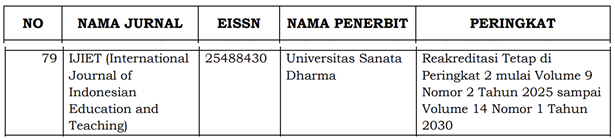
The new certificate is to upload when it is available. Thank you

IJIET Sinta 2 Certificate (please click here)

This work is licensed under CC BY-SA.
This work is licensed under a Creative Commons Attribution-ShareAlike 4.0 International License.

IJIET DOI: https://doi.org/10.24071/ijiet
p-ISSN: 2548-8422 (since 5 January 2017); e-ISSN: 2548-8430 (since 5 January 2017)
IJIET (International Journal of Indonesian Education and Teaching) is published twice a year, namely in January and July, by the Faculty of Teacher Training and Education of Sanata Dharma University, Yogyakarta, Indonesia.