




 Email this article
HIGHER EDUCATION IN CAMBODIA: AN EMPIRICAL STUDY OF STUDENT CHALLENGES
(1) Royal University of Phnom Penh, Cambodia
(*) Corresponding Author
Abstract
Students are recognized as the fundamental component in developing a country’s higher education mission. However, there is less attention in the scholarly literature focused on student life in higher education. The purpose of the study is to explore the challenges of Cambodian higher education students. A qualitative approach was utilized, and purposive sampling was used (n = 97). The data were analysed using thematic coding, derived from a literature review and emergent patterns. The study highlights the five main challenges: (1) Academic performance; (2) Personality adaptation; (3) Career readiness; (4) Socio-cultural background; and (5) Student services platform. The findings of this study provide concrete, actionable recommendations that will directly support the Ministry of Education, Youth, and Sports, HEIs, industry partners, and other relevant stakeholders in closing the skills gap and strengthening graduate employability, enabling them to collaborate closely and effectively to deliver responsive services and meet the needs of the job market. This is particularly important for ensuring the quality, sustainability, and inclusiveness of economic growth, as the government emphasizes.
Keywords
Full Text:
PDFReferences
Abiola, O. B., & Paul, A. T. (2019). The inclusion of guidance and counseling program into basic education curriculum for quality assurance. Asian Journal of Interdisciplinary Research, 2(2), 33–43. https://doi.org/10.34256/ajir1924
Accreditation Committee of Cambodia. (2023). The instruction book on the recognition of quality of higher education institutions. Cambodia: ACC.
Altbach, P. G., & Knight, J. (2007). The internationalization of higher education: Motivations and realities. Journal of Studies in International Education, 11(3–4), 290–305. https://doi.org/10.1177/1028315307303542
Andrews, J., Clark, R., & Thomas, L. (Eds.). (2012). Compendium of effective practice in higher education retention & success. York: The Higher Education Academy.
Bearman, M. (2019). Eliciting rich data: A practical approach to writing semi-structured interview schedules. Focus on Health Professional Education: A Multi-Professional Journal, 20(3), 1–11. https://search.informit.org/doi/10.3316/informit.002757698372666
Braun, V., & Clarke, V. (2006). Using thematic analysis in psychology. Qualitative Research in Psychology, 3(2), 77–101. https://doi.org/10.1191/1478088706qp063oa
Brock, C., & Symaco, L. P. (2011). Education in South-East Asia. Providence, RI: Symposium Books Ltd. https://doi.org/10.1108/S1479-367920190000036012
Bunthoeurn, S. (2018). Exploring ICT for higher education: The case of French and Cambodian end/key users. Phnom Penh.
Burgstahler, S. E., & Cory, R. C. (Eds.). (2010). Universal design in higher education: From principles to practice. Cambridge, MA: Harvard Education Press.
Cambodia Development Resource Institute. (2015). Cambodia education 2015: Employment and empowerment. Phnom Penh: Green Investment Green Business Printing House.
Camelia, S., & Nastase, E. (2018). University dropout: Causes and solutions. Journal of Economic Studies, 10(4), 2–4. https://doi.org/10.32437/mhgcj.v1i1.29
Chason, A. K., Bullock-Yowell, E., Sampson, J. P., Lenz, J. G., & Reardon, R. C. (2013). Relationships among career thoughts, career interests, and career decision state. Canadian Journal of Career Development, 12(1), 39-47. https://doi.org/10.82396/cjcd.v12i1.3055
Chet, C. (2009). Higher education in Cambodia. In Y. Hirosato & Y. Kitamura (Eds.), The political economy of educational reforms and capacity development in Southeast Asia (pp. 153–165). Dordrecht: Springer. https://doi.org/10.1007/978-1-4020-9377-7_10
Chet, C., Sok, S., & Sou, V. (2022). The antecedents and consequences of study commitment to online learning at higher education institutions (HEIs) in Cambodia. Sustainability, 14, 3184. https://doi.org/10.3390/su14063184
Ciobanu, A. (2013). The role of student services in improving the student experience in higher education. Social and Behavioral Sciences, 92, 169-173. https://doi.org/10.1016/j.sbspro.2013.08.654
Clayton, T. (1998). Building the new Cambodia: Educational destruction and construction under the Khmer Rouge, 1975–1979. History of Education Quarterly, 38(1), 1975-1979. https://doi.org/10.2307/369662
Cohen, L., Manion, L., & Morrison, K. (2007). Research methods in education (6th ed.). London: Routledge. https://doi.org/10.4324/9780203029053
Creswell, J. W. (2012). Educational research: Planning, conducting, and evaluating quantitative and qualitative research. Boston, MA: Pearson.
Creswell, J.W., & Poth, C.N. (2018). Qualitative inquiry and research design choosing among five approaches (4th Ed.). Thousand Oaks: SAGE Publications, Inc.
Eisenberg, D., Hunt, J., & Speer, N. (2013). Mental health in American colleges and universities: Variation across student subgroups and across campuses. The Journal of Nervous and Mental Disease, 201(1), 60–67. https://doi.org/10.1097/NMD.0b013e31827ab077
Fisher, S., Murray, K., & Frazer, N. A. (1985). Homesickness, health, and efficiency in first-year students. Journal of Environmental Psychology, 5(2), 181–195. https://doi.org/10.1016/S0272-4944(85)80016-5
Giotakou, A. (2024). Higher education and cultural capital: The role of parental education in Greek medical school choices. International Journal of Current Education Studies (IJCES), 3(2), 37-50. https://doi.org/10.46328/ijces.142
Gochhayat, L., & Das, S. R. (2023). Exploring the impact of Covid-19 on higher education in India: A systematic review of online teaching –learning and examination practices. International Journal of Current Educational Studies, 2(1), 37-61. https://doi.org/10.46328/ijces.61
Harvey, L., Drew, S., & Smith, M. (2006). The first-year experience: A review of literature for the Higher Education Academy. York, UK: Higher Education Academy.
Heng, K. (2013). The effects of faculty behavior on the academic achievement of first-year Cambodian urban university students. Educational Research for Policy and Practice, 13(3), 233–250. https://doi.org/10.1007/s10671-013-9159-z
Heng, K. (2024). Challenges and developments in university research in Cambodia: A case study of two universities. Higher Education, 87(6), 1593–1613. https://doi.org/10.1007/s10734-023-01080-2
Heng, K. (2024). Understanding Cambodian provincial university students’ perspectives on Cambodia’s vision to become a knowledge-based society. Sage Open, 14(2). https://doi.org/10.1177/21582440241242197
Heng, K., & Sol, K. (2023). Challenges facing higher education in Cambodia and ideas for reform. Cambodian Journal of Educational Research, 3(1), 1-19. https://doi.org/10.62037/cjer.2023.03.01.01
Heng, K., Doeur, B., & Din, L. (2023). Promoting higher education quality in Cambodia: Challenges and recommendations. Cambodian Journal of Educational Research, 3(1), 92-109. https://doi.org/10.62037/cjer.2023.03.01.05
Holly, K. M. (2015). The year of change: Challenges faced by first-year students based on individual identities. Harrisonburg: James Madison University. https://commons.lib.jmu.edu/honors201019/102
Huong, N. T. T. (2022). Speaking problems facing first-year English majors at University of Education–Thai Nguyen University. TNU Journal of Science and Technology, 227(04), 186–194. https://doi.org/10.34238/tnu-jst.5684
ILO. (2021). Soft skills improve the employability of youth and job seekers. Retrieved from https://www.ilo.org/resource/news/soft-skills-improve-employability-youth-and-job-seekers
Johnson, C., Gitay, R., Salam, A. G., Bensaid, A., Ismail, Al-Tameemi, R. A. N., Rpmanowski, M. H., Fakih, B. M. K., & Hazaa, K. A. (2022). Student support in higher education: Campus service utilization, impact, and challenges. Cell Press, 1–13. Retrieved from https://www.cell.com/action/showPdf?pii=S2405-8440%2822%2903847-6
Kajoina, O. (2022). The role of student services in student retention: A case study of a Ugandan private university (Dissertation, University of the Incarnate Word, San Antonio, Texas). https://athenaeum.uiw.edu/uiw_etds/405
Kantanis, T. (2000). The role of social transition in students’ adjustment to the first year of university. Journal of Institutional Research, 9, 100–110.
Khoo, S., Ha, H., & McGregor, S. L. T. (2017). Service quality and student/customer satisfaction in the private tertiary education sector in Singapore. International Journal of Educational Management, 31(4), 430–444. https://doi.org/10.1108/IJEM-09-2015-0121
Lea, S. J., & Farbus, L. (2000). Student support: Educational necessity or mawkish indulgence? Psychology Teaching Review, 9(1), 16–25. https://doi.org/10.53841/bpsptr.2000.9.1.16
Lincoln, Y.S., & Guba, E.G. (1985). Naturalistic inquiry. Newbury Park, CA: Sage Publications.
Liu, E. (2023). Exploring social connectedness and its impact on university adjustment and well-being: A mixed-methods study in New Zealand. Rangahau Aranga: AUT Graduate Review, 2(3). https://doi.org/10.24135/rangahau-aranga.v2i3.209
Mahmud, M., Amat, S., & Abu Bakar, A. (2022). Issues and challenges in career counselling in higher education. Sciences, 12(9), 733-739. http://dx.doi.org/10.46886/IJARP/v12-i9/12155
Ministry of Education, Youth and Sport (MoEYS). (2017). Education congress: The education, youth, and sport performance in the academic year 2015–2016 and goal for the academic year 2016–2017. Ministry of Education, Youth, and Sport.
Ministry of Labour and Vocational Training (2024). Report on the Cambodia job outlook survey. Retrieved from https://mlvt.gov.kh/media/k2/attachments/report-on-cambodia-job-outlook-survey_2024-en_1.pdf
Moeurn, C. (2025). Enhancing students’ cognitive skills through interactive learning strategies in science education. Educative: Jurnal Ilmiah Pendidikan, 3(3), 135-148. https://doi.org/10.70437/educative.v3i3.1496
Moeurn, C., Sam, C., & Mok, S. (2025). The practice of student services in Cambodia: A case study of public higher education institutions. Cambodian Journal of Education and STEM, 3(1), 66–102. https://doi.org/10.62219/cjes.2025314
Noble, H., & Smith, J. (2025). Ensuring validity and reliability in qualitative research. Evidence-based nursing, 28(4), 206–208. https://doi.org/10.1136/ebnurs-2024-104232
Nooreen, N., Habibah, E., & Rahil, H. M. (2009). Understanding psychological behavioural patterns: Factors and problems in school to university transition. Journal of Social Sciences and Applications, 1(1), 42-56.
Norzaini, A., Zalizan, M. J., & Manisah, M.A. (2003). Effective higher educational practices in UKM. A survey of student engagement. Research in Progress. HERDSA Conference. Retrieved from http://surveys.canterbury.ac.nz/herdsa03/pdfnon/NI004.pdf
Nowell, L. S., Norris, J. M., White, D. E., & Moules, N. J. (2017). Thematic analysis: Striving to meet the trustworthiness criteria. International journal of qualitative methods, 16(1). https://doi.org/10.1177/1609406917733847
O’Connor, C., & Joffe, H. (2020). Intercoder reliability in qualitative research: Debates and practical guidelines. International journal of qualitative methods, 19. https://doi.org/10.1177/1609406919899220
Patton, M. Q. (2002). Qualitative research & evaluation methods (3rd ed.). Thousand Oaks, CA: Sage Publications.
Phyrom, S., & Sopheak, S. (2023). Technology integration of Cambodian higher education: Emerging changes since Covid-19 and notable challenges. Phnom Penh. Retrieved from https://www.unesco.org/gem-report/sites/default/files/medias/fichiers/2023/09/SopheakandPhyrom.pdf
Rendon, L. I., & Nora, A. (1992). A synthesis and application of research on Hispanic students on community colleges. Community College Review, 17(1), 17-24.
Selim, A., & Muhammad, M. (2014). Measuring service quality of a higher educational institute towards student satisfaction. American Journal of Educational Research, 2(7), 447–455. https://doi.org/10.12691/education-2-7-5
Stofer, K. A. (2019). Preparing for one-on-one qualitative interviews: Designing and conducting the interview: AEC675/WC338, 8/2019. EDIS, 2019(4), 4. https://doi.org/10.32473/edis-wc338-2019
Tao, N. (2025). English as a foreign language teachers’ challenges of their online instruction during the Covid-19 outbreak in Cambodia. Insight: Cambodia Journal of Basic and Applied Research, 7(1), 55-75. https://www.doi.org/10.61945/cjbar.2025.7.1.04
Thang, S. M. (2009). Investigating the learner autonomy of Malaysian ESL learners: Towards a redefinition. In S.M. Thang & B. Sinclair (Eds.), Learner autonomy: Research and practice in Malaysia and Singapore (pp. 13-32). Petaling Jaya, Selangor: Pearson Longman.
Tinto, V. (1983). Leaving college: Rethinking the causes and cures of student attrition (2nd ed.). Chicago, IL: University of Chicago Press. https://doi.org/10.7208/chicago/9780226922461.001.0001
Tinto, V. (1987). Leaving college: Rethinking the causes and cures of student attrition. Chicago, IL: University of Chicago Press.
Tinto, V. (1993). Leaving college: Rethinking the causes and cures of student attrition (2nd ed.). Chicago, IL: University of Chicago Press. https://doi.org/10.7208/chicago/9780226922461.001.0001
Tinto, V. (2015). Through the eyes of students. Journal of College Student Retention: Research, Theory & Practice, 19(3), 254–269. https://doi.org/10.1177/1521025115621917
Un, L., & Sok, S. (2018). Higher education governance in Cambodia: An update. Phnom Penh.
UNESCO. (2000). Higher education in developing countries: Peril and promise. The World Bank.
UNESCO. (2002). The role of student affairs and services in higher education: A practical manual for developing, implementing, and assessing student affairs programmes and services. Retrieved from https://www.scribd.com/document/248668012/128118e-pdf
UNESCO. (2009). Student affairs and services in higher education: Global foundations, issues, and best practices. UNESCO. Retrieved from https://unesdoc.unesco.org/ark:/48223/pf0000183221
Wintre, M., & Yaffe, M. (2000). First-year students’ adjustment to university life as a function of relationships with parents. Journal of Adolescent Research, 15(1), 9–37. https://doi.org/10.1177/0743558400151002
World Economic Forum. (2020). The future of jobs report 2020. Retrieved from https://www3.weforum.org/docs/WEF_Future_of_Jobs_2020.pdf
World Economic Forum. (2024). The future of jobs report 2024. WEF. Retrieved from https://www.weforum.org/reports/future-of-jobs-report-2024/
Yasmin, C., Sarah, G., Hannah, G., Kiu, S., & Yue, Y. (2024). Challenges and barriers for first-year home and international students in higher education in the UK and Ireland: A scoping review. Student Engagement in Higher Education Journal, 5(2).
Yorke, M., & Thomas, L. (2003). Improving the retention of students from lower socio-economic groups. Journal of higher education policy and management, 25(1), 63-74. https://doi.org/10.1080/13600800305737
Young, M. C., & Courtad, C. A. (2016). Inclusion and students with learning disabilities. In General and special education inclusion in an age of change: Impact on students with disabilities (Vol. 31, pp. 13–29). Leeds, UK: Emerald Group Publishing Limited. https://doi.org/10.1108/S0270-401320160000031002
Zepke, N., & Leach, L. (2010). Improving student engagement: Ten proposals for action. Active Learning in Higher Education, 11(3), 167–177. https://doi.org/10.1177/1469787410379680
DOI: https://doi.org/10.24071/ijiet.v10i2.14708
Refbacks
- There are currently no refbacks.
Copyright (c) 2026 Chantrea Moeurn

This work is licensed under a Creative Commons Attribution-ShareAlike 4.0 International License.
Indexed and abstracted in:








IJIET Sinta 2 Certificate (S2 = Level 2)
We would like to inform you that IJIET (International Journal of Indonesian Education and Teaching):has been nationally re-accredited Sinta 2 by the Ministry of Higher Education, Science and Technology of the Republic of Indonesia based on the decree No. Surat Keputusan 355/DST/D.D1/HM.01.01/2026. Validity for 5 years: Vol 9 No 2, 2025 until Vol 14 No 1, 2030.
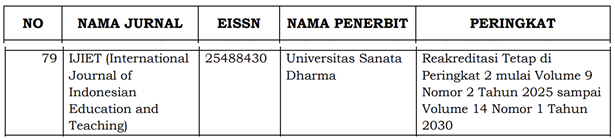
The new certificate is to upload when it is available. Thank you

IJIET Sinta 2 Certificate (please click here)

This work is licensed under CC BY-SA.
This work is licensed under a Creative Commons Attribution-ShareAlike 4.0 International License.

IJIET DOI: https://doi.org/10.24071/ijiet
p-ISSN: 2548-8422 (since 5 January 2017); e-ISSN: 2548-8430 (since 5 January 2017)
IJIET (International Journal of Indonesian Education and Teaching) is published twice a year, namely in January and July, by the Faculty of Teacher Training and Education of Sanata Dharma University, Yogyakarta, Indonesia.