




 Email this article

PROFESSIONAL LEARNING COMMUNITY MODEL FOR SCHOOL TEACHERS ADMINISTERED BY THE EDUCATION DEPARTMENT OF BANGKOK ARCHDIOCESE
(1) Joseph Upatham School, Bangkok, Thailand Assumption University, Bangkok, Thailand
(2) Siam Technology College, Thailand
(3) Saengtham College, Thailand
(*) Corresponding Author
Abstract
Keywords
Full Text:
PDFReferences
Admiraal, W., Schenke, W., De Jong, L., & Emmelot, Y. (2021). Schools as professional learning communities: What can schools do to support professional development of their teachers? Professional Development in Education, 47(4), 684-698. doi:10.1080/19415257.2019.1665573
Beltramo, J., Layam, K., Lucas, J., & Schmitt, J. (2021). Cultivating Catholic classroom communities during remote teaching. Journal of Catholic Education, 24(2), 43-61. https://doi.org/10.15365/joce.2402032021
Catholic Education Council of Thailand. (2018). Revisit the identity of Catholic education in Thailand. Bangkok: Catholic Education Council of Thailand.
Congregation for Catholic Education. (1997). The Catholic school on the threshold of the third millennium. Vatican City.
Congregation for Catholic Education. (2002). Lay Catholics in schools: Witnesses to faith. Vatican City.
Congregation for Catholic Education. (2007). Educating together in Catholic schools: A shared mission between consecrated persons and the lay faithful. Vatican City.
Darling-Hammond, L., Hyler, M., & Gardner, M. (2017). Effective teacher professional development. Palo Alto, CA: Learning Policy Institute.
Dokmai, P., Sakorn, W., & Nontapa, R. (2023). The professional learning community for teachers’ professional development training in classroom action research for enhancing students’ science, mathematics and technology competencies in new normal. International Journal of Science Education and Teaching, 2(1), 38-50. doi:10.14456/ijset.2023.3
DuFour, R., DuFour, R., Eaker, R., & Many, T. (2006). A handbook for Professional Learning Communities at work. Bloomington, IN: Solution Tree Press.
Dumandan, F., & Paglinawan, J. (2025). The relationship of professional learning communities’ (PLC) engagement towards teachers’ competence. International Journal of Research and Innovation in Applied Science, 10(5), 499–513. doi:10.51584/IJRIAS.2025.100500046
Fernandez, A. (2017). A qualitative study on sustainable professional learning communities in Catholic elementary schools (Ed.D. dissertation, Creighton University). ERIC ED579968.
Fred, H., Meeuwen Pierre, V., Ellen, R., & Marjan, V. (2020). How to enhance teachers’ professional learning by stimulating the development of professional learning communities: Operationalising a comprehensive PLC concept for assessing its development in everyday educational practice. Professional Development in Education, 46(5), 751–769. doi:10.1080/19415257.2019.1634630
Guskey, T. (2014). Planning professional learning. Educational Leadership, 71(8), 10–16.
Guskey, T. R. (2002). Professional Development and Teacher Change. Teachers and Teaching: Theory and Practice, 8, 381-391. Retrieved from http://dx.doi.org/10.1080/135406002100000512
Hargreaves, A., & Fullan, M. (2012). Professional capital: Transforming teaching in every school. New York, NY: Teachers College Press.
Hord, S. (1997). Professional learning communities: Communities of continuous inquiry and improvement. Austin, Texas: Southwest Educational Development Laboratorary.
Hsu, C.-C., & Sandford, B. (2007). The Delphi technique: Making sense of consensus. Practical Assessment, Research & Evaluation, 12(10), 1-8.
Janjang, S., Vetsawat, C., Pariput, P., & Panyapa, R. (2024). Teaching ability development through professional learning community: A case study of teacher for local development project on induction period in Thailand. Journal of Green Learning, 4(2), 82-90. doi:10.53889/jgl.v4i2.482
Jesuit Schools Network of North America. (2015). Ignatian pedagogical paradigm (IPP). Washington, DC: Jesuit Schools Network.
Koelsch, J.-M. (2016). Teacher Perceptions of Professional Learning Community Maturity in Catholic Schools. Walden University Scholar Works. Retrieved from https://scholarworks.waldenu.edu/dissertations
Lambert, L. (2003). Leadership Capacity for Lasting School Improvement. Alexandria, VA: Association for Supervision and Curriculum Development.
Madden, R. (2020). Dialogue in community: Conditions and enablers for teacher professional development in Catholic schools. Journal of Religious Education, 68(103), 125–139. https //doi.org/10.1007/s40839-020-00104-8
Mariani-Petroze, C. (2023). The positive impacts of a professional learning community model on student achievement in small schools. Journal of Catholic Education, 26(2), 23–49. https://doi.org/10.15365/joce.2602022023
Mhunpiew, N., & Asavisanu, P. (2023). Southeast Asia Teacher Competency Framework (SEA-TCF): Application in Thai Catholic schools. Journal of Humanities and Social Sciences Nakhon Phanom University, 13(3), 19-34. Retrieved from https://so03.tci-thaijo.org/index.php/npuj/article/view/269615/181211
Namwong, O.-A. (2021, July-September). Scrutinizing Professional Learning Community: Its Pros and Cons to Basic Education Teachers. Journal of Education, Mahasarakham University, 15(3), 20-34. Retrieved from http://edu.msu.ac.th/journal/home/journal_file/783.pdf.
Office of the Education Council. (2023). Education in Thailand 2022 (OEC Publication No. 56/2023). Office of the Education Council, Ministry of Education. Bangkok: Prigwhan Graphic. Retrieved from https://www.onec.go.th
Owen, S. (2014). Teacher professional learning communities: Going beyond contrived collegiality toward challenging debate and collegial learning and professional growth. Australian Journal of Adult Learning, 54(2), 54-77.
Prachagool, V., & Nuangchalerm, P. (2021, August). Perspective of Thai educators toward 21st century instruction. Journal of Education and Learning (EduLearn), 15(3), pp. 432-437. doi:10.11591/edulearn.v15i3.20281
Rufus, R. (2023). Catholic school principal’s leadership and professional learning communities: A qualitative descriptive study (Doctoral Dissertation). Retrieved from https://eric.ed.gov/?q=qualitative+AND+descriptive&id=ED638774
Sriklaub, K., & Ruengtrakul, A. (2022). Teachers’ Experiences in a Professional Learning Community: Insights on Policy Delivery and Characteristics of the PLC in Schools. Kasetsart Journal of Social Sciences, 43(2), 303-310. Retrieved from https://so04.tci-thaijo.org/index.php/kjss/article/view/258487
Stoll, Bolam, McMahon, Thomas, & Wallace. (2006). Professional Learning Communities: A Review of the Literature. Journal of Educational Change, 221-258.
Stufflebeam, D. (2014). Daniel Stufflebeam’s CIPP model for evaluation: An improvement-and-accountability-oriented approach. In D. Stufflebeam, & C. Coryn, Evaluation theory, models, and applications (2 ed., pp. 309–332). San Francisco, CA: Jossey-Bass.
Wahyudhanti, T., Mhunpiew, N., & Bistis, M. (2025). Professional learning communities in Catholic schools: A qualitative exploration for teacher professional development. Saengtham College Journal, 17(2), 332–367. Retrieved from https://so01.tci-thaijo.org/index.php/scj/article/view/282205
Worapun, W., Khamdit, S., & Siridhrungsri, P. (2022). Teacher perceptions toward professional learning community on the development of Thai students’ 21st century skills. Journal of Educational Issues, 8(1), 59-72.
DOI: https://doi.org/10.24071/ijiet.v10i2.14631
Refbacks
- There are currently no refbacks.
Copyright (c) 2026 Theresia Astanti Rorik Wahyudhanti, Nathara Mhunpiew, Michael Bistis

This work is licensed under a Creative Commons Attribution-ShareAlike 4.0 International License.
Indexed and abstracted in:








IJIET Sinta 2 Certificate (S2 = Level 2)
We would like to inform you that IJIET (International Journal of Indonesian Education and Teaching):has been nationally re-accredited Sinta 2 by the Ministry of Higher Education, Science and Technology of the Republic of Indonesia based on the decree No. Surat Keputusan 355/DST/D.D1/HM.01.01/2026. Validity for 5 years: Vol 9 No 2, 2025 until Vol 14 No 1, 2030.
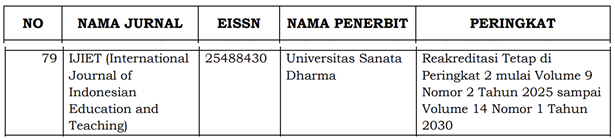
The new certificate is to upload when it is available. Thank you

IJIET Sinta 2 Certificate (please click here)

This work is licensed under CC BY-SA.
This work is licensed under a Creative Commons Attribution-ShareAlike 4.0 International License.

IJIET DOI: https://doi.org/10.24071/ijiet
p-ISSN: 2548-8422 (since 5 January 2017); e-ISSN: 2548-8430 (since 5 January 2017)
IJIET (International Journal of Indonesian Education and Teaching) is published twice a year, namely in January and July, by the Faculty of Teacher Training and Education of Sanata Dharma University, Yogyakarta, Indonesia.