




 Email this article
INTEGRATION OF SELF-ESTEEM ENHANCEMENT PROGRAMS IN COLLEGE OUTREACH ACTIVITIES TO PERSONS WITH DISABILITIES: TOWARD A FRAMEWORK FOR INCLUSIVE PEDAGOGY
(1) Harris Memorial College, Philippines
(2) University of Asia and the Pacific, Philippines
(*) Corresponding Author
Abstract
This study explores the development of self-esteem among individuals with physical conditions through proposed self-esteem enhancement programs by faculty and students engaged in outreach activities at a local private college in Rizal province for persons with disabilities (PWDs), who are often excluded from mainstream education. Relying on autoethnography as a research method, this qualitative work provides timely observations and reflections drawn from recorded research notes on the subject of self-esteem as it relates to individuals with physical challenges and what can be done to address their needs outside the four walls of educational institutions. Major autoethnographic findings highlight some of the best possible practices necessary in the conduct of self-esteem enhancement tasks for PWDs and how they can be implemented in places such as Tahanang Walang Hagdanan (Home Without Stairs), a pioneering organization that empowers persons with disabilities by providing livelihood, skills training, and advocacy for accessibility and inclusion in the Philippines. Our autoethnographic records further point to the need to identify self-esteem enhancement strategies that can be integrated into the faculty-student community outreach endeavors designed for people with physical limitations. Observations and conclusions have implications for inclusive pedagogy and a framework for education that integrates those with disabilities in formal and non-formal education in line with the United Nations Sustainable Development Goals (SDGs) in Education, particularly SDGs 4.3 and 4.5.
Keywords
Full Text:
PDFReferences
Aldridge, J. (1993). Self-esteem: Loving yourself at every age. Nora: Doxa Books.
Alleyne, J. (2003, December 11). Self-esteem, sport and physical activity. Retrieved from www.caaws.ca/e/resources/pdfs/Self_Esteem.pdf
Arce, W. F. (1998). Systematic qualitative data research: An introduction for Filipino practitioners. Manila: Ateneo de Manila University.
Buenaventura, L. L. (1987). Physical disability and the management of stigma: The Bahay-Biyaya case (Unpublished dissertation, Ateneo de Manila University, Quezon City, Philippines).
Chong, G. D. (2009). Flying on broken wings: Stories of courage in overcoming disabilities. Manila: New Day.
Clegg, S., & Bradley, S. (2006). Models of personal development planning: Practice and processes. British Educational Research Journal, 32(1), 57–76. https://doi.org/10.1080/01411920500402003
Dalgas-Pelish, P. (2006). Effects of a self-esteem intervention program on school-age children. Pediatric Nursing, 8, 341-349.
Dobbins, R. (1996). Student teacher self-esteem in the practicum. Australian Journal of Teacher Education, 21(2), 16-28. https://doi.org/10.14221/ajte.1996v21n2.2
Durlak, J. A., & Weissberg, R. P. (2007). The impact of after-school programs that promote personal and social skills. Chicago, IL: Collaborative for Academic.
Economic and Social Commission for Asia and the Pacific. (1991). Vocational rehabilitation and employment of persons with disabilities: Magna Carta for disabled persons- Philippines. United Nations. Economic and Social Commission for Asia and the Pacific.
Ellison, C. W. (1983). Self-esteem: An overview. In C. W. Ellison (Ed.), Your better self: Christianity, psychology & self-esteem (pp.1-20). Manhattan, NY: Harper & Row.
Hamdan, A. (2012). Autoethnography as a genre of qualitative research: A journey inside out. International Journal of Qualitative Methods, 11(5), 585–606. https://doi.org/10.1177/160940691201100505
Harper, D. C., & Peterson, D. B. (2001). Children of the Philippines: Attitudes toward visible physical impairment. The Cleft Palate-Craniofacial Journal, 38(6), 566–576. https://doi.org/10.1597/1545-1569_2001_038_0566_cotpat_2.0.co_2
Harris Memorial College. (2018). Catalogue 2018 – AS/education department. Rizal, Philippines: Harris Memorial College.
Heelan, A. (2009). Survey of students with learning difficulties and/or disabilities in 2nd level schools in the Republic of Ireland. Dublin: Association for Higher Education Access and Disability (AHEAD).
Henderson, G., & Bryan, W. V. (2004). Psychosocial aspects of disability (3rd ed.). London: Publisher LTD.
Hills, M. D. (2007). The psychological and social impact of epilepsy. Neurology Asia, 12(1), 10–12.
Jacobson, S. (1996). A spiritual guide to counting the Omer. Brooklyn, NY: Meaningful Life Center.
Kahng, S. K., & Mowbray, C. T. (2005). What affects self-esteem of persons with psychiatric disabilities: The role of causal attributions of mental illnesses. Psychiatric Rehabilitation Journal, 28(4), 354 – 361. https://doi.org/10.2975/28.2005.354.360
Konings, K. D., Wiers, R. W., Van de Wiel, M. W., & Schmidt, H. G. (2005). Problem-based learning as a valuable educational method for physically disabled teenagers? The discrepancy between theory and practice. Journal of Developmental and Physical Disabilities, 17(2), 107-117. https://www.doi.org/10.1007/S10882-005-3683-6
Krueger, D. L., DiRocco, P., & Felix, M. (2000). Obstacles adapted physical education specialists encounter when developing transition plans. Adapted Physical Education Quarterly, 17, 222-236.
Kwan, V. S. Y., Kenny, D. A., John, O. P., Bond, M. H., & Robins, R. W. (2004). Reconceptualizing individual differences in self-enhancement bias: An interpersonal approach. Psychological Review, 111(1), 94–110. https://doi.org/10.1037/0033-295X.111.1.94
Lawrence, D. (2006). Enhancing self-esteem in the classroom (3rd ed). London: Sage.
Lim, L., Saulsman, L., & Nathan, P. (2005). Improving self-esteem. Perth: Centre for Clinical Interventions.
Mason, M.W. (2003). Physical education. Retrieved from http://www.marylandpublicschools.org/MSDE/divisions/instruction/physical_education.htm
McCarthey, P. L., & Knopf, K. G. (1998). Adapted physical education for adults with disabilities. Denver: Bowers.
McVey, G. L., Davis, R., Tweed, S., & Shaw, B. F. (2004). Evaluation of a school-based program designed to improve body image satisfaction, global self-esteem, and eating attitudes and behaviors: A replication study. International Journal of Eating Disorders, 36, 1–11. https://doi.org/10.1002/eat.20006
Merrill, M. D. (2007). A task-centered instructional strategy. Journal of Research on Technology in Education, 40(1), 5-22.
National Disability Authority (NDA). (2005). The experiences of students with physical disabilities in second level schools. Dublin: NDA.
Norman, G. R., & Schmidt, H. G. (1992). The psychological basis of problem-based learning: A review of the evidence. Academic Medicine, 67(9), 557-565. https://doi.org/10.1097/00001888-199209000-00002
Nosek, M. A., & Hughes, R. B. (2003). Psychosocial issues of women with physical disabilities. Rehabilitation Counseling Bulletin, 46(4), 224-233. https://doi.org/10.1177/003435520304600403
Nosek, M. A., Hughes, R. B., Swedlund, N., Taylor, H. B., & Swank, P. (2003). Self-esteem and women with disabilities. Social Science and Medicine, 56(8),1737-1747. https://doi.10.3389/fpsyt.2019.00698
Nuriye, S. (2006). Effect of problem-based learning on the critical thinking of students in the intellectual and ethical development unit. Social Behavior and Personality, 1-8. https://doi.org/10.2224/sbp.2006.34.9.1127
Philippine Statistics Authority. (2019, January 06). Disability spares no one: A new perspective. Retrieved from https://psa.gov.ph/
Phillips, V. (1991). Personal development. Carmel Valley, CA: Personal Development.
Post, G. (2008). Unlimited love - towards a new human Science. Philadelphia: Metanexus Institute.
Reinecke, C. R. (1993, December). A biblical and psychological comparative study of self-concept. Paper presented at the International Faith and Learning Seminar, Helderberg College, Somerset West, South Africa.
Sheehy, A. (2008). What is counseling? Retrieved from http://www.andrea-sheehy.com/whatiscounselling.htm
Singg, S., & Farquhar, K.C. (2001, January 29). Evaluation of a self-enhancement program for alternative school students. Perspectives Journal, 29(4), 331-336.
Sprecher, S., & Fehr, B. (2005). Compassionate love for close others and humanity. Journal of Social and Personal Relationships, 22(5), 629-651.
Sprecher, S., & Fehr, B. (2006). Enhancement of mood and self-esteem as a result of giving and receiving compassionate love. Current Research in Social Psychology, 11(16), 227-242.
Sprecher, S., Fehr, B., & Zimmerman, C. (2007, March). Expectation for mood enhancement as a result of helping: The effects of gender and compassionate love. Behavioral Science, 56(7-8), 543-549. https://doi.org/10.1007/s11199-007-9192-6
Teehankee, B. (2004). Culturally sensitive leadership in the Philippine setting. In D. Tjosvold & K. Leung (Eds.), Leading in high growth Asia: Managing relationships for teamwork and change (pp. 211-230). 5 Toh Tuck Link, Singapore: World Scientific Publishing Co.
Turner, T. (2000, September 23). Self-esteem. Retrieved from http://www.bbc.co.uk/health/conditions/mental_health/emotion_esteem.shtml
United States Department of Labor (2000). Disability friendly strategies for the workplace. Washington, DC: United States Department of Labor.
Valstar, T. S. (2008). How to include challenging children. Christian Educator’s Journal, 48(1), 22-23.
Voskuil, D. (1983). The theology of self-esteem: An analysis. In C. W. Ellison (Ed.), Your better self: Christianity, psychology & self-esteem (pp.50-59). Manhattan, NY: Harper & Row.
Wan Mamat, W. H., Raja Hussain, R. M., Salleh, N. M., & Saat, R. M. (2007). Problem-based learning in Asian universities: Students’ perspectives. Studies in Higher Education, 32(6), 761–772. https://doi.org/10.1080/03075070701685171
Wang, H. (2009). Respect for human rights and equal opportunity practices. Human Resource Division.
Wang, Z., & Chang, W. (2021). Enhance self-esteem evaluation model for children's social anxiety and loneliness. Aggression and Violent Behavior, 10(16), 1-7. https://doi.org/10.1016/j.avb.2021.101666
Yong Yong, C. (2005). The new SPD education program. Speech given at the SPD Education Program Awards Presentation Ceremony at the SPD Ability Center, Peng Nguan, Singapore.
DOI: https://doi.org/10.24071/ijiet.v10i2.14360
Refbacks
- There are currently no refbacks.
Copyright (c) 2026 Rafael Ibe Santos, Rosalyn Laylo Ward

This work is licensed under a Creative Commons Attribution-ShareAlike 4.0 International License.
Indexed and abstracted in:








IJIET Sinta 2 Certificate (S2 = Level 2)
We would like to inform you that IJIET (International Journal of Indonesian Education and Teaching):has been nationally re-accredited Sinta 2 by the Ministry of Higher Education, Science and Technology of the Republic of Indonesia based on the decree No. Surat Keputusan 355/DST/D.D1/HM.01.01/2026. Validity for 5 years: Vol 9 No 2, 2025 until Vol 14 No 1, 2030.
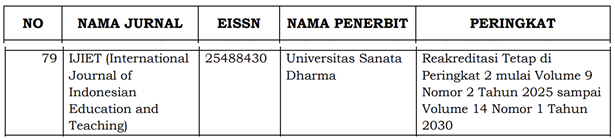
The new certificate is to upload when it is available. Thank you

IJIET Sinta 2 Certificate (please click here)

This work is licensed under CC BY-SA.
This work is licensed under a Creative Commons Attribution-ShareAlike 4.0 International License.

IJIET DOI: https://doi.org/10.24071/ijiet
p-ISSN: 2548-8422 (since 5 January 2017); e-ISSN: 2548-8430 (since 5 January 2017)
IJIET (International Journal of Indonesian Education and Teaching) is published twice a year, namely in January and July, by the Faculty of Teacher Training and Education of Sanata Dharma University, Yogyakarta, Indonesia.