





 Email this article
STRENGTHENING THE EXISTENCE OF STAKEHOLDER INVOLVEMENT IN THE DECISION-MAKING PROCESS IN THE EDUCATION SECTOR
(1) University Muhammadiyah of Kendari, Indonesia
(2) University Muhammadiyah of Kendari, Indonesia
(3) University Muhammadiyah of Kendari, Indonesia
(*) Corresponding Author
Abstract
Education is an important foundation for human resource development, and the involvement of stakeholders such as government, teachers, parents, and the community is key to the decision-making process. This study aims to strengthen stakeholder involvement in decision-making in the education sector. The methodology used is quantitative, with a survey of 115 stakeholders in five different schools in Kendari City. The results of the study indicate that stakeholder participation has a significant effect on the effectiveness of educational decisions, with a Pearson correlation value of 0.805. This indicates a very strong correlation between the two variables. In general interpretation, a correlation value between 0.70 and 1.00 is considered a strong correlation. When stakeholders are more involved in the decision-making process, the results of the decision tend to be better or more positive. These findings remain relevant in the long term and open up opportunities for further research on more structured decision-making mechanisms. The conclusion of the study emphasizes the importance of strengthening stakeholder involvement on an ongoing basis to ensure the sustainability of education quality.
Keywords
Full Text:
PDFReferences
Balyer, A., Karatas, H., & Alci, B. (2015). School principals’ roles in establishing collaborative professional learning communities at schools. Procedia - Social and Behavioral Sciences, 197, 1340–1347. https://doi.org/10.1016/j.sbspro.2015.07.387
Benner, A. D., Boyle, A. E., & Sadler, S. (2016). Parental involvement and adolescents’ educational success: The roles of prior achievement and socioeconomic status. Journal of Youth and Adolescence, 45(6), 1053–1064. https://doi.org/10.1007/s10964-016-0431-4
Birnbaum, S. (2016). Environmental co-governance, legitimacy, and the quest for compliance: When and why is stakeholder participation desirable? Journal of Environmental Policy & Planning, 18(3), 306–323. https://doi.org/10.1080/1523908X.2015.1077440
Bischoff, K., Volkmann, C. K., & Audretsch, D. B. (2018). Stakeholder collaboration in entrepreneurship education: An analysis of the entrepreneurial ecosystems of European higher educational institutions. The Journal of Technology Transfer, 43(1), 20–46. https://doi.org/10.1007/s10961-017-9581-0
Boonk, L., Gijselaers, H. J. M., Ritzen, H., & Brand-Gruwel, S. (2018). A review of the relationship between parental involvement indicators and academic achievement. Educational Research Review, 24, 10–30. https://doi.org/10.1016/j.edurev.2018.02.001
Braun, V., & Clarke, V. (2022). Conceptual and design thinking for thematic analysis. Qualitative Psychology, 9(1), 3–26. https://doi.org/10.1037/qup0000196
Brezicha, K. F., Ikoma, S., Park, H., & LeTendre, G. K. (2020). The ownership perception gap: Exploring teacher job satisfaction and its relationship to teachers’ and principals’ perception of decision-making opportunities. International Journal of Leadership in Education, 23(4), 428–456. https://doi.org/10.1080/13603124.2018.1562098
Bryk, A. S. (2010). Organizing schools for improvement. Phi Delta Kappan, 91(7), 23–30. https://doi.org/10.1177/003172171009100705
Castellano, S., Davidson, P., & Khelladi, I. (2017). Creativity techniques to enhance knowledge transfer within global virtual teams in the context of knowledge-intensive enterprises. The Journal of Technology Transfer, 42(2), 253–266. https://doi.org/10.1007/s10961-016-9509-0
Castro, M., Expósito-Casas, E., López-Martín, E., Lizasoain, L., Navarro-Asencio, E., & Gaviria, J. L. (2015). Parental involvement in student academic achievement: A meta-analysis. Educational Research Review, 14, 33–46. https://doi.org/10.1016/j.edurev.2015.01.002
Chrispeels, J. H., & Rivero, E. (2001). Engaging Latino families for student success: How parent education can reshape parents’ sense of place in the education of their children. Peabody Journal of Education, 76(2), 119–169. https://doi.org/10.1207/S15327930pje7602_7
Connor, D. J., & Cavendish, W. (2018). Sharing power with parents: Improving educational decision making for students with learning disabilities. Learning Disability Quarterly, 41(2), 79–84. https://doi.org/10.1177/0731948717698828
Creswell, J. W. (2014). Research design: Qualitative, quantitative, and mixed methods approaches (4th ed.). Thousand Oaks, CA: SAGE Publications.
Datnow, A., & Hubbard, L. (2016). Teacher capacity for and beliefs about data-driven decision making: A literature review of international research. Journal of Educational Change, 17(1), 7–28. https://doi.org/10.1007/s10833-015-9264-2
De Wit-de Vries, E., Dolfsma, W. A., van der Windt, H. J., & Gerkema, M. P. (2019). Knowledge transfer in university–industry research partnerships: A review. The Journal of Technology Transfer, 44(4), 1236–1255. https://doi.org/10.1007/s10961-018-9660-x
Dolph, D. (2017). Challenges and opportunities for school improvement: Recommendations for urban school principals. Education and Urban Society, 49(4), 363–387. https://doi.org/10.1177/0013124516659110
Eden, C.A., Chisom, O.N., & Adeniyi, I.S. (2024). Parent and community involvement in education: Strengthening partnerships for social improvement. International Journal of Applied Research in Social Sciences, 6(3), 372–382. https://doi.org/10.51594/ijarss.v6i3.894
Elfert, M. (2017). UNESCO, the faure report, the delors report, and the political utopia of lifelong learning. European Journal of Education, 50(1), 88–100. https://doi.org/10.1111/ejed.12104
Erickson, L. B., Wisniewski, P., Xu, H., Carroll, J. M., Rosson, M. B., & Perkins, D. F. (2016). The boundaries between Parental involvement in a teen’s online world. Journal of the Association for Information Science and Technology, 67(6), 1384–1403. https://doi.org/10.1002/asi.23450
Fenton, P., Ocasio-Stoutenburg, L., & Harry, B. (2017). The power of parent engagement: Sociocultural considerations in the quest for equity. Theory Into Practice, 56(3), 214–225. https://doi.org/10.1080/00405841.2017.1355686
Field, A. (2024). Discovering statistics using IBM SPSS statistics. Thousand Oaks, CA: SAGE Publications.
Flannery, W., Healy, N., & Luna, M. (2018). Exclusion and non-participation in marine spatial planning. Marine Policy, 88, 32–40. https://doi.org/10.1016/j.marpol.2017.11.001
Galvis, Á. H. (2018). Supporting decision-making processes on blended learning in higher education: Literature and good practices review. International Journal of Educational Technology in Higher Education, 15(1), 25. https://doi.org/10.1186/s41239-018-0106-1
Hatipoglu, B., Alvarez, M. D., & Ertuna, B. (2016). Barriers to stakeholder involvement in the planning of sustainable tourism: The case of the Thrace region in Turkey. Journal of Cleaner Production, 111, 306–317. https://doi.org/10.1016/j.jclepro.2014.11.059
Hill, N. E., Witherspoon, D. P., & Bartz, D. (2018). Parental involvement in education during middle school: Perspectives of ethnically diverse parents, teachers, and students. The Journal of Educational Research, 111(1), 12–27. https://doi.org/10.1080/00220671.2016.1190910
Hornby, G., & Blackwell, I. (2018). Barriers to parental involvement in education: An update. Educational Review, 70(1), 109–119. https://doi.org/10.1080/00131911.2018.1388612
Hsiao, Y.-J., Higgins, K., & Diamond, L. (2018). Parent empowerment: Respecting their voices. Teaching Exceptional Children, 51(1), 43–53. https://doi.org/10.1177/0040059918790240
Karger, T., Kalenda, J., Kalenda, S., & Kroutilová Nováková, R. (2022). Legitimisation of non-participation in adult education and training: The situational logic of decision-making. International Journal of Lifelong Education, 41(3), 277–293. https://doi.org/10.1080/02601370.2022.2057606
Nederhand, J., & Klijn, E. H. (2019). Stakeholder involvement in public–private partnerships: Its influence on the innovative character of projects and on project performance. Administration & Society, 51(8), 1200–1226. https://doi.org/10.1177/0095399716684887
Ni, Y., Yan, R., & Pounder, D. (2018). Collective leadership: Principals’ decision influence and the supportive or inhibiting decision influence of other stakeholders. Educational Administration Quarterly, 54(2), 216–248. https://doi.org/10.1177/0013161X17723427
Palinkas, L. A., Horwitz, S. M., Green, C. A., Wisdom, J. P., Duan, N., & Hoagwood, K. (2015). Purposeful sampling for qualitative data collection and analysis in mixed method implementation research. Administration and Policy in Mental Health and Mental Health Services Research, 42(5), 533–544. https://doi.org/10.1007/s10488-013-0528-y
Robinson, D. V. (2017). Collaborative partnerships between high-poverty and minority parents and educational leaders. Journal for Multicultural Education, 11(1), 2–18. https://doi.org/10.1108/JME-11-2015-0035
Stahnke, R., Schüler, S., & Roesken-Winter, B. (2016). Teachers’ perception, interpretation, and decision-making: A systematic review of empirical mathematics education research. ZDM, 48(1–2), 1–27. https://doi.org/10.1007/s11858-016-0775-y
Toros, K. (2021). A systematic review of children’s participation in child protection decision‐making: Tokenistic presence or not? Children & Society, 35(3), 395–411. https://doi.org/10.1111/chso.12418
UNESCO. (2015). Education for All 2000-2015: Achievements and challenges. Paris: UNESCO Publishing.
Virginia, B., Victoria, C., & Weate, P. (2016). Using thematic analysis in sport and exercise research. In B. Smith & A. C. Sparkes (Eds.), Routledge handbook of qualitative research in sport and exercise (pp. 213–227). London: Routledge. https://doi.org/10.4324/9781315762012-26
Wang, H., & Ran, B. (2023). Network governance and collaborative governance: A thematic analysis on their similarities, differences, and entanglements. Public Management Review, 25(6), 1187–1211. https://doi.org/10.1080/14719037.2021.2011389
Zhuang, T., Qian, Q. K., Visscher, H. J., Elsinga, M. G., & Wu, W. (2019). The role of stakeholders and their participation network in decision-making of urban renewal in China: The case of Chongqing. Cities, 92, 47–58. https://doi.org/10.1016/j.cities.2019.03.014
DOI: https://doi.org/10.24071/ijiet.v10i2.14349
Refbacks
- There are currently no refbacks.
Copyright (c) 2026 Pahenra A Nongko, Hasmira Said, Yaman La Ndibo

This work is licensed under a Creative Commons Attribution-ShareAlike 4.0 International License.
Indexed and abstracted in:








IJIET Sinta 2 Certificate (S2 = Level 2)
We would like to inform you that IJIET (International Journal of Indonesian Education and Teaching):has been nationally re-accredited Sinta 2 by the Ministry of Higher Education, Science and Technology of the Republic of Indonesia based on the decree No. Surat Keputusan 355/DST/D.D1/HM.01.01/2026. Validity for 5 years: Vol 9 No 2, 2025 until Vol 14 No 1, 2030.
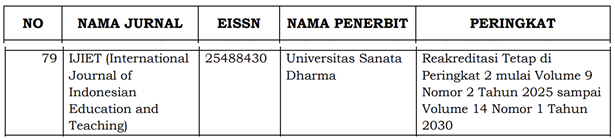
The new certificate is to upload when it is available. Thank you

IJIET Sinta 2 Certificate (please click here)

This work is licensed under CC BY-SA.
This work is licensed under a Creative Commons Attribution-ShareAlike 4.0 International License.

IJIET DOI: https://doi.org/10.24071/ijiet
p-ISSN: 2548-8422 (since 5 January 2017); e-ISSN: 2548-8430 (since 5 January 2017)
IJIET (International Journal of Indonesian Education and Teaching) is published twice a year, namely in January and July, by the Faculty of Teacher Training and Education of Sanata Dharma University, Yogyakarta, Indonesia.