




 Email this article

TRANSLANGUAGING IN ENGLISH AS A MEDIUM OF INSTRUCTION (EMI) CONTENT CLASSROOMS: UNFOLDING THE TEACHERS’ NARRATIVES
(1) Janta Multiple Campus, Tribhuvan University, Nepal
(*) Corresponding Author
Abstract
Translanguaging has been practiced in multilingual educational settings by teachers for several purposes. In the field of teaching and learning, it has gained significant attention not only by teachers but also by researchers for its potential to address diversity, create equality, and promote social justice. It has been used by content teachers such as science and mathematics purposefully in the EMI setting. However, their experiences of using translanguaging and its pedagogical benefits have been underexplored, particularly in the context of Nepalese EMI science and mathematics classrooms. The study aims to unfold the narratives/experiences of secondary-level science and mathematics teachers teaching in multilingual EMI public schools in Sunsari, Nepal, along with the reasons for using the pedagogical approach. Using in-depth interviews and field notes as research tools, I explored and analyzed the content teachers' experiences of using translanguaging, who were purposively selected as a sample. The collected information was recorded, transcribed, coded, categorized, and thematically analyzed. The study found that translanguaging is useful to enhance comprehension, enable co-learning, increase learner engagement, and foster inclusivity by challenging conventional monolingual ideologies. The study implies that EMI content teachers like science and mathematics would better use students’ linguistic and cultural knowledge as a resource in their teaching for better engagement, deeper understanding, and empowerment.
Keywords
Full Text:
PDFReferences
Braun, V., & Clarke, V. (2006). Using thematic analysis in psychology. Qualitative Research in Psychology, 3(2), 77-101. https://doi.org/10.1191/1478088706qp063oa
Canagarajah, S. (2011). Translanguaging in the classroom: Emerging issues for research and pedagogy. Applied Linguistics Review, 2, 1-28. https://doi.org/10.1515/9783110239331.1
Cenoz, J., & Gorter, D. (2017). Translanguaging as a pedagogical tool in multilingual education. In J. Cenoz, D. Gorter & S. May (Eds.), Language awareness and multilingualism (pp.309-321). Berlin: Springer.
Clandinin, D. J., & Connelly, F. M. (2000). Narrative inquiry: Experience and story in qualitative research. Hoboken, NJ: Jossey-Bass Publishers.
Creese, A., & Blackledge, A. (2010). Translanguaging in bilingual classroom: A pedagogy for learning and teaching. The Modern Language Journal, 94(10), 103-115.
Daniel, S., Jiménez, R., Pray, L., & Pacheco, M. (2017). Scaffolding to make translanguaging a classroom norm. TESOL Journal, 10(1). https://doi.org/10.1002/tesj.361
Dearden, J. (2014). English as a medium of instruction: A growing global phenomenon. London: British Council.
Denzin, N. K. (1989). Interpretive biography. Newbury Park, CA: Sage.
García, O. (2009). Bilingual education for the 21st century: A global perspective. Hoboken, NJ: Wiley Blackwell.
García, O., & Kano, N. (2014). Translanguaging as process and pedagogy: Developing the English writing of Japanese students in the US. In J. Conteh & G. Meier (Eds.), The multilingual turn in languages education (pp. 258-277). Bristol: Multilingual Matters. https://doi.org/10.21832/9781783092246-018
Garcia, O., & Leiva, C. (2014). Theorizing and enacting translanguaging for social justice. In A. Blackledge & A. Creese (Eds.), Heteroglossia as practice and pedagogy (pp. 199-216). New York: Springer.
García, O., & Lin, A.M.Y. (2017). Translanguaging in bilingual education. In O. Garcia, A.M.Y. Lin, & S. May (Eds.), Bilingual and multilingual education (pp.117-130). Cham: Springer. https://doi.org/10.1007/978-3-319-02258-1_9
Garcia, O., & Wei, L. (2014). Translanguaging: Language, bilingualism and education. London: Palgrave.
Gautam, B., & Poudel, P. (2022). Diversity, multilingualism and democratic practices in Nepal. Bandung, 9(1-2), 80-102. https://doi.org/10.1163/21983534-09010004
Giri, R. (2020). The politics of language contact in the Himalaya. Journal of Multilingual and Multicultural Development, 41(10), 899-900. https://doi.org/10.1080/01434632.2020.1749770
Giri, R.A. (2022). Plurilingual education in developing contexts: A pedagogical framework. 20 September 2022, Springer Pre-print (Version 1). https://doi.org/10.21203/rs.3.rs-2067037/v1
Government of Nepal. (n.d.). Constitution of Nepal.
Hurst, E., & Mona, M. (2017). Translanguaging as a socially just pedagogy. UNISA Education as Change, 21(2), 126-148.
Kandel, B. (2021). Awareness and initiatives on language policy in local governments. Journal of NELTA Gandaki, 4(1-2), 1-18. https://doi.org/10.3126/jong.v4i1-2.42637
Karlsson, A., Larsson, P., & Jakobsson, A. (2018). Multilingual students’ use of translanguaging in science classrooms. International Journal of Science Education, 41(15), 2049-2069. https://doi.org/10.1080/09500693.2018.1477261
Li, W. (2018). Translanguaging as a practical theory of language. Applied Linguistics, 39(1), 9-30. https://doi.org/10.1093/applin/amx044.
Macaro, E. (2018). English medium instruction: Content and language in policy and practice. Oxford: Oxford University Press.
Mbirimi-Hungwe, V., & Hungwe, T. (2019). Translanguaging for epistemic access to computer science concepts: A call for change. Per Linguam, 34(2), 97–111. https://doi.org/10.5785/34-2-771
Menken, K., & Garcia, O. (2010). Negotiating language policies in schools: Educators as policymakers. New York: Routledge.
Ministry of Education. (2028, 9th Amendment, 2074). Education Act. Government of Nepal.
Moll, L. C. (1992). Funds of knowledge: An emerging theory of teaching and learning. In R. Gutierrez & B. Jordan (Eds.), Language, culture, and power: Bilingual education in the U.S. (pp. 75-83). Boulder: Westview Press.
Moll, L. C., Amanti, C., Neff, D., & Gonzalez, N. (1992). Funds of knowledge for teaching: Using a qualitative approach to connect homes and classrooms. Theory Into Practice, 31(2), 132-141. https://doi.org/10.1080/00405849209543534
National Statistics Office. (2021). National population and housing census 2021 results. Government of Nepal.
Ndhlovana, S., & Charamba, E. (2023). The efficacy of translanguaging in selected South African mathematics and science intermediate phase classrooms. Journal of Languages and Language Teaching, 11(3), 373–389. https://doi.org/10.33394/jollt.v11i3.7904
Ollerenshaw, J., & Creswell, J. W. (2002). Narrative research: A comparison of two restorying data analysis approaches. Qualitative Inquiry 8, 329-347.
Otheguy, R., García, O., & Reid, W. (2015). Clarifying translanguaging and deconstructing named languages: A perspective from linguistics. Applied Linguistics Review, 6(3), 281-307. https://doi.org/10.1515/applirev-2015-0014
Palmer, D., Martinez, R.A., Mateus, S.G., & Henderson, K. (2014). Reframing the debate about English language learners: Boosting academic achievement by capitalizing on students’ strengths. Bilingual Research Journal, 37(3), 199-212. https://doi.org/10.1111/j.1540-4781.2014.12121.x
Paudel, P.P., & Choi, T.H. (2024). Enactment of English medium instruction in under-resourced educational contexts: A case of multilingual public secondary schools in Nepal. System, 121, https://doi.org/10.1016/j.system.2024.103223.
Paudel, R. (2023). Multilingualism in Nepal: Challenges and opportunities. Journal Tilottama, 1(1), 100-113. https://doi.org/10.3126/jtilottama.v1i1.64559
Pecorari, D., & Malmström, H. (2018). At the crossroads of TESOL and English medium instruction. TESOL Quarterly, 52(3), 497-515. https://doi.org/10.1002/tesq.470
Phyak, P. (2013). Language ideologies and local languages as the medium of instruction policy: A critical ethnography study of a multilingual school in Nepal. Current Issues in Language Planning, 14(1), 127-143.
Phyak, P. (2016). Local-global tension in the ideologies and practices of English language teaching in Nepal. In R. Tupas (Ed.), Unequal Englishes: The politics of Englishes today (pp. 53-69). London: Palgrave Macmillan.
Phyak, P. (2018). Translanguaging as a pedagogical resource in English language teaching: A response to unplanned language education policies in Nepal. In K. Kuchah & F. Shamim (Eds.), International perspectives in teaching English in difficult circumstances (pp. 49-70). Palgrave. https://doi.org/10.1057/978-1-137-53104-9_3
Phyak, P., & Ojha, L. P. (2019). Language education policy and inequalities of multilingualism in Nepal: Ideologies, histories, and updates. In A. Kirkpatrick & A. J. Liddicoat (Eds.), The Routledge international handbook of language education policy in Asia (pp. 341–354). London: Routledge. https://doi.org/10.4324/9781315666235-24
Phyak, P., Sah, P.K., Ghimire, N., & Lama, A. (2022). Teacher agency in creating a translingual space in Nepal’s multilingual English medium schools. RELC Journal, 53(2), 1-21. https://doi.org/10.1177/00336882221113950
Pierson, A., Clark, D., & Brady, C. (2021). Scientific modeling and translanguaging: A multilingual and multimodal approach to support science learning and engagement. Science Education, 105(4), 776-813. https://doi.org/10.1002/sce.21622
Polkinghorne, D. E. (1995). Narrative configuration in narrative analysis. International Journal of Qualitative Studies in Education, 8(1), 5-23. https://doi.org/10.1080/0951839950080103
Poudel, P. (2019). The medium of instruction policy in Nepal: Towards critical engagement on the ideological and pedagogical debate. Journal of Language and Education, 5(3), 102-110. https://doi.org/10.17323/jle.2019.8995
Qi, Z., Osborne, C., Shao, L., & Lin, M. (2020). A translanguaging perspective on medium of instruction in the CFL classroom. Journal of Multilingual and Multicultural Development, 43(5), 359-372. https://doi.org/10.1080/01434632.2020.1737089
Rana, K. (2018). Retention of English language tension in multilingual communities of Nepal: A review of teachers’ narratives. Journal of NELTA, 23(1-2), 40-53. https://doi.org/10.3126/nelta.v23i1-2.23347
Rauteda, K. R. (2022). Translanguaging as a pedagogical resource in multilingual ELT classrooms: Exploring perceptions and practices [Master’s Thesis, Tribhuvan University].
Rauteda, K. R. (2024a). Use of EMI at secondary education: Exploring non-English Nepalese teachers’ ideologies. Siddhajyoti Interdisciplinary Journal, 5(1), 33-43. https://doi.org/10.3126/sij.v5i1.63596
Rauteda, K. R. (2024b). Unveiling pedagogical translanguaging: Investigating teachers’ translingual practices and purposes in ELT classrooms. English Language Teaching (ELT) PERSPECTIVES, 9(1-2), 51-66.
Rauteda, K. R. (2025a). Translanguaging for transformation: Identity, equity, and pedagogical resistance in Nepalese ELT classrooms. Indonesian Journal of English Language Studies (IJELS), 11(2), 150-162. https://doi.org/10.24071/ijels.v11i2.12202
Rauteda, K. R. (2025b). Enhancing learner engagement through translanguaging pedagogy: A reflective narrative from a multilingual ELT classroom in Nepal [Blog article]. ELT Choutari. Available at: https://eltchoutari.com/2025/11/enhancing-learner-engagement-through-translanguaging-pedagogy-a-reflective-narrative-from-a-multilingual-elt-classroom-in-nepal/
Rauteda, K. R. (2026a). Qualitative research in education: Philosophical foundations, methodological challenges, and applications. Journal of Education and Learning Reviews, 3(2), e3096. https://doi.org/10.60027/jelr.2026.e3096
Rauteda, K. R. (2026b). Linguistic hybridity in Nepalese ELT classrooms: A narrative inquiry into English language teachers’ beliefs and practices. Journal of Janta Multiple Campus, 5(1), 147-170. https://doi.org/10.3126/jjmc.v5i1.97994
Rauteda, K. R., & Luitel, B. (2025). Teachers’ pedagogical resistance of EMI through classroom translanguaging in Nepalese science classrooms. IJIET (International Journal of Indonesian Education and Teaching), 9(2), 441-456. https://doi.org/10.24071/ijiet.v9i2.12043
Sah, P. K. (2020). English medium instruction in south Asian’s multilingual schools: Unpacking the dynamics of ideological orientations, policy/practices, and democratic questions. International Journal of Bilingual Education and Bilingualism, 25(2), 742-755. https://doi.org/10.1080/13670050.2020.1718591
Sah, P. K., & Guofang, L. (2018). English medium instruction (EMI) as linguistic capital in Nepal: Promises and realities. International Multilingual Research Journal, 12(2), 109-123. https://doi.org/10.1080/19313152.2017.1401448
Sah, P.K. (2022). English medium instruction in South Asian’s multilingual schools: Unpacking the dynamics of ideological orientations, policy/practices, and democratic questions. International Journal of Bilingual Education and Bilingualism, 25(2), 742-755. https://doi.org/10.1080/13670050.2020.1718591
Sah, P.K., & Karki, J. (2023). Elite appropriation of English as a medium of instruction policy and epistemic inequalities in Himalayan schools. Journal of Multilingual and Multicultural Development, 44(1), 20-34. https://doi.org/10.1080/01434632.2020.1789154
Saud, M. (2020). English medium public schools in Nepal: A new linguistic market in education. LLT Journal: A Journal on Language and Language Teaching, 23(2), 319-333. https://doi.org/10.24071/llt.v23i2.2571
Sharma, S. (2023). Exploring children’s negotiation of meanings about “d” in 2d and 3d shapes in a year 5/6 New Zealand primary classroom. Mathematics Education Research Journal, 36(2), 259-283. https://doi.org/10.1007/s13394-023-00443-3
Sharma, U. (2022). Translanguaging as a mediator of learning: Observation in the EFL classes of Nepal. Education and Development, 32(1), 105-120. https://doi.org/10.3126/ed.v32i1.61586
Tai, K. (2021). Translanguaging as inclusive pedagogical practices in English-medium instruction science and mathematics classrooms for linguistically and culturally diverse students. Research in Science Education, 52(3), 975-1012. https://doi.org/10.1007/s11165-021-10018-6
Tai, K., & Wei, L. (2020). Co-learning in Hong Kong English medium instruction mathematics secondary classrooms: A translanguaging perspective. Language and Education, 35(3), 241-267. https://doi.org/10.1080/09500782.2020.1837860
Tai, K., & Wei, L. (2023). Embodied enactment of a hypothetical scenario in an English medium instruction secondary mathematics classroom: A translanguaging approach. Language Teaching Research, 136216882311528. https://doi.org/10.1177/13621688231152858
Wei, L. (2014). Translanguaging knowledge and identity in complementary classrooms for multilingual minority ethnic children. Classroom Discourse, 5(2), 158-175. https://doi.org/10.1080/19463014.2014.893896
Zhou, X., & Mann, S. (2021). Translanguaging in a Chinese University CLIL classroom: Teacher strategies and student attitudes. Studies in Second Language Learning and Teaching, 11(2), 265-289. https://doi.org/10.14746/ssllt.2021.11.2.5
DOI: https://doi.org/10.24071/ijiet.v10i2.14291
Refbacks
- There are currently no refbacks.
Copyright (c) 2026 Khem Raj Rauteda

This work is licensed under a Creative Commons Attribution-ShareAlike 4.0 International License.
Indexed and abstracted in:








IJIET Sinta 2 Certificate (S2 = Level 2)
We would like to inform you that IJIET (International Journal of Indonesian Education and Teaching):has been nationally re-accredited Sinta 2 by the Ministry of Higher Education, Science and Technology of the Republic of Indonesia based on the decree No. Surat Keputusan 355/DST/D.D1/HM.01.01/2026. Validity for 5 years: Vol 9 No 2, 2025 until Vol 14 No 1, 2030.
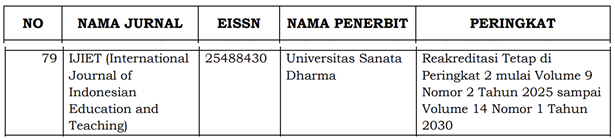
The new certificate is to upload when it is available. Thank you

IJIET Sinta 2 Certificate (please click here)

This work is licensed under CC BY-SA.
This work is licensed under a Creative Commons Attribution-ShareAlike 4.0 International License.

IJIET DOI: https://doi.org/10.24071/ijiet
p-ISSN: 2548-8422 (since 5 January 2017); e-ISSN: 2548-8430 (since 5 January 2017)
IJIET (International Journal of Indonesian Education and Teaching) is published twice a year, namely in January and July, by the Faculty of Teacher Training and Education of Sanata Dharma University, Yogyakarta, Indonesia.