







 Email this article
EVALUATING THE IMPLEMENTATION OF DIFFERENTIATED INSTRUCTION IN ENGLISH LANGUAGE CLASSES
(1) Yogyakarta State University, Indonesia
(2) Yogyakarta State University, Indonesia
(*) Corresponding Author
Abstract
This study aims to evaluate the suitability and effectiveness of the implementation of differentiated learning in English subjects, from the following aspects: student identification, learning objectives, socio-cultural, human resources (teachers and students), learning material planning, availability of facilities and infrastructure, utilization of facilities and learning processes, and outcomes after participating in learning. The methodology used was descriptive quantitative with a qualitative approach. The Context, Input, Process, Product (CIPP) evaluation model is used to evaluate it, while data collection was in the form of questionnaires, observations, document reviews, and interviews. The results of the study show the level of suitability and effectiveness of students: 76%, 82%, 77%, and 76%, while non-conformity or ineffectiveness: 24%, 18%, 23%, and 24%. This means that input, process, and output have not been implemented well. Meanwhile, for teachers: 83%, 84%, 86%, 84%, and inappropriate or ineffective: 17%, 16%, 14%, and 16%, which means it has been implemented well. The description above indicates positive results from differentiated learning in English. Teachers stated it was appropriate and effective, while students needed ongoing, specialized support to achieve shared expectations.
Keywords
Full Text:
PDFReferences
Ainun, F., & Putro, N.H.P.S. (2024). English teachers’ strategies in implementing differentiated instruction in three public senior high schools. International Journal of Multicultural and Multireligious Understanding, 11(11), 700–707. http://dx.doi.org/10.18415/ijmmu.v11i11.6535
Alfarisy, F. (2021). Kebijakan pembelajaran bahasa Inggris di Indonesia. Jurnal Ilmiah Profesi Pendidikan, 6(3), 303–313. https://dx.doi.org/10.29303/jipp.v6i3.207
Arikunto, S. (2013). Dasar-dasar evaluasi pendidikan (2nd ed.). Jakarta: Bumi Aksara.
Azizah, D. M., & Surya, A. (2017). Implementasi pembelajaran bahasa Inggris SD berbasis budaya di Yogyakarta. DWIJA CENDEKIA: Jurnal Riset Pedagogik, 1(1), 10–18. https://doi.org/10.20961/jdc.v1i1.13052
Dethan, M. J. S., Bire, A. L. , & Sitorus, E. (2024). Evaluasi program pembelajaran berdiferensiasi pada sekolah dasar dengan model CIPP. Jurnal Inovasi Kurikulum, 21(1), 167-180.
EF.co.id. (2025). Daftar peringkat terbesar berdasarkan kemampuan bahasa Inggris di negara dan wilayah terbesar dunia. Retrieved from https://www.ef.co.id/
Fatah, M., Suud, F. M., & Chaer, M. T. (2021). Jenis-jenis kesulitan belajar dan faktor penyebabnya sebuah kajian komprehensif pada siswa SMK Muhammadiyah Tegal. Psycho Idea, 19(1), 89-102. https://doi.org/10.30595/psychoidea.v19i1.6026
Halim, N., & Suseno, M. (2022). Evaluasi program bahasa Inggris bertujuan khusus dengan pendekatan. Jurnal Ilmiah Untuk Peningkatan Mutu Pendidikan, 9(1), 117–130. https://doi.org/10.21009/improvement.v9i1.27791
Ibrahim, M.M. (2018). Penelitian evaluasi bidang pendidikan (pendekatan kualitatif). Makassar: Alauddin University Press.
Kheryadi, K., Ghufron, M. A., & Syafi’i, A. (2022). Evaluation of differentiated instruction implementation in English language teaching: A CIPP model approach. Journal of English Language Teaching and Linguistics, 7(3), 563-578.
Magableh, I., & Abdullah, A. (2020). The effect of differentiated instruction on EFL learners: Teachers’ perspective. International Journal of Academic Research in Business and Social Sciences, 10(5), 626-641. http://dx.doi.org/10.6007/IJARBSS/v10-i5/7235
Mardhatillah, M., & Suharyadi, S. (2023). Differentiated instruction: Challenges and opportunities in EFL classroom. Journal of English Language Teaching and Linguistics, 8(1), 69-77. https://doi.org/10.21462/jeltl.v8i1.1022
Marlina, M. (2020). Strategi pembelajaran berdiferensiasi di sekolah inklusif. Padang: CV Afifa Utama.
Muliyah, P., & Aminatun, D. (2020). Teaching English for specific purposes in vocational high school: Teachers' beliefs and practices. Journal of English Teaching, 6(2), 122-133. https://doi.org/10.33541/jet.v6i2.1756
Muryanti, M., Ayub, D., & Syafitra, V. (2023). Revisiting English proficiency and its policy in higher education: The case of the University of Riau. International Journal of Educational Best Practices (IJEBP), 7(1), 105-116. https://doi.org/10.32851/ijebp.v7n1.p105-116
Purba, M., Purnamasari, N., Soetantyo, S., Suwarma, I. R., & Susanti, E. I. (2021). Prinsip pengembangan pembelajaran berdiferensiasi (differentiated instruction) (1st ed.). Jakarta: Pusat Kurikulum dan Pembelajaran.
Purnamaningwulan, R. A., & Purwanto, A. R. (2025). Differentiated instruction strategies to enhance EFL learning in a mixed-proficiency seventh-grade classroom. Elsya: Journal of English Language Studies, 7(1), 1–22. https://doi.org/10.31849/elsya.v7i1.22076
Purwowidodo, A., & Zaini, M. (2023). Teori dan praktik model pembelajaran berdiferensiasi implementasi Kurikulum Merdeka Belajar. Penerbit: Penebar Media Pustaka.
Rama, A., Ambiyar, A., Rizal, F., Jalinus, N., Waskito, W., & Wulansari, R. E. (2023). Konsep model evaluasi context, input, process, dan product (CIPP) di sekolah menengah kejuruan. JRTI: Jurnal Riset Tindakan Indonesia, 8(1), 82-86. https://doi.org/10.29210/30032976000
Santangelo, T., & Tomlinson, C. A. (2012). Teacher educators’ perceptions and use of differentiated instruction practices: An exploratory investigation. action in teacher education. Action in Teacher Education, 34(4), 309–327. https://doi.org/10.1080/01626620.2012.717032
Sari, G.I., Winasis, S., Pratiwi, I., Nuryanto, U.W., & Basrowi, B. (2024). Strengthening digital literacy in Indonesia: Collaboration, innovation, and sustainability education. Social Science & Humanities Open, 10, 101100. https://doi.org/10.1016/j.ssaho.2024.101100
Supriyadi, S., Barus, R. A., Rusilowati, A., Isnaeni, W., Susilaningsih, E., Djuniadi, D., Sun’an, U. N., Rapi, M., Fardiana, R., & Suraji, S. (2024). Improving differentiated learning literacy through differentiated learning training and guidebooks. Community Development Journal: Jurnal Pengabdian Masyarakat, 5(1), 1466–1476.
Tomlinson, C. A. (2001). How to differentiate instruction in mixed-ability classrooms (2nd Ed.). Upper Saddle River, NJ: Pearson Education.
Tomlinson, C. A., & Allan, S. D. (2000). Leadership for differentiating schools & classrooms. Alexandria, VA: Association for Supervision and Curriculum Development.
Tomlinson, C. A., & Imbeau, M. B. (2010). Leading and managing: A differentiated classroom. Alexandria, VA: ASCD.
Tomlinson, C. A., & Moon, T. R. (2013). Assessment and student success in a differentiated classroom. Alexandria, VA: Association for Supervision and Curriculum Development.
Wahyuni, S. (2023). The implementation of differentiated learning in Merdeka curriculum in learning English at high school. Journal of Applied Linguistics and English, 1(01), 27–33.
Wahyuningsari, D., Mujiwati, Y., Hilmiyah, L., Kusumawardani, F., & Sari, I. (2022). Pembelajaran berdiferensiasi dalam rangka mewujudkan merdeka belajar. Jurnal Jendela Pendidikan, 2(04), 529-535. https://doi.org/10.57008/jjp.v2i04.301
Widoyoko, S. E. P. (2018). Evaluasi program pembelajaran: Panduan praktis bagi pendidik dan calon pendidik. Yogyakarta: Pustaka Pelajar.
DOI: https://doi.org/10.24071/ijiet.v10i1.13215
Refbacks
- There are currently no refbacks.
Copyright (c) 2026 D’aquinaldo Stefanus Fani Seran

This work is licensed under a Creative Commons Attribution-ShareAlike 4.0 International License.
Indexed and abstracted in:








IJIET Sinta 2 Certificate (S2 = Level 2)
We would like to inform you that IJIET (International Journal of Indonesian Education and Teaching):has been nationally accredited Sinta 2 by the Ministry of Education, Culture, Research and Technology of the Republic of Indonesia based on the decree No. Surat Keputusan 158/E/KPT/2021. Validity for 5 years: Vol 5 No 2, 2021 until Vol 10 No 1, 2026.
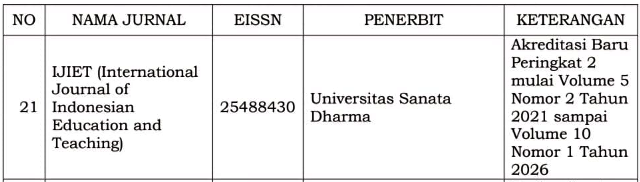

IJIET Sinta 2 Certificate (please click here)

This work is licensed under CC BY-SA.
This work is licensed under a Creative Commons Attribution-ShareAlike 4.0 International License.

IJIET DOI: https://doi.org/10.24071/ijiet
p-ISSN: 2548-8422 (since 5 January 2017); e-ISSN: 2548-8430 (since 5 January 2017)
IJIET (International Journal of Indonesian Education and Teaching) is published twice a year, namely in January and July, by the Institute for Research and Community Services of Sanata Dharma University, Yogyakarta, Indonesia.