




 Email this article

NEGOTIATING LANGUAGE IDEOLOGIES AND ETHICAL BOUNDARIES: LECTURERS’ NARRATIVES ON AI USE IN ENGLISH LANGUAGE TEACHING
(1) Universitas Harapan Bangsa, Indonesia
(2) Universitas Harapan Bangsa, Indonesia
(3) Universitas Harapan Bangsa, Indonesia
(*) Corresponding Author
Abstract
The rapid evolution of AI in education has triggered contentious debates over its ethical use and effects on language learning. This study investigated how English teachers negotiate and appeal to language ideologies and ethical boundaries as they respond to AI tools in English Language Teaching (ELT). Grounded on language ideology and pedagogical technology theories, the research employed narrative inquiry design in examining the Indonesian university lecturers' experiences of language, ethics, and AI-driven classroom practice. Preliminary screening questionnaires and narrative in-depth interviews were used in collecting the data. The findings demonstrate that while AI tools have become valued for efficiency in supplying grammatical correction, lecturers are worried that the reliance on AI might hinder critical thought and emergence of agency. Lecturers also note the inadequacy of AI at engaging the local diversity of languages and dialects, and AI often tends to construct a standardized version of English. The study indicates that AI can be a useful tool in ELT by offering feedback and improving language accuracy, but caution is necessary to maintain academic integrity and ensure meaningful learning. This research contributes to the conversation on AI in education, offering actionable insights on ethical and productive AI use in language teaching.
Keywords
Full Text:
PDFReferences
Ali, L. F., Siraj, J., & Ali, M. F. (2024). AI-driven vocabulary development in ESL context: Advancing autonomous learning through technology. Journal of Asian Development Studies, 13(4), 1067–1082. https://doi.org/10.62345/jads.2024.13.4.86
An, K. (2021). A brief analysis of the application of English Language in British and American literature based on artificial intelligence. Journal of Physics: Conference Series, 1915, 022060. https://doi.org/10.1088/1742-6596/1915/2/022060
Azima, R., & Fithriani, R. (2024). Indonesian EFL students’ perception of Google translate utilization as a translingual tool in writing class. Academic Journal Perspective : Education, Language, and Literature, 12(1), 45–53. https://doi.org/10.33603/ef8wqz06
Balalle, H., & Pannilage, S. (2025). Reassessing academic integrity in the age of AI: A systematic literature review on AI and academic integrity. Social Sciences & Humanities Open, 11, 101299. https://doi.org/10.1016/j.ssaho.2025.101299
Bizami, N. A., Tasir, Z., & Kew, S. N. (2023). Innovative pedagogical principles and technological tools capabilities for immersive blended learning: A systematic literature review. Education and Information Technologies, 28, 1373–1425. https://doi.org/10.1007/s10639-022-11243-w
Cavanaugh, J. R. (2020). Language ideology revisited. International Journal of the Sociology of Language, 2020(263), 51–57. https://doi.org/10.1515/ijsl-2020-2082
Celik, I. (2023). Towards intelligent-TPACK: An empirical study on teachers’ professional knowledge to ethically integrate artificial intelligence (AI)-based tools into education. Computers in Human Behavior, 138(August 2022), 107468. https://doi.org/10.1016/j.chb.2022.107468
Dulundu, A. (2024). AI in education: Benefits and concerns. Next Generation Journal for The Young Researchers, 8(1), 81. https://doi.org/10.62802/3fr4f412
Irvine, J. T., & Gal, S. (2000). Language ideology and linguistic differentiation. In P. V. Kroskrity (Ed.), Regimes of language: Ideologies, politics, and identities (pp. 35–84). Santa Fe: School of American Research Press.
Izlin, R., & Widiyati, E. (2023). Teachers’ perspective on using multimedia technology for teaching English. IJIET (International Journal of Indonesian Education and Teaching), 7(2), 172–182. https://doi.org/10.24071/ijiet.v7i2.6048
Koehler, M. J., Mishra, P., & Cain, W. (2013). What is technological pedagogical content knowledge (TPACK)? Journal of Education, 193(3), 13–19. https://doi.org/10.1177/002205741319300303
Kroskrity, P. V. (2004). Language ideologies. In A. Duranti (Ed.), A companion to linguistic anthropology (pp. 496–517). Malden: Blackwell Publishing Ltd.
Kurbanova, S. M., Madrahimova, M. B., & Abdullayeva, N. K. (2020). In terms of understanding and effective application of pedagogical technologies. ISJ Theoretical & Applied Science, 5(85), 866–869. https://dx.doi.org/10.15863/TAS.2020.05.85.161
Mali, Y. C. G. (2025). Factors hindering the integration and potential of technology in EFL classrooms. IJIET (International Journal of Indonesian Education and Teaching), 9(1), 171–185. https://doi.org/10.24071/ijiet.v9i1.9553
Munni, B. E., & Rafique, R. (2025). Teachers’ experiences of using AI-powered technologies in Bangladeshi English language classrooms. Spectrum, 18(1), 89–100. https://doi.org/10.3329/spectrum.v18i1.76362
Mutanga, B., Jugoo, V., & Adefemi, K. O. (2024). Lecturers’ perceptions on the integration of artificial intelligence tools into teaching practice. Trends in Higher Education, 3(4), 1121–1133. https://doi.org/10.3390/higheredu3040066
Ou, A. W., Stöhr, C., & Malmström, H. (2024). Academic communication with AI-powered language tools in higher education: From a post-humanist perspective. System, 121, 103225. https://doi.org/10.1016/j.system.2024.103225
Pack, A., & Maloney, J. (2023). Potential affordances of generative AI in language education: Demonstrations and an evaluative framework. Teaching English with Technology, 23(2), 4–24. https://doi.org/10.56297/BUKA4060/VRRO1747
Sah, P. K., & Uysal, H. (2022). Unbiased but ideologically unclear: Teacher beliefs about language practices of emergent bilingual students in the U.S. Linguistics and Education, 72. https://doi.org/10.1016/j.linged.2022.101126
Savin-Baden, M., & Van Niekerk, L. (2007). Narrative inquiry: Theory and practice. Journal of Geography in Higher Education, 31(3), 459–472. https://doi.org/10.1080/03098260601071324
Smith, G., Fleisig, E., Bossi, M., Rustagi, I., & Yin, X. (2018). Standard language ideology in AI-generated language. ACM/IMS Journal of Data Science, 37(4). Association for Computing Machinery. https://doi.org/10.48550/arXiv.2406.08726
Soumia, B. (2025). Students’ reliance on AI-based tools in written expression course: Challenges and solutions. The Barcelona Conference on Education 2024: Official Conference Proceedings, 33–42. https://doi.org/10.22492/issn.2435-9467.2024.5
Su, Y. (2023). Delving into EFL teachers’ digital literacy and professional identity in the pandemic era: Technological pedagogical content knowledge (TPACK) framework. Heliyon, 9(6). https://doi.org/0.1016/j.heliyon.2023.e16361
Suello, A.O., & Alda, R.C. (2025). English teachers’ ethical considerations in AI integration: A narrative inquiry. Journal of Teaching English for Specific and Academic Purposes, 12(3), 769–781. https://doi.org/10.22190/jtesap241016057s
Suhono, S. (2023). An assistance of islamic university EFL students through artificial intelligence (AI) machine translation and writing tools. International Journal of Community Engagement Payungi, 3(2), 74-90. https://doi.org/10.58879/ijcep.v3i2.36
Sutrisman, H., Simanjuntak, R., Prihartanto, A., & Kusumo, B. (2024). The impact of using AI in learning on understanding of material by young students. International Journal of Educational Research, 1(3), 24–32. https://doi.org/10.62951/ijer.v1i3.43
Tankosić, A., Milak, E., Steele, C., & Dobinson, T. (2024). Meeting standards: (Re)colonial and subversive potential of AI modification. Australian Review of Applied Linguistics, 47(3), 366–382. https://doi.org/10.1075/aral.24099.tan
Tondeur, J., Scherer, R., Baran, E., Siddiq, F., Valtonen, T., & Sointu, E. (2019). Teacher educators as gatekeepers: Preparing the next generation of teachers for technology integration in education. British Journal of Educational Technology, 50(3), 1189–1209. https://doi.org/10.1111/bjet.12748
Wafa, Z., & Sulistyaningsih, E. F. (2025). Exploring the integration of artificial intelligence in English language teaching: Trends, challenges, and pedagogical implications. English Education and Literature Journal, 5(01), 119–128. https://doi.org/10.53863/e-jou.v5i01.1509
Wang, L., Chen, H. C., Lee, J. C., Yu, E. K., & Tian, J. X. (2022). Investigation of technology-enhanced language learning and teaching e-resources/tools in the online context. International Journal of Computer-Assisted Language Learning and Teaching (IJCALLT), 12(1), 1–21. https://doi.org/10.4018/IJCALLT.307150
Wiredu, J. K., Abuba, N. S., & Zakaria, H. (2024). Impact of generative AI in academic integrity and learning outcomes: A case study in the upper east region. Asian Journal of Research in Computer Science, 17(8), 70–88. https://doi.org/10.9734/ajrcos/2024/v17i7491
Woolard, K. A. (2021). Language ideology. In The international encyclopedia of linguistic anthropology (pp. 1–21). Hoboken, NJ: John Wiley & Sons, Inc. https://doi.org/10.1002/9781118786093.iela0217
DOI: https://doi.org/10.24071/ijiet.v10i1.12946
Refbacks
- There are currently no refbacks.
Copyright (c) 2026 Tri Pujiani, Lilia Istifani, Muhammad Pandu Khoiron

This work is licensed under a Creative Commons Attribution-ShareAlike 4.0 International License.
Indexed and abstracted in:







IJIET Sinta 2 Certificate (S2 = Level 2)
We would like to inform you that IJIET (International Journal of Indonesian Education and Teaching):has been nationally re-accredited Sinta 2 by the Ministry of Higher Education, Science and Technology of the Republic of Indonesia based on the decree No. Surat Keputusan 355/DST/D.D1/HM.01.01/2026. Validity for 5 years: Vol 9 No 2, 2025 until Vol 14 No 1, 2030.
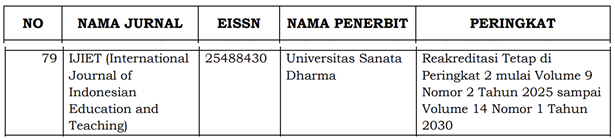
The new certificate is to upload when it is available. Thank you

IJIET Sinta 2 Certificate (please click here)

This work is licensed under CC BY-SA.
This work is licensed under a Creative Commons Attribution-ShareAlike 4.0 International License.

IJIET DOI: https://doi.org/10.24071/ijiet
p-ISSN: 2548-8422 (since 5 January 2017); e-ISSN: 2548-8430 (since 5 January 2017)
IJIET (International Journal of Indonesian Education and Teaching) is published twice a year, namely in January and July, by the Faculty of Teacher Training and Education of Sanata Dharma University, Yogyakarta, Indonesia.