





 Email this article
CHALLENGES AND STRATEGIES IN WRITING ENGLISH ACADEMIC PAPERS: A GRADUATE STUDENT’S SELF-REFLECTION
(1) Atma Jaya Catholic University of Indonesia, Jakarta, Indonesia
(2) Atma Jaya Catholic University of Indonesia, Jakarta, Indonesia
(*) Corresponding Author
Abstract
Writing academic papers in English is complex and daunting. However, many students are able to face the difficulties and find appropriate solutions to tackle the problems, one of which is through a self-reflection. This study aims at extending the literature by focusing on one student’s self-reflection that was carried out during the learning process in one academic writing class in a master’s program in Applied English Linguistics. The reflection centred upon the feedback given on all assignments given in the first half of the semester. The reflective notes were analysed qualitatively. Findings demonstrated that the participant’s most salient problems included incorporating the academic convention into her writing, understanding and using terminologies in Applied English Linguistics, and using appropriate syntax. To deal with the challenges, she used both direct and indirect language learning strategies, namely correcting her assignments based on the teacher’s feedback, communicating the writing problems with the teacher, writing other classroom papers in English directly, and making self-correction using an AI-based tool. The participant’s learning strategies were made on the basis of her self-efficacy beliefs and self-regulation. The study recommends the incorporation of self-reflection into academic writing class to develop students’ academic writing skills.
Keywords
Full Text:
PDFReferences
Alt, D., & Raichel, N. (2020). Reflective journaling and metacognitive awareness: insights from a longitudinal study in higher education. Reflective Practice, 21(2), 145–158. https://doi.org/10.1080/14623943.2020.1716708
Alt, D., Raichel, N., & Naamati-Schneider, L. (2022). Higher education students’ reflective journal writing and lifelong learning skills: Insights from an exploratory sequential study. Frontiers in Psychology, 12, 707168. doi: 10.3389/fpsyg.2021.707168
Bakhou, B., & Bouhania, B. (2020). A qualitative inquiry into the difficulties experienced by Algerian EFL master students in thesis writing: ‘Language is not the only problem’. Arab World English Journal, 11(2), 243-257. doi: https://dx.doi.org/10.24093/awej/vol11no2.17
Calma, A., Cotronei-Baird, V., & Chia, A. (2022). Grammarly: An instructional intervention for writing enhancement in management education. The International Journal of Management Education, 20(3), 100704. doi: https://doi.org/10.1016/j.ijme.2022.100704
Cenoz, J., & Gorter, D. (2022). Pedagogical translanguaging and its application to language classes. RELC journal, 53(2), 342-354. doi: https://doi.org/10.1177/0033688222108275
Ellis, R. (2016). Focus on form: A critical review. Language Teaching Research, 20(3), 405-428. Doi: https://doi.org/10.1177/1362168816628627
Febriani, T. N. (2022). “Writing is challenging”: factors contributing to undergraduate students’ difficulties in writing English essays. Erudita: Journal of English Language Teaching, 2(1), 83–93. https://doi.org/10.28918/erudita.v2i1.5441
Fitriyah, I., Ningrum, A. S. B., & Gozali, I. (2024). An investigation of written corrective feedback in EFL writing assessment: How teachers’ feedback practices meet students’ expectations. International Journal of Language Testing, 14(1), 166–184. https://doi.org/10.22034/IJLT.2023.411616.1275
Gan, Z., An, Z., & Liu, F. (2021) Teacher feedback practices, student feedback motivation, and feedback behavior: How are they associated with learning outcomes? Frontiers in Psychology. 12, 697045. doi: 10.3389/fpsyg.2021.697045
Gebremariam, H. T., & Hiluf, B. (2023). Using need-based writing instruction through self-reflection to improve students' writing difficulties: A counterbalanced design. International Journal of Educational Research Open, 5, 100293. doi: https://doi.org/10.1016/j.ijedro.2023.100293
Ha, Y. N., & Ho, N. P. (2025). EFL postgraduate students’ perceptions on the use of Grammarly and peer feedback to improve their academic writing skills. International Journal of TESOL & Education, 5(1), 25-49. https://doi.org/10.54855/ijte.25512
Katajamäki, H. (2020, December). Terminological problems in academic writing: A study of texts written by university students. Paper presented at the Työelämän viestintä III, Arbetslivskommunikation III, Workplace Communication III, Kommunikation im Berufsleben III. VAKKI Symposium XL 6.–7.2. VAKKI ry. Retrieved on April 3, 2025 from https://osuva.uwasa.fi/handle/10024/11855
Khan, J. & Liu, C. (2020). The impact of colors on human memory in learning English collocations: Evidence from South Asian tertiary ESL student. Asian Pacific Journal of Second and Foreign Language Education, 5(17), pp. 1-10
Lai, W., & Wei, L. (2019). A critical evaluation of Krashen's monitor model. Theory and Practice in Language Studies, 9(11), 1459-1464. doi:https://doi.org/10.17507/tpls.0911.13
Lee, S. M., & Briggs, N. (2021). Effects of using machine translation to mediate the revision process of Korean university students’ academic writing. ReCALL, 33(1), 18-33. Doi: 10.1017/S0958344020000191
Lesmana, N., & Ariffin, K. (2020). Problems in writing scholarly articles in English among Indonesian EFL post-graduate students. International Journal of Academic Research in Progressive Education and Development, 9(4), 12-24. Doi: http://dx.doi.org/10.6007/IJARPED/v9-i4/8174
Mickwitz, Å. & Suojala, M. (2020). Learner autonomy, self-regulation skills and self-efficacy beliefs – How can students’ academic writing skills be supported?. Language Learning in Higher Education, 10(2), 381-402. https://doi.org/10.1515/cercles-2020-2026
Ngoc, T. B. & Ngoc, T. T. M. (2021). Challenges faced by English majors when writing research papers. American Journal of Humanities and Social Sciences Research, 5(12), 162-166. Retrieved on April 1, 2025, from https://www.ajhssr.com/wp-content/uploads/2021/12/T21512162166.pdf
Oxford R.L. (1990). Language learning strategies: What every teacher should know. Boston, MA: Heinle & Heinle
O’Neill, R., & Russell, A. M. (2019). Grammarly: Help or hindrance? Academic Learning Advisors’ perceptions of an online grammar checker. Journal of Academic Language and Learning, 13(1), A88-A107. Retrieved from https://journal.aall.org.au/index.php/jall/article/view/591
Patra, I., Alazemi, A., Al-Jamal, D., & Gheisari, A. (2022). The effectiveness of teachers’ written and verbal corrective feedback (CF) during formative assessment (FA) on male language learners’ academic anxiety (AA), academic performance (AP), and attitude toward learning (ATL). Language Testing in Asia, 12, 19. Doi: https://doi.org/10.1186/s40468-022-00169-2
Pawlak, M. (2021). Investigating language learning strategies: Prospects, pitfalls and challenges. Language Teaching Research, 25(5), 817-835. doi: https://doi.org/10.1177/1362168819876
Sofyan, N., Wahid, J. H. J., & Idris, N. H. (2021). The effectiveness of reading aloud strategy in concerning students’ reading skills. Journal of English Language Teaching, 8(1), pp. 11-18
Tsai, S. C. (2020). Chinese students’ perceptions of using Google Translate as a translingual CALL tool in EFL writing. Computer Assisted Language Learning, 35(5-6), 1250-1272. doi: https://doi.org/10.1080/09588221.2020.1799412
Wei, W., Cheong, C. M., Zhu, X., & Lu, Q. (2022). Comparing self-reflection and peer feedback practices in an academic writing task: a student self-efficacy perspective. Teaching in Higher Education, 29(4), 896–912. https://doi.org/10.1080/13562517.2022.2042242
Wijaya, K. F. (2021). English education master students' self-regulated learning strategies in academic writing. Journal of English Teaching, 7(1), 15-29. Doi: https://doi.org/10.33541/jet.v7i1.2313
Yu, S., & Liu, C. (2021). Improving student feedback literacy in academic writing: An evidence-based framework. Assessing Writing, 48, 100525. doi: https://doi.org/10.1016/j.asw.2021.100525
Zinkevich, N. A., & Ledeneva, T. V. (2021). Using Grammarly to enhance students’ academic writing skills. Professional Discourse & Communication, 3(4), 51-63. doi: https://doi.org/10.24833/2687-0126-2021-3-4-51-63
Zuhriah, N., Fatoni, M., Putri, N. V. W., & Zainuddin, M. (2024). Student perceptions: Challenges and opportunities of using Grammarly on thesis writing. New Language Dimensions, 5(2), 91-101. Doi: https://doi.org/10.26740/nld.v5n2.p91-101
DOI: https://doi.org/10.24071/ijiet.v9i2.12048
Refbacks
- There are currently no refbacks.
Copyright (c) 2025 Dwi Ariyati, Anna Marietta da Silva

This work is licensed under a Creative Commons Attribution-ShareAlike 4.0 International License.
Indexed and abstracted in:








IJIET Sinta 2 Certificate (S2 = Level 2)
We would like to inform you that IJIET (International Journal of Indonesian Education and Teaching):has been nationally re-accredited Sinta 2 by the Ministry of Higher Education, Science and Technology of the Republic of Indonesia based on the decree No. Surat Keputusan 355/DST/D.D1/HM.01.01/2026. Validity for 5 years: Vol 9 No 2, 2025 until Vol 14 No 1, 2030.
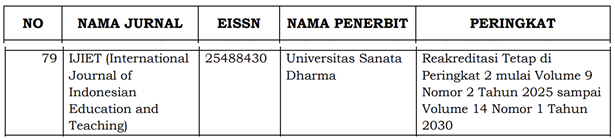
The new certificate is to upload when it is available. Thank you

IJIET Sinta 2 Certificate (please click here)

This work is licensed under CC BY-SA.
This work is licensed under a Creative Commons Attribution-ShareAlike 4.0 International License.

IJIET DOI: https://doi.org/10.24071/ijiet
p-ISSN: 2548-8422 (since 5 January 2017); e-ISSN: 2548-8430 (since 5 January 2017)
IJIET (International Journal of Indonesian Education and Teaching) is published twice a year, namely in January and July, by the Faculty of Teacher Training and Education of Sanata Dharma University, Yogyakarta, Indonesia.