




 Email this article

TEACHERS’ PEDAGOGICAL RESISTANCE OF EMI THROUGH CLASSROOM TRANSLANGUAGING IN NEPALESE SCIENCE CLASSROOMS
(1) Graduate School of Education Tribhuvan University, Nepal
(2) Tribhuvan University, Nepal
(*) Corresponding Author
Abstract
English as a Medium of Instruction (EMI) is an approach used to teach content subjects in English, particularly in regions where English is not the primary language of most of the population. The increasing adoption of EMI in Nepalese public schools has sparked debate among educators, policymakers, and linguists. While local bodies promote EMI, teachers often utilize Nepali and English, allowing students to use their home languages. However, the science teachers’ use of multilingual practices and resistance to exclusive English instruction remain underexplored. This study aimed to analyze how secondary-level EMI science teachers incorporate students' home languages in the classroom. Using phenomenology as a research design, we collected data from two science teachers teaching at English medium public schools in Sunsari through in-depth interviews and analyzed the data thematically. The study found that secondary-level EMI science teachers frequently use Nepali and English and incorporate students' home languages purposefully, a practice known as translanguaging. Additionally, the study found that teachers use translanguaging as a pedagogical tool and a form of resistance in EMI science classrooms to enhance engagement, comprehension, and inclusivity while challenging monolingual policies. It suggests that multilingual strategies like translanguaging can foster change and reform policies through teacher agency at the micro level.
Keywords
Full Text:
PDFReferences
Al-Bakri, S. (2013). Problematizing English medium instruction in Oman. International journal of bilingual and multilingual teachers of English, 207(1172), 1-15.
Archer, M. S. (2000). Being human: The problem of agency. Cambridge University Press.
Ary, D., Jacobs, L. C., & Razavieh, A. (2002). Introduction to research in education. Wadsworth/ Thomson Learning.
Bourdieu, P. (1991). Language and symbolic power. Harvard University Press.
Bourdieu, P. (2000). The production and reproduction of legitimate language (1982). In L. Burke & A. Girvin (Eds.), The Routledge language and culture reader (pp. 467–477). Routledge.
Braun, V., & Clarke, V. (2006). Using thematic analysis in psychology. Qualitative Research in Psychology, 3(2), 77-101.
Brown, H., & Bradford, A. (2018). Teaching subject content through English: CLIL and EMI courses in the Japanese university. In Teaching English at Japanese universities (pp. 103-108). Routledge.
Canagarajah, S. (2011). Translanguaging in the classroom: Emerging issues for research and pedagogy. Applied Linguistics Review, 2(1), 1–28. https://doi.org/10.1515/9783110239331.1
Canagarajah, S. (2013). Translingual practice: Global Englishes and cosmopolitan relations. Routledge.
Cohen, L., Manion, L., & Morrison, K. (2018). Research methods in education. Routledge.
Creese, A., & Blackledge, A. (2015). Translanguaging and identity in educational settings. Applied Linguistics, 36(5), 575-586.
De Costa, P. I., Green-Eneix, C. A., & Li, W. (2022). Problematizing EMI language policy in a transnational world: China’s entry into the global higher education market. English Today, 38(2), 80-87. https://doi.org/10.1017/S026607842000005X.
Dearden, J. (2014). English as a medium of instruction _ a growing global phenomenon. British Council.
Fang, F., & Hu, G. (2022). English medium instruction, identity construction and negotiation of Teochew-speaking learners of English. Journal of Multilingual and Multicultural Development, 1-16. https://doi.org/10.1080/01434632.2022.2051711
Gao, X., & Wang, W. (2017). Bilingual education in the people’s republic of China. In Garcia, O., Lin, A. M. Y., & May, S. (Eds.), Bilingual and multilingual education, (pp. 219–23). Springer.
Garcia, O. (2009). Bilingual education for the 21st century: A global perspective. Wiley Black-Well.
Garcia, O., & Wei, L. (2014). Translanguaging: Language, bilingualism and education. Palgrave Macmillan.
Gautam, B. & Poudel, P. (2022). Diversity, multilingualism and democratic practices in Nepal. Bandung, 9(1-2), 80-102. https://doi.org/10.1163/21983534-09010004
Giddens, A. (1984). Constitution of society polity press. Cambridge.
Giri, R. A. (2020). The politics of English language education in multilingual Nepal. Multilingual Matters.
Giroux, H. A. (1988). Teachers as intellectuals: Toward a critical pedagogy of learning. Bergin & Garvey.
Hamid, M. O., Jahan, I., & Islam, M. M. (2021). Medium of instruction policies and language practices in higher education: A postcolonial analysis. Language Policy, 20(2), 215-237.
Hammersley, M. (2013). What is qualitative research? Bloomsbury Academic.
Jenkins, J. (2014). English as a lingua franca in the international university: The politics of academic English language policy. Routledge.
Johnson, D. C. (2013). Language policy. Palgrave Macmillan.
Lantolf, J. P., & Pavlenko, A. (2001). Second language activity theory: Understanding second language learners as people. In M. Breen (Ed.), Learner contributions to language learning: New directions in research (pp. 141-158). Pearson Education.
Macaro, E. (2018). English medium instruction: Content and language in policy and practice. Oxford University Press.
Macaro, E. (2020). Exploring the role of language in English medium instruction. International Journal of Bilingual Education and Bilingualism, 23 (3), 263–276.
Macaro, E., S. Curle, J. Pun, J. An, & J. Dearden. (2018). A systematic review of English medium instruction in higher education. Language Teaching 51 (1), 36–76.
Menken, K., & Garcia, O. (2010). Negotiating language policies in schools: Educators as policymakers. Routledge.
Ministry of Education. (2028, 9th Amendment, 2074). Education act. Government of Nepal.
Mohanty, A. (2018). The multilingual reality: Living with languages. Multilingual Matters. https://doi.org/10.21832/9781788921978
Moll, L. C., Amanti, C., Neff, D., & Gonzalez, N. (1992). Funds of knowledge for teaching: Using a qualitative approach to connect homes and classrooms. Theory Into Practice, 31(2), 132-141.
National Statistics Office. (2021). National population and housing census 2021 results. Government of Nepal.
Ortner, S. B. (1984). Theory in anthropology since the sixties. Comparative Studies in Society and History, 26(1), 126-166.
Paudel, J. (2021). Translanguaging as a pedagogy of enacting social justice in a multilingual setting. In Teaching Practices and Language Ideologies for Multilingual Classrooms (pp. 131-150). IGI Global.
Paudel, P. P., & Choi, T. H. (2021). Policymakers’ agency and the structure: The case of medium of instruction policy in multilingual Nepal. Current Issues in Language Planning, 22(1-2), 79-98.
Paudel, P. P., & Choi, T. H. (2024). Enactment of English medium instruction in under-resourced educational contexts: A case of multilingual public secondary schools in Nepal. System, 121, https://doi.org/10.1016/j.system.2024.103223.
Phillipson, R. (1992). Linguistic imperialism. Oxford University Press.
Phyak, P. & Ojha, L. P. (2019). Language education policy and inequalities of multilingualism in Nepal: Ideologies, histories, and updates. In A. Kirkpatrick & A. J. Liddicoat (eds.), The Routledge international handbook of language education policy in Asia, 341–354. Routledge.10.4324/9781315666235-24
Phyak, P. (2013). Language ideologies and local languages as the medium of instruction policy: A critical ethnography study of a multilingual school in Nepal. Current Issues in Language Planning, 14(1), 127-143.
Phyak, P. (2016). Local-global tension in the ideologies and practices of English language teaching in Nepal. In Tupas, R. (Ed.), Unequal Englishes: The politics of Englishes today (pp. 53-69). Palgrave Macmillan.
Phyak, P. (2018). Translanguaging as a pedagogical resource in English language teaching: A response to unplanned language education policies in Nepal. In K. Kuchah, & F. Shamim (Eds.), International Perspectives in Teaching English in Difficult Circumstances (pp. 49-70). Palgrave. https://doi.org/10.1057/978-1-137-53104-9_3.
Phyak, P. (2023). Translanguaging as a space of simultaneity: theorizing translanguaging pedagogies in English medium schools from a spatial perspective. Modern Language Journal, 107(1), 289-307. https://doi.org/10.1111/modl.12830
Phyak, P., Sah, P.K., Ghimire, N., & Lama, A. (2022). Teacher agency in creating a translingual space in Nepal’s multilingual English medium schools. RELC Journal, 53(2), 1-21. 10.1177/00336882221113950
Pickering, A. (1995). The mangle of practice: Time, agency and science. University of Chicago Press.
Poudel, P. (2019). The medium of instruction policy in Nepal: Towards critical engagement on the ideological and pedagogical debate. Journal of Language and Education, 5(3), 102-110. https://doi.org/10.17323/jle.2019.8995
Priestley, M., Biesta, G., & Robinson, S. (2015). Teacher agency: An ecological approach. Bloomsbury.
Rana, K. (2018). Retention of English language tension in multilingual communities of Nepal: A review of teachers’ narratives. Journal of NELTA, 23(1-2), 40-53. https://doi.org/10.3126/nelta.v23i1-2.23347
Rauteda, K. R. (2022). Translanguaging as a pedagogical resource in multilingual ELT classrooms: Exploring perceptions and practices [Master’s Thesis]. Tribhuvan University.
Rauteda, K. R. (2024a). Use of EMI at secondary education: Exploring non-English Nepalese teachers’ ideologies. Siddhajyoti Interdisciplinary Journal, 5(1), 33-43. https://doi.org/10.3126/sij.v5i1.63596
Rauteda, K. R. (2024b). Unveiling pedagogical translanguaging: Investigating teachers’ translingual practices and purposes in ELT classrooms. English Language Teaching (ELT) PERSPECTIVES, 9(1-2), 51-66.
Ricento, T. K., & Hornberger, N. H. (1996). Unpeeling the onion: Language planning and policy and the ELT professional. TESOL Quarterly, 30(3), 401–427.
Sah, P. K. (2015). English Medium Instruction (EMI) in Nepalese education: Potential or problem? ELT Chautari.
Sah, P. K., & Guofang, Li. (2018). English medium instruction (EMI) as linguistic capital in Nepal: Promises and realities. International Multilingual Research Journal, 12(2), 109-123.
Sah, P.K. (2022). English medium instruction in South Asian’s multilingual schools: unpacking the dynamics of ideological orientations, policy/practices, and democratic questions, International Journal of Bilingual Education and Bilingualism, 25(2), 742-755. https://doi.org/10.1080/13670050.2020.1718591.
Sah, P.K., & Karki, J. (2023). Elite appropriation of English as a medium of instruction policy and epistemic inequalities in Himalayan schools, Journal of Multilingual and Multicultural Development, 44(1), 20-34. https://doi.org/10.1080/01434632.2020.1789154.
Schiffman, H. F. (1996). Linguistic culture and language policy. Routledge
Tai, K. (2021). Translanguaging as inclusive pedagogical practices in English-medium instruction science and mathematics classrooms for linguistically and culturally diverse students. Research in Science Education, 52(3), 975-1012. https://doi.org/10.1007/s11165-021-10018-6
Tai, K., & Wei, L. (2020). Co-learning in Hong Kong English medium instruction mathematics secondary classrooms: A translanguaging perspective. Language and Education, 35(3), 241-267. https://doi.org/10.1080/09500782.2020.1837860
Tai, K., & Wei, L. (2023). Embodied enactment of a hypothetical scenario in an English medium instruction secondary mathematics classroom: A translanguaging approach. Language Teaching Research, 136216882311528. https://doi.org/10.1177/13621688231152858
Tollefson, J. W., & Tsui, A. B. M. (2023). Language policy, culture, and identity in Asian contexts. Routledge.
Tupas, R. (2015). Unequal Englishes: The politics of Englishes today. Palgrave Macmillan.
Vygotsky, L. S. (1978). Mind in society: The development of higher psychological processes. Harvard University Press.
DOI: https://doi.org/10.24071/ijiet.v9i2.12043
Refbacks
- There are currently no refbacks.
Copyright (c) 2025 Khem Raj Rauteda, Bhawana Luitel

This work is licensed under a Creative Commons Attribution-ShareAlike 4.0 International License.
Indexed and abstracted in:








IJIET Sinta 2 Certificate (S2 = Level 2)
We would like to inform you that IJIET (International Journal of Indonesian Education and Teaching):has been nationally re-accredited Sinta 2 by the Ministry of Higher Education, Science and Technology of the Republic of Indonesia based on the decree No. Surat Keputusan 355/DST/D.D1/HM.01.01/2026. Validity for 5 years: Vol 9 No 2, 2025 until Vol 14 No 1, 2030.
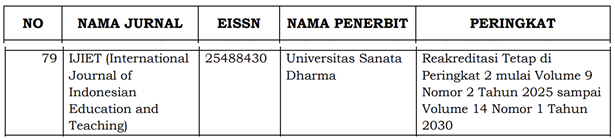
The new certificate is to upload when it is available. Thank you

IJIET Sinta 2 Certificate (please click here)

This work is licensed under CC BY-SA.
This work is licensed under a Creative Commons Attribution-ShareAlike 4.0 International License.

IJIET DOI: https://doi.org/10.24071/ijiet
p-ISSN: 2548-8422 (since 5 January 2017); e-ISSN: 2548-8430 (since 5 January 2017)
IJIET (International Journal of Indonesian Education and Teaching) is published twice a year, namely in January and July, by the Faculty of Teacher Training and Education of Sanata Dharma University, Yogyakarta, Indonesia.