



 Email this article

PRAGMATIC COMPETENCE CONSTRUCT IN SECOND LANGUAGE ACQUISITION: CRITICAL THEORETICAL AND PEDAGOGICAL PERSPECTIVES IN LANGUAGE TEACHING
(1) University of Asia and the Pacific, Philippines
(*) Corresponding Author
Abstract
Drawing from literature on language and interlanguage pragmatics as well as education and business, this conceptual paper presents the current realities in second language learning and instruction and argues for the need to align collegiate second language acquisition curricula that emphasize linguistic and pragmatic competence. Such revision is consistent with the need to prepare college students to meet the critical demands of multi-context communication, which necessitates a deliberate teaching of pragmatic competence. More than the typical cognitive and technical skills, both local and global job markets need wide-ranging sets of communication-related competences as these affect meaning-making and quality of relationships, particularly in the workplace. Acquisition or enhancement of these skills paves the way for career, business, and life success. Said competencies also highlight the value of social or sociocultural skills as well as internal attributes that are critical in fostering healthy relationships and fruitful interaction. Both sets of skills speak of a person’s appropriateness in terms of use of pragmalinguistic and sociopragmatic resources and norms in communication, in addition to the aptness of understanding of linguistic and non-linguistic codes. Ultimately, these skills all boil down to pragmatic competence, which is needed in a balanced second language teaching approach.
Keywords
Full Text:
PDFReferences
Abdulrahman, N., & Abu-Ayyash, E. A. S. (2019). Linguistic competence, communicative competence, and interactional competence. International Journal of Computer and Technology, 19, Article 8505. https://doi.org/10.24297/ijct.v19i0.8505
Abrams, Z. (2013). Say what?! L2 sociopragmatic competence in CMC: Skill transfer and development. CALICO Journal, 30(3), 423-445. https://doi.org/10.11139/cj.30.3.423-445
Acosta, P., Igarashi, T., Olfindo, R., & Rutkowski, J. (2017). Developing socioemotional skills for the Philippines’ labor market. Directions in development. Washington, DC: World Bank. https://doi.org/10.1596/978-1-4648-1191-3
AFP. (2016, September 6). Obama cancels meeting with Philippine president after getting called a 'son of a b----'. Agence France Presse. https://www.businessinsider.com/afp-philippines-duterte-calls-barack-obama-son-of-a-whore-2016-9
Aftab, R., Mahmood, A., & Abdullah, M. (2022). Language and culture: A study in the sociolinguistic perspective. Journal of Positive School Psychology, 6(9), 5398–5412.
Altarriba, J., & Basnight-Brown, D. (2022). The psychology of communication: The interplay between language and culture through time. Journal of Cross-Cultural Psychology, 53(7–8). https://doi.org/10.1177/0022022122111404
AP News. (1992, January 3). Bush’s V-sign has different meaning for Australians with PM-Bush. https://apnews.com/42939a95e2b694ec6262ff5949d910c9
Bachman, L. (1990). Fundamental considerations in language testing. New York: Oxford University Press.
Bagarić, V., & Djigunović, J. M. (2007). Defining communicative competence. Metodika, 8(1), 94-103. https://hrcak.srce.hr/file/42651
Baker, D. (2014, December 1). When will critics of the children of prominent politicians learn? The San Diego Union-Tribune. https://www.sandiegouniontribune.com/opinion/the-conversation/sdut-gop-aide-resigns-obama-daughters-2014dec01-htmlstory.html
Bardovi-Harlig, K. (2013). Developing L2 pragmatics. Language Learning, 63(1), 68-86. https://doi.org/10.1111/j.1467-9922.2012.00738.x
Bardovi-Harlig, K., & Dörnyei, Z. (1998). Do language learners recognize pragmatic violations? Pragmatic versus grammatical awareness in instructed L2 learning. TESOL Quarterly, 32(2), 233–262. https://doi.org/10.2307/3587583
Brown, P., & Levinson, S. (1987). Politeness: Some universals in language usage. Studies in Interactional Sociolinguistics, 4. Cambridge: Cambridge University Press.
California Department of Education. (2019). Partnership for 21st century skills. Retrieved from https://www.cde.ca.gov/eo/in/cr/p21cskls.asp
Canale, M., & Swain, M. (1980). Theoretical bases of communicative approaches to second language. Applied Linguistics, 1, 1-47.
Cao, J. (2022). A study of Saussure’s “Langue” and “Parole” from Marxist’s the law of the unity and opposites. Open Journal of Social Sciences, 10, 26-33. https://doi.org/10.4236/jss.2022.105003
Cazden, C. B. (2011). Dell Hymes's construct of "communicative competence". Anthropology & Education Quarterly, 42(4), 364-369.
Chomsky, N. (1965). Aspects of the theory of syntax. Cambridge: MIT
Commission on Higher Education. (2013). Purposive communication preliminaries. Office of the President.
Cultural Atlas. (2022, Feb. 1). Communication. Australian Culture. https://culturalatlas.sbs.com.au/australian-culture/australian-culture-communication
De Saussure, F. (1916). Course in general linguistics (W. Baskin, Trns.). New York: McGraw-Hill.
DelReal, S. A., & O’Keefe, E. (2014, December 1). Hill staffer Elizabeth Lauten resigns after remarks about Obama daughters. The Washington Post. Retrieved from https://www.washingtonpost.com/news/post-politics/wp/2014/12/01/embattled-hill-staffer-elizabeth-lauten-reportedly-resigns-after-controversial-remarks/
Dong, Q., & Day, K. D. (n.d.). A relational orientation to communication: Origins, foundations, and theorists. Stockton, CA: University of the Pacific. Retrieved from https://www-s3-live.kent.edu/s3fs-root/s3fs- public/file/09- Qingwen- Dong-Kenneth-D.-Day.pdf
Eghtesadi, A. R. (2017). Models of communicative competence: Implications for language teachers and teacher educators. Knowledge improvement. ROSHD FLT, 31(3), 28-40.
Elmira, H. (2022). The application of pragmatics in ESL classes. ISCIENCE, 9(89), 22-31.
Félix-Brasdefer, C. (2023). Politeness 2: Pragmatics & discourse at IU. Bloomington: University of Indiana. https://pragmatics.indiana.edu/politeness/politeness2.html
Grice, H. P. (1975). Logic and conversation. In P. Cole & J. L. Morgan (Eds.), Syntax and semantics: Speech acts (Vol 3, pp. 41–58). New York: Academic Press.
Halliday, M. A. K. (2002). Relevant models of language. In B.M. Power & R.S. Hubbard (Eds.), Language development: A reader for teachers (2nd ed.). New Jersey: Merrill Prentice Hall.
Harlow, L. L. (1990). Do they mean what they say? sociopragmatic competence and second language learners. The Modern Language Journal, 74(3), 328-351. https://doi.org/10.1111/j.1540-4781.1990.tb01070.x
Harrington, H.J., & Lewis, R. (2014). Closing the communication gap: An effective method for achieving desired results (1st ed.). New York: Productivity Press.
Hossain, K. I. (2024). Reviewing the role of culture in English language learning: Challenges and opportunities for educators. Social Sciences & Humanities Open, 9, 100781. https://doi.org/10.1016/j.ssaho.2023.100781
Hozjan, D. (2009). Key competences for the development of lifelong learning in the European Union. European Journal of Vocational Training, 46(1), 196-207.
Hymes, D. H. (1967). Models of the interaction of language and social setting. Journal of Social Issues, 23(2), 8-28.
Hymes, D. H. (1972). On communicative competence. In J. B. Pride & J. Holmes (Eds.), Sociolinguistics (pp. 269-293). Baltimore, USA: Penguin Education, Penguin Books Ltd.
Jaffe, A. (2014, December 2). GOP staffer resigns over criticism of Obama daughters. CNN. https://edition.cnn.com/2014/12/01/politics/gop-staffer-resigns-over-criticism-of-obama-daughters/index.html
Jumanazarov, U.U. (2021). Theory and structure of linguistic competence. The American Journal of Interdisciplinary Innovations and Research, 3(4), 42–47. https://doi.org/10.37547/tajiir/Volume03Issue04-07
Lakoff, R. (1973). The logic of politeness, or minding your P’s and Q’s. Chicago Linguistics Society, 9, 292-305.
League of Managers Association (2017, January 26). Diversity and inclusion. https://leaguemanagers.com/leadership-wellbeing/lma-insights/61-diversity-and-inclusion/
Leech, G. (1983). Principles of pragmatics. London: Longman.
Malinowski, B. (1935). Coral gardens and their magic (Vol 2). London: Allen & Unwin.
Mister Tibbs@TChallaMac. (2014, Dec. 1). @seanspicer These are kids. Maybe if #ElizabethLauten wasn’t such an Adult Bully. Now we all know what you guys[Tweet Post]. Twitter. https://twitter.com/seanspicer/status/539395550274387968
National Education Association. (n.d.). Preparing 21st century students for a global society: An educator’s guide to the “four Cs”. http://www.nea.org/assets/docs/A-Guide-to-Four-Cs.pdf
Parkinson, J. (2014, December 2). GOP staffer resigns after remarks about Obama girls. Eyewitness News. ABC7. https://abc7ny.com/417761/
Qasserras, L. (2023). Systematic review of communicative language teaching (CLT) in language education: A balanced perspective. European Journal of Education and Pedagogy, 4(6), 17-23.
Rayon, L. D. (2017). Task-based approach as an effective tool in developing pragmatic competence. JPAIR Multidisciplinary Research, 27, 112-127. http://dx.doi.org/10/7719/jpair.vi1.461
Santos, R. (2020). Output-based approach in media and information literacy toward 21st century skills development in the Philippines. International Journal of Research Studies in Education, 9(7), 13-29. https://doi.org/10.5861/ijrse.2020.5045
Santos, R., & Bae, J. B. (2022). T-Shaped graduates: Developing cognitive and metacognitive (socioemotional) skills in a science, technology, engineering, and mathematics-aligned course using project-based approach in an online learning environment. International Journal of Research Studies in Education, 11(14), 91-105. https://doi.org/10.5861/ijrse.2022.b021
Savignon, S. (1983). Communicative competence: Theory and classroom practice. Reading, MA: Addison–Wesley Publishing Company.
Savignon, S. (1997). Communicative competence: Theory and practice (6th ed). New York: McGraw Hill.
Savignon, S. J. (1991). Communicative language teaching: State of the art. TESOL Quarterly, 25(2), 261-277.
Senft, G. (2004). Bronislaw Malinowski and linguistic pragmatics. Nijmegen: Max Planck Institute for Psycholinguistics.
Spicer, S. (2014, Dec. 1). In over 20 years in politics I have never seen 1 of the countless inappropriate comments by democrats ever covered [Tweet Post]. Twitter. https://twitter.com/seanspicer/status/539395550274387968
Taguchi, N., Li, S., & Xiao, F. (2016). Effects of intercultural competence and social contact on speech act production in a Chinese study abroad context. The Modern Language Journal,100(4), 775-796.
Tan, J. P., Koh, E., Chan, M., Costes-Onishi, P., & Hung, D. (2017). Advancing 21st century competencies in Singapore. Belfast: Center for Global Education. Asia Society. Retrieved from https://asiasociety.org/sites/default/files/2017-10/advancing-21st-century-competencies-in-singapore.pdf
Thomas, J. (1983). Cross-cultural pragmatic failure. Applied Linguistics 4, 91-112
Tulgar, A. T. (2016). The role of pragmatic competence in foreign language education. Turkish Online Journal of English Language Teaching (TOJELT), 1(1), 10–19.
Vidyarthi, S., Winkle, C., Smith, J., Zhang, T., Kawamura, K., & Hoch, C. (2012). Holistic, inclusive and practical: Teaching plan-making at the core. The Town Planning Review, 83(6), 625-645. https://doi.org/10.3828/tpr.2012.40
Wan, W., & Nakamura, D. (2016, September 6). Obama cancels meeting with ‘colorful’ Philippine president, who now expresses regret. The Washington Post. https://www.washingtonpost.com/news/post-politics/wp/2016/09/05/philippine-president-threatens-to-curse-out-obama-obama-calls-him-a-colorful-guy/
Wang, H. (1999). Errors and teaching for pragmatic competence. The Korean Language in America, 3, 127-143.
Whyte, S. (2019). Revisiting communicative competence in the teaching and assessment of language for specific purposes. Language Education & Assessment, 2(1), 1–19. https://doi.org/10.29140/lea.v2n1.33
Wyner, L., & Cohen, A. D. (2015). Second language pragmatic ability: Individual differences according to environment. Studies in Second Language Learning and Teaching, 5(4), 519-556.
DOI: https://doi.org/10.24071/ijiet.v9i2.11467
Refbacks
- There are currently no refbacks.
Copyright (c) 2025 Rafael Ibe Santos

This work is licensed under a Creative Commons Attribution-ShareAlike 4.0 International License.
Indexed and abstracted in:








IJIET Sinta 2 Certificate (S2 = Level 2)
We would like to inform you that IJIET (International Journal of Indonesian Education and Teaching):has been nationally re-accredited Sinta 2 by the Ministry of Higher Education, Science and Technology of the Republic of Indonesia based on the decree No. Surat Keputusan 355/DST/D.D1/HM.01.01/2026. Validity for 5 years: Vol 9 No 2, 2025 until Vol 14 No 1, 2030.
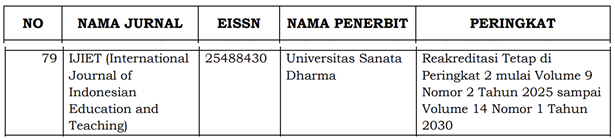
The new certificate is to upload when it is available. Thank you

IJIET Sinta 2 Certificate (please click here)

This work is licensed under CC BY-SA.
This work is licensed under a Creative Commons Attribution-ShareAlike 4.0 International License.

IJIET DOI: https://doi.org/10.24071/ijiet
p-ISSN: 2548-8422 (since 5 January 2017); e-ISSN: 2548-8430 (since 5 January 2017)
IJIET (International Journal of Indonesian Education and Teaching) is published twice a year, namely in January and July, by the Faculty of Teacher Training and Education of Sanata Dharma University, Yogyakarta, Indonesia.