







 Email this article
PLAYING MUSIC, CREATING THE FUTURE: EXPLORING CARDBOARD MEDIA IN DAYAK MUSICAL INSTRUMENT LEARNING
(1) Tanjungpura University, Indonesia
(*) Corresponding Author
Abstract
The limited access to traditional Dayak musical instruments, the Dau', drives innovation in music learning in the digital era. This research explores students' perceptions of using cardboard media as a creative alternative in learning the basics of the instrument. Through a qualitative approach, this study found that students responded positively to the cardboard media. Data were collected through participant observation, documentation, and interviews with the 2023 cohort of Performing Arts Education students at Tanjungpura University. Open-ended questions were used to understand how students perceive the cardboard media used in the learning process. Data analysis used triangulation techniques to understand students' opinions regarding the learning media. The research results show that students have a positive view of using cardboard media in the basic music learning of the Dayak. They assess that this media is not only effective in facilitating the understanding of Dayak music concepts but also stimulates creativity and fine motor skills. These findings indicate that cardboard media can be an innovative and flexible solution in traditional music education, especially in resource-limited environments. The implications of this research open up opportunities for further development, such as the integration of augmented reality technology, to create a more immersive and engaging learning experience for the millennial generation.
Keywords
Full Text:
PDFReferences
Amiri, S., Parvizi Fard, A., Khaledi-Paveh, B., Foroughi, A., Bavafa, A., Bazani, M., Mohammadian, Y., & Sadeghi, K. (2019). The effectiveness of music therapy on insomnia using Persian traditional music. Journal of Kermanshah University of Medical Sciences, 23(2). https://doi.org/10.5812/jkums.86914
Ćaleta, J. (2023). The festival of Dalmatian Klapa in Omiš as an example of the festivalization of Croatian traditional music. Muzikologija, 2023(35), 67-85. https://doi.org/10.2298/MUZ2335067C
Callista, K. R., Olendo, Y. O., & Muniir, A. (2022). Bentuk penyajian dan fungsi musik ritual muang panyakit padi suku Dayak Kayatn desa Ampaning. Khatulistiwa, 11(9), 1883-1893. https://doi.org/10.26418/jppk.v11i9.58606
Christy, A., & Rachman, A. (2023). Form of Bundengan traditional music arrangement by Sanggar Akustika in Wonosobo. Jurnal Seni Musik, 12(1), 1-11. https://doi.org/10.15294/jsm.v12i1.67147
Daly, D. K. (2022). Creativity, autonomy and Dalcroze Eurhythmics: An arts practice exploration. International Journal of Music Education, 40(1), 105-117. https://doi.org/10.1177/02557614211028600
Febriyani, F., & Sukmayadi, Y. (2023). Pembelajaran seni musik sebelum, semasa, sesudah pandemi Covid-19 di SMP. Edukatif : Jurnal Ilmu Pendidikan, 5(2), 1440-1453. https://doi.org/10.31004/edukatif.v5i2.5246
Firdaus, M. B., Chrisvitandy, A., Taruk, M., Wati, M., Tejawati, A., & Suandi, F. (2022). Augmented reality pengenalan alat musik tradisional Sape’. Jurnal Integrasi, 14(2), 75-80. https://doi.org/10.30871/ji.v14i2.4041
Fukamizu, Y., En, J., Kano, T., & Arikawa, I. (2009). Power of music that moves mind and body - music therapy in the Hansen’s disease sanatorium in Japan. Japanese Journal of Leprosy, 78(1), 35-39. https://doi.org/10.5025/hansen.78.35
Guclu, H., Kocer, S., & Dundar, O. (2021). Application of augmented reality in music education. The Eurasia Proceedings of Science Technology Engineering and Mathematics, 14, 45-56. https://doi.org/10.55549/epstem.1050174
Hapidzin, R. I., Narawati, T., & Nugraheni, T. (2022). Nilai-nilai kearifan lokal: Pertunjukan tari dalam upacara adat bakti purnamasari di Sukabumi. Gondang: Jurnal Seni dan Budaya, 6(1), 214–221. https://doi.org/10.24114/gondang.v6i1.34996
Hemming, E. G., & Kvarnhall, V. (2015). Music listening and matters of equality in music education. Svensk Tidskrift För Musikforskning, 97, 27–44.
Hidayat, M., Rozak, R. W. A., Hakam, K. A., Kembara, M. D., & Parhan, M. (2022). Character education in Indonesia: How is it internalized and implemented in virtual learning? Cakrawala Pendidikan, 41(1), 186–198. https://doi.org/10.21831/cp.v41i1.45920
Kaschub, M. (2024). The Oxford Handbook of Music Composition Pedagogy. Oxford: Oxford University Press. https://doi.org/10.1093/oxfordhb/9780197574874.001.0001
Ladamay, O., & Mustakim, M. (2023). Character building in the perspective of Pancasila: A case study of islamic religious education students. Waskita: Jurnal Pendidikan Nilai dan Pembangunan Karakter, 7(1), 93-122. https://doi.org/10.21776/ub.waskita.2023.007.01.7
Mansyur, M. (2016). Kesenian musik dan tari tradisional suku Dayak Manunggal. Pelataran Seni, 1(2), 81-100. https://doi.org/10.20527/jps.v1i2.5193
Miles, M. B., & Huberman, A. M. (1994). Qualitative data analysis a methods sourcebook (3rd ed.). Thousand Oak, CA: Sage.
Olendo, Y. O., Dewantara, J. A., & Efriani, E. (2022). Tradition, ritual, and art of the Baliatn The conceptualization of philosophy and the manifestation of spirituality among the Dayak Kanayatn. Wacana, 23(2) 491-518. https://doi.org/10.17510/wacana.v23i2.1059
Patteson, T. (2016). “The joy of precision”: Mechanical instruments and the aesthetics of automation. In Instruments for new music (pp. 18–51). Oakland, CA: University of California Press. https://www.jstor.org/stable/10.1525/j.ctt1ffjn9k.6
Permadi, T. A., & Budiwati, D. S. (2016). Implikasi penggunaan media audio digital terhadap pembelajaran gamelan degung I di departemen pendidikan seni musik FPSD UPI. Swara: Jurnal Antologi Departemen Pendidikan Seni Musik FPSD UPI, 4(2), 1-10.
Permana, B. S., Hazizah, L. A., & Herlambang, Y. T. (2024). Teknologi pendidikan: Efektivitas penggunaan media pembelajaran berbasis teknologi di era digitalisasi. Khatulistiwa: Jurnal Pendidikan dan Sosial Humaniora, 4(1), 19-28. https://doi.org/10.55606/khatulistiwa.v4i1.2702
Putra, Z. A. W., Ghozali, I., Sagala, M. D., Satrianingsih, A. R. O., & Aditya, M. C. P. (2023). Pelatihan evaluasi pembelajaran berbasis website bagi dosen program studi seni pertunjukan di masa pandemi. Wahana Dedikasi: Jurnal PkM Ilmu Kependidikan, 6(2) 305-320. https://doi.org/10.31851/dedikasi.v6i2.13151
Razak, A., & Ferdinand, F. (2019). Fungsi musik Dayak Kanayatn. Selonding, 15(1), 1-7. https://doi.org/10.24821/selonding.v15i1.3109
Sagala, M. D. (2024). Improving social relations between students through learning Dayak music ensembles using the peer tutor method. Jurnal Pendidikan Sosiologi dan Humaniora, 15(1), 385–394. https://doi.org/10.26418/j-psh.v15i1.79242
Sarbadhikary, S. (2023). Intellectual exchange with hands: Materiality and cosmology in manual sharing practices of an Asian sacred drum. In J. Copeman, N. J. Long, L. M. Chau, J. Cook, & M. Marsden (Eds.), An anthropology of intellectual exchange (1st ed., pp. 209–234). New York: Berghahn Books.
Satriami, E. W., & Sumiati, S. (2022). Pemberian terapi musik klasik Dayak terhadap penurunan tingkat kecemasan ibu hamil trimester III primigravida. Jurnal Medika: Karya Ilmiah Kesehatan, 7(1), 1-9.
Scoot, K. B. (2016). Teacher vs. student perception of teaching methodologies implemented on the collegiate level [Thesis, Guilford College, North Carolina].
Sunardi, S. (2023). Efektivitas model bermain peran terhadap keterampilan bercerita siswa sekolah dasar. Scholaria: Jurnal Pendidikan dan Kebudayaan, 13(1), 87-107s. https://doi.org/10.24246/j.js.2023.v13.i1.p87-107
Váradi, J. (2022). A review of the literature on the relationship of music education to the development of socio-emotional learning. SAGE Open, 12(1). https://doi.org/10.1177/21582440211068501
Vitale, J. L. (2011). Music makes you smarter: A new paradigm? Perceptions and perspectives from four groups of elementary education stakeholders. Canadian Journal of Education Revue Canadienne De l’éducation, 34(3), 317–343.
DOI: https://doi.org/10.24071/ijiet.v10i1.10883
Refbacks
- There are currently no refbacks.
Copyright (c) 2026 Mastri Dihita Sagala

This work is licensed under a Creative Commons Attribution-ShareAlike 4.0 International License.
Indexed and abstracted in:








IJIET Sinta 2 Certificate (S2 = Level 2)
We would like to inform you that IJIET (International Journal of Indonesian Education and Teaching):has been nationally accredited Sinta 2 by the Ministry of Education, Culture, Research and Technology of the Republic of Indonesia based on the decree No. Surat Keputusan 158/E/KPT/2021. Validity for 5 years: Vol 5 No 2, 2021 until Vol 10 No 1, 2026.
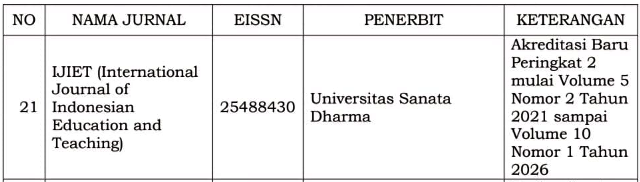

IJIET Sinta 2 Certificate (please click here)

This work is licensed under CC BY-SA.
This work is licensed under a Creative Commons Attribution-ShareAlike 4.0 International License.

IJIET DOI: https://doi.org/10.24071/ijiet
p-ISSN: 2548-8422 (since 5 January 2017); e-ISSN: 2548-8430 (since 5 January 2017)
IJIET (International Journal of Indonesian Education and Teaching) is published twice a year, namely in January and July, by the Institute for Research and Community Services of Sanata Dharma University, Yogyakarta, Indonesia.