





 Email this article

CONTROLLING EXAMOPHOBIA AMONG COLLEGES OF EDUCATION STUDENTS USING ASSERTIVENESS TRAINING AND COGNITIVE RESTRUCTURING
(1) Kwara State College of Education, Ilorin, Nigeria
(2) Kwara State College of Education, Ilorin, Nigeria
(*) Corresponding Author
Abstract
This study examined the effectiveness of assertiveness training and cognitive restructuring on examophobia among Colleges of Education students in Kwara state. The study adopted quasi experimental research design with pretest, posttest, non-randomized and non-equivalent control group of 3x2x2 factorial design. The experimental groups were exposed to assertiveness training and cognitive restructuring treatments while the control group was taught using the lecture method. The instruments used for data collection were Examination Phobia Scale and Adapted Study Habits Inventory while descriptive statistics, and ANCOVA were used to analyze data. The study revealed that cognitive restructuring and assertiveness training were effective techniques for treating examophobia. However, students’ gender and study habits were not determinants in the effectiveness of cognitive restructuring and assertiveness training techniques in treating examophobia. Also, the study found that there was no significant interaction effect of gender, study habits and treatments on examophobia among students. Therefore, the study recommended the establishment of modern student counselling and human development centres in the Colleges of Education.
Keywords
Full Text:
PDFReferences
Afolabi-Ige, T. E. (2016). Effects of cognitive restructuring therapy and test-taking skills training in the management of examination anxiety among undergraduates in Southwestern Nigeria [Doctoral dissertation, University of Ibadan, Nigeria].
Agberotimi, S. F., Olaseni, A. O., & Oladele, O. T. (2015). Efficacy of psycho-education and problem-solving therapy on mathematics anxiety among selected secondary school students in Ilesa, Osun state, Nigeria. Edorium Journal Psychology, 1, 1-8. https://doi.org/10.5348/P13-2015-1-OA-1
Asikhia, O. (2014). Effect of cognitive restructuring on the reduction of mathematics anxiety among senior secondary school students in Ogun State, Nigeria. International Journal of Education and Research, 2(2), 1-20.
Ayemoba, O. F. (2021). Effectiveness of study skills and cognitive restructuring in improving academic performance of secondary school students in Ibadan, Nigeria [Doctoral thesis, University of Ilorin, Nigeria].
Bakare, C. G. M. (1977). Study habits inventory (SHI). Ibadan: University of Ibadan Press
Berk, R. A., & Nanda, J. (2006). A randomized trial of humor effects on test anxiety and test performance. Humor: International Journal of Human Research, 19(4), 425-454. https://doi.org/10.1515/HUMOR.2006.021
Bethany, A. G. (2014). The efficacy of cognitive restructuring and mindfulness strategies in reducing post-event processing among socially anxious individual [Unpublished Ph. D. Thesis, Ryerson University, Toronto, Ontario, Canada].
Cassady, J. C., & Johnson, R. E. (2002), Cognitive test anxiety and academic performance. Contemporary Educational Psychology, 27(2), 270-295. https://doi.org/10.1006/ceps.2001.1094
Chinwe, O. (2014). Implementation of assertiveness and systematic desensitization in reducing examination phobia among university students. Journal of Education Research and Behavioural Sciences, 4(1), 001-004.
Daryoush, G., Masume, Y., Mohammad, Z. K., Moshen, J. Z., & Zahara, M. (2014). Effectiveness of assertiveness training on social anxiety and happiness. Journal of Social Issues & Humanities, 2(4), 19-21.
Farooqi, Y. N., Ghanl, R., & Spielberger, C. D. (2012). Gender differences in test anxiety and academic performance of medical students. International Journal of Psychology and Behavioural Sciences, 2(2), 38-43. https://doi.org/10.5923/j.ijpbs.20120202.06
Jalil, F., Rahim, B. G., & Parviz, S. (2013). An investigation of the effects of cognitive therapy training on test anxiety in secondary education. European Journal of Experimental Biology, 3(1), 116-120.
Kajavinthan, K. (2015). Gender difference in test anxiety among university students in Jaffna, Srilanka. International Journal of Science and Research, 4(7), 1398-1399. https://dx.doi.org/10.21275/SUB156664
Khatoon, S., & Parveen, F. (2009). Examination phobia among secondary level students. International Research Journal of Arts & Humanities (IRJAH), 37, 129-146.
Lowe, P. A. (2021). Examination of test anxiety in a sample of 18 to 26 year-old Singapore and U.S. undergraduate male and female students on the test anxiety measure for college students -short form. Journal of Psychoeducational Assessment, 1-16.
Makinde, B. O., & Akinteye, A. J. (2013). Effects of mentoring and assertiveness training on adolescent’s self-confidence in Lagos State secondary schools. Journal of Educational Review, 6(2), 139-148. https://doi.org/10.11114/ijsss.v2i3.438
Mandler, G., & Sarason, S. B. (1952). A study of anxiety and learning. Journal of Abnormal and Social Psychology, 47, 166-173. https://psycnet.apa.org/doi/10.1037/h0062855
Manesh, R. S., Fallahzadeh, S., Panah, M. S. E., Koochehbiuki, N., Arabi, A., & Sahami, M. A. (2015). The effectiveness of assertiveness training on social anxiety of health volunteers of Yazd. Psychology, 6(6), 782-787. http://dx.doi.org/10.4236/psych.2015.66077
Ngwoke, D. U., & Numonde, D. (2013). Effect of cognitive restructuring intervention programme on test anxiety of low-achieving students in Nigeria. Journal of Educational Review, 6(1), 73-80.
Noble, T., & McGrath, H. (2005). Emotional growth-helping children and families “bounce back”. Australian Family Physician, 34(9), 749-752.
Oduwaiye, R. O. (2014). Students’ perception of factors and solution to examination malpractices in Nigerian universities: A case study of the University of Ilorin. www.academia.edu
Okoiye, O. E., Chinwe, O., & Nwoga, A. N. (2015). Assertiveness training and cognitive restructuring technique on self-esteem of female undergraduate victims of relationship violence in south-west Nigeria. European Journal of Educational and Development Psychology, 3(2), 15-29.
Paneva, I., & Mavrodiev, S. (2013). A historical approach to assertiveness. Psychological Thought, 6(1), 3-26. https://doi.org/10.5964/psyct.v6i1.14
Paterson, M., Green, J. M., Basson, C. J., & Ross, F. (2002). Probability of assertive behaviour, interpersonal anxiety and self-efficacy of South African Registered Dietitians. Journal of Human Nutrition and Dietetics, 15(1), 9-17. https://doi.org/10.1046/j.1365-277x.2002.00326.x
Rafiq, R., Ghazal, S., & Farooqi, Y. N. (2007). Test anxiety in students: Semester vs annual system. Journal of Behavioural Sciences, 17, 79- 95.
Roth, D. A, Winnie, E, & Heimberg, R. G. (2002). Cognitive behavioural therapy: Encyclopedia of psychotherapy. Elsener Science (USA).
Salman, M. F., Esere, M. O., Omotosho, J. A., Abdullahi, O. E., & Oniyangi, S. O. (2010). Effect of two psychological techniques in improving academic performance of secondary school students in mathematics. Journal of Modern Mathematics and Statistics, 4(3), 96-100. https://doi.org/10.3923/jmmstat.2010.96.100
Sankara, P. P., & Nazia, S. (2019). Exam phobia and gender - A case study on government high school students, Guntur District, Andhra Pradesh, India. International Journal of Scientific Research in Science, Engineering and Technology, 6(1), 195-203. https://doi.org/10.32628/IJSRSET196147
Sindhu, P. (2015). A theoretical approach to management of examination phobia among high school students. The International Journal of Indian Psychology, 2(4), 73-81.
Thanga, T. B., & Yusof, H. M. (2016). An overview of the literature of assertiveness and assertiveness inventory. The Social Sciences, 11(7), 7413-7417.
Turner, N. E., Macdonald, J., & Somerset, M. (2008). Life skills, mathematical reasoning and critical thinking: A curriculum for the preven¬tion of problem gambling. Journal of Gambling Studies, 24(3), 367-380. https://doi.org/10.1007/s10899-007-9085-1
Wolpe, J. (1958). Psychotherapy by reciprocal inhibition. Palo Alto, CA: Stanford University Press.
DOI: https://doi.org/10.24071/ijiet.v10i1.10788
Refbacks
- There are currently no refbacks.
Copyright (c) 2026 Saka Ibrahim Babatunde, Hassan Kadiri

This work is licensed under a Creative Commons Attribution-ShareAlike 4.0 International License.
Indexed and abstracted in:








IJIET Sinta 2 Certificate (S2 = Level 2)
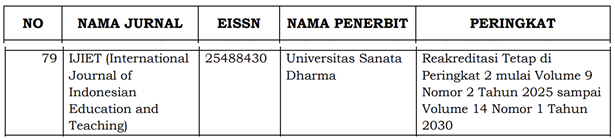
We would like to inform you that IJIET (International Journal of Indonesian Education and Teaching):has been nationally re-accredited Sinta 2 by the Ministry of Higher Education, Science and Technology of the Republic of Indonesia based on the decree No. Surat Keputusan 355/DST/D.D1/HM.01.01/2026. Validity for 5 years: Vol 9 No 2, 2025 until Vol 14 No 1, 2030.
The new certificate is to upload when it is available. Thank you

IJIET Sinta 2 Certificate (please click here)

This work is licensed under CC BY-SA.
This work is licensed under a Creative Commons Attribution-ShareAlike 4.0 International License.

IJIET DOI: https://doi.org/10.24071/ijiet
p-ISSN: 2548-8422 (since 5 January 2017); e-ISSN: 2548-8430 (since 5 January 2017)
IJIET (International Journal of Indonesian Education and Teaching) is published twice a year, namely in January and July, by the Faculty of Teacher Training and Education of Sanata Dharma University, Yogyakarta, Indonesia.