


 Email this article
 CONVERSATIONAL IMPLICATURE BETWEEN AN ENGLISH TEACHER AND STUDENTS
(1) Tanjungpura University, Indonesia
(2) Tanjungpura University, Indonesia
(3) Tanjungpura University, Indonesia
(*) Corresponding Author
Abstract
This study analyzed the conversational implicatures in the conversation between the English teacher and the students during an English class session in one of the classrooms at SMP Negeri 9 Pontianak. The purposes of this study were to identify the types of conversational implicatures used by the English teacher and the students, and also to describe the implied meaning of the conversational implicatures used by the English teacher and the students during one English class session in the classroom. This study focused on analyzing the conversation using Paul Grice’s theory of conversational implicature. The results of this study demonstrated the usage of two different types of conversational implicature by both the teacher and the students: generalized and particularized. The analysis also demonstrated that the implied meanings derived from these conversational implicatures conveyed a variety of communicative purposes beyond the literal meaning of the words spoken. These included informing, requesting, ordering, confirming, and expressing ignorance.
Keywords
Full Text:
PDFReferences
Alsalloom, F. A. (2022). The effectiveness of consciousness-raising approach in interpreting conversational implicature using audiovisual input. Journal of Second Language Acquisition and Teaching, 28, 55–95. https://doi.org/10.2458/jslat.5259
Creswell, J. W., & Creswell, J. D. (2023). Research design: Qualitative, quantitative, and mixed methods approaches (6th ed.). Thausand Oaks, CA: SAGE Publication, Inc.
Cristina, V., & Afriana, A. (2021). The functions of conversational implicature in tv show “F.R.I.E.N.D.S”: Pragmatics approach. Journal BASIS, 8(1), 75–84. https://doi.org/10.33884/basisupb.v8i1.2935
Darweesh, S. M. A., & Al-Khanji, R. R. (2024). Conversational implicatures in medical discourse: An analysis of doctor-patient dialogues in amman, Jordan. Theory and Practice in Language Studies, 14(7), 2203–2210. https://doi.org/10.17507/tpls.1407.28
Elmahady, O. R. M., Subaiah, S., & Mohammed, S. B. A. (2022). Investigating the importance of conversational implicature and violation of maxims in daily conversations. Arab World English Journal, 13(2), 109–122. https://doi.org/10.24093/awej/vol13no2.8
Grice, H. . (1975). Logic and conversation. In P. Cole & J. L. Morgan (Eds.), Syntax and semantics 3: Speech arts (pp. 41–58). New York: Academic Press.
Huang, Y. (2017). Implicature. In Y. Huang (Ed.), The oxford handbook of pragmatics (pp. 155–179). New York: Oxford University Press.
Jiang, X., & Yu, L. (2023). Pragmatics online, kate scott. routledge: New york (2022), ix+168pp. Journal of Contemporary Language Research, 2(1), 68–71. https://doi.org/10.58803/jclr.2023.385313.1006
Kroeger, P. R. (2022). Analyzing meaning: An introduction to semantics and pragmatics (3rd ed.). Berlin: Language Science Press. https://doi.org/10.5281/zenodo.6855854
Legiansyah, G., & Supri, I. Z. (2020). Investigating implicature in illocutionary acts employed by museum guide and English speaking tourists. English Journal Literacy Utama, 4(2), 208–217. https://doi.org/10.33197/ejlutama.vol4.iss2.2020.416
Lei, W. (2022). A study of conversational implicature in Lady Chatterley ’ s lover from the perspective of cooperative principle. Academic Journal of Humanities & Social Sciences, 5(5), 83–90. https://doi.org/10.25236/AJHSS.2022.050513
Lesmana, A. H. P. (2022). Implicature analysis of Abdur’s stand up comedy on Kompas TV. Research on Applied Linguistics and Literature, 1(2), 44–50.
Li, S. (2021). Conversational implicature instruction as a pedagogical strategy for English majors in a Chinese context: A pragmatic-analysis of its effectiveness. Theory and Practice in Language Studies, 11(10), 1279–1287. https://doi.org/10.17507/tpls.1110.16
Luo, Y. (2016). Context and its significance to pragmatics. International Journal of Humanities and Social Science Invention, 5(8), 17–21.
Mahmud, M. (2017). Doing discourse analysis: An introduction. Yogyakarta: Phoenix Publisher.
Mappaita, S. P. (2022). The implication of conversational implicature used by teachers in offline classroom interaction. BATARA DIDI: English Language Journal, 1(2), 78–89. https://doi.org/10.56209/badi.v1i2.47
Nassar, H. M. A., & Al-Ghrafy, A. M. G. (2020). The understandable English conversational implicatures by Yemeni EFL. International Journal of Language and Literary Studies, 2(1), 65–80. https://doi.org/10.36892/ijlls.v1i3.71
Ramdan, A. H. (2020). Implicature of the utterances at court: A pragmatics study. English Journal Literacy Utama, 4(1), 186–192. https://doi.org/10.33197/ejlutama.vol4.iss1.2020.390
Sidnell, J. (2013). Basic conversation analytic methods. In J. Sidnell & T. Stivers (Eds.), The handbook of conversation analysis (pp. 77–100). Chichester, UK: Blackwell Publishng Ltd.
Sofyan, A., Yudistira, R., Muta’allim, M., Alfani, F. R., & Ghaffar, A. A. (2022). The analysis of conversational implicature between students and teachers at Al-Azhar Islamic boarding school. RETORIKA: Jurnal Ilmu Bahasa, 8(1), 65–72. https://doi.org/10.55637/jr.8.1.4042.65-72
Ye, Y. (2022). Interpretation of conversational implicature in the film green book from the perspective of the cooperative principle. Theory and Practice in Language Studies, 12(5), 943–947. https://doi.org/10.17507/tpls.1205.15
Yokossi, D. T., Datondji, A. C., & Koutchadé, I. S. (2022). A pragmatic study of generalized and particularized implicatures in “the arrangers of marriage” from adichie’s the thing around your neck. International Journal of English Language and Linguistics Research, 10(4), 1-18. https://doi.org/10.37745/ijellr.13/vol10n4118
Yule, G. (1996). Pragmatics. Oxford: Oxford University Press.
Yulianti, S., Arafah, B., Rofikah, U., Idris, A. M. S., Samsur, N., & Arafah, A. N. B. (2022). Conversational implicatures on Saturday Night Live talk show. Journal of Language Teaching and Research, 13(1), 189–197. https://doi.org/10.17507/JLTR.1301.22
DOI: https://doi.org/10.24071/uc.v6i1.9629
Refbacks
- There are currently no refbacks.
Copyright (c) 2025 Muhammad Reza

This work is licensed under a Creative Commons Attribution-ShareAlike 4.0 International License.
UC Journal is indexed in:







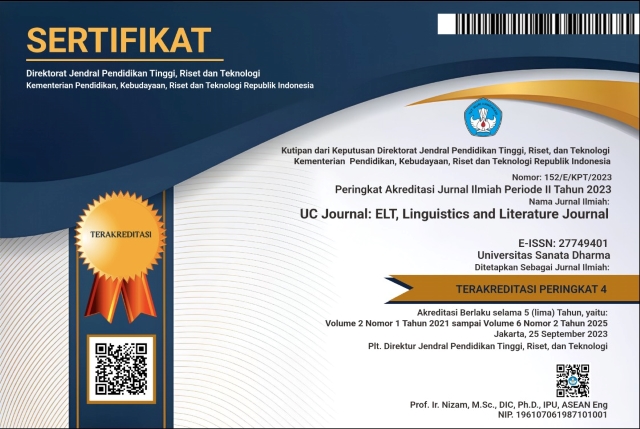
UC Journal Sinta 4 Certificate (S4 = Level 4)
We would like to inform you that UC Journal: ELT, Linguistics and Literature Journal, or UC Journal has been nationally accredited Sinta 4 by the Ministry of Education, Culture, Research and Technology of the Republic of Indonesia based on the decree No. Surat Keputusan 152/E/KPT/2023. Validity for 5 years: Vol 2 No 1, 2021 till Vol 6 No 2, 2025
DOI: https://doi.org/10.24071/uc
e-ISSN (validity starting Vol 1, No 2, November 2020): 2774-9401

This work is licensed under CC BY-SA.
Creative Commons Attribution-ShareAlike 4.0 International License
 UC Journal: ELT, Linguistics and Literature Journal, a scientific peer-reviewed journal, was established in 20 May 2020 and is published twice a year, namely in May and November, by the English Language Education Study Programme (S1/Sarjana PBI) in collaboration with the English Education Master's Programme (S2/Magister PBI) of Sanata Dharma University, Yogyakarta, Indonesia.