







 Email this article
INVESTIGATING THE LEARNING CONDITIONS IN THE ONLINE-BASED TEACHER-LEARNING COMMUNITIES IN INDONESIA
(1) Universitas Negeri Makassar, Indonesia
(2) Universitas Negeri Makassar, Indonesia
(3) Universitas Negeri Makassar, Indonesia
(4) Universitas Negeri Makassar, Indonesia
(*) Corresponding Author
Abstract
Keywords
Full Text:
PDFReferences
Abakah, E., Widin, J., & Ameyaw, E. K. (2022). Continuing professional development (CPD) practices among basic school teachers in the central region of Ghana. SAGE Open, 12(2), 215824402210945. https://doi.org/10.1177/21582440221094597
AITSL, A. (2014). Designing professional learning. Melbourne: The Australian Institute for Teaching and School Leadership (AITSL).
Coutinho, C. P., & Lisbôa, E. S. (2013). Social networks as spaces for informal teacher professional development: Challenges and opportunities. International Journal of Web Based Communities, 9(2), 199–211. https://doi.org/10.1504/IJWBC.2013.053244
Creswell, J. W., & Creswell, J. D. (2018). Research and design qualitative, quantitative and mixed methods approaches (5th ed.). Thousand Oaks, CA: Sage Publication, Inc.
Darling-Hammond, L., Hyler, M. E., & Gardner, M. (2017). Effective teacher professional development (research brief). Palo Alto, CA: Learning Policy Institute. https://doi.org/10.54300/122.311
Degeng, N. S., & Degeng, P. D. D. (2018). Ilmu pembelajaran (2nd ed.). Yogyakarta: Taman Pustaka Kristen Indonesia.
Desimone, L. M. (2009). Improving impact studies of teachers’ professional development: Toward better conceptualizations and measures. Educational Researcher, 38(3), 181–199. https://doi.org/10.3102/0013189X08331140
Fernandez, E. M. R., Rodriguez, G. D., Jimenez, J. S., & P.Pasco, F. (2022). Perceptions of public secondary school teachers on continuing professional development towards an intervention program. International Journal of Novel Research in Education and Learning, 9(2), 90-118. https://doi.org/10.5281/ZENODO.6496890
Fogarty, R., & Pete, B. (2010). Professional learning 101: A syllabus of seven protocols. Phi Delta Kappa, 91(4), 32–34. https://doi.org/10.1177/003172171009100407
Forde, C., & McMahon, M. (2019). Teacher quality, professional learning and policy. Teacher Quality, Professional Learning and Policy, 139–166. London: Palgrave Macmillan. https://doi.org/10.1057/978-1-137-53654-9
Isandespha, I. N. (2022). Facebook groups for effective online teacher professional development. Proceeding of ICE 2022, 1, 1–7.
Knowles, M. S., Holton, E. F., & Swanson, R. A. (2015). The adult learner: The definitive classic in adult education and human resource development (8th ed.). Oxon: Routledge.
Li, R., Liu, H., Chen, Y., & Yao, M. (2022). Teacher engagement and self-efficacy: The mediating role of continuing professional development and moderating role of teaching experience. Current Psychology, 41(1), 328–337. https://doi.org/10.1007/s12144-019-00575-5
Liljekvist, Y., Bommel, J. van, & Olin-Scheller, C. (2017). Professional learning communities in a web 2.0 world: Rethinking the conditions for professional development. In I. H. Amzat & N. P. Valdez (Eds.), Teacher empowerment toward professional development and practices (pp. 269–280). Singapore: Springer Nature Singapore Pte Ltd. https://doi.org/DOI 10.1007/978-981-10-4151-8_18
Lincoln, Y. S., & Guba, E. G. (1985). Naturalistic inquiry. Thousand Oaks, CA: SAGE. http://dx.doi.org/10.1016/0147-1767(85)90062-8
Macià, M., & García, I. (2016). Informal online communities and networks as a source of teacher professional development: A review. Teaching and Teacher Education, 55, 291–307. https://doi.org/10.1016/j.tate.2016.01.021
Patahuddin, S. M., & Logan, T. (2019). Facebook as a mechanism for informal teacher professional learning in Indonesia. Teacher Development, 23(1), 101–120. https://doi.org/10.1080/13664530.2018.1524787
Prestridge, S. (2018). Categorising teachers’ use of social media for
their professional learning: A self-generating professional learning paradigm. Computers & Education, 129, 143–158. https://doi.org/10.1016/j.compedu.2018.11.003
Reigeluth, C. M., & Merrill, M. D. (1979). Classes of instructional variables. Educational Technology, 19(3), 5–24.
Salmons, J. (2022). Using social media in data collection: Designing studies with the qualitative e-research framework. In L. Sloan & A. Quan-Haase (Eds.), The SAGE handbook of social media research methods (2nd ed.). SAGE reference.
Sari, E., & Lim, C. P. (2012a). Design-based research: Understanding its application in a teacher professional development study in Indonesia. Asia-Pacific Education Researcher, 21(1), 28–38.
Sari, E., & Lim, C. P. (2012b). Online learning community: Building the professional capacity of Indonesian teachers. Educational Stages and Interactive Learning: From Kindergarten to Workplace Training, 451–467. https://doi.org/10.4018/978-1-4666-0137-6.ch024
Sari, E., Pagram, J., & Newhouse, C. (2012). Go online and have a chat with your colleagues: A new image of teacher professional learning in Indonesia. ACEC2012: ITs Time Conference, 1–8.
Sari, E. R. (2012). Online learning community: A case study of teacher professional development in Indonesia. Intercultural Education, 23(1), 63–72. https://doi.org/10.1080/14675986.2012.664755
Scutt, C., & Harrison, S. (2019). Teacher CPD: International trends, opportunities and challenges. London, UK: Chartered College of Teaching.
Sumaryanta, S., Mardapi, D., Sugiman, S., & Herawan, T. (2019). Community-based teacher training: Transformation of sustainable teacher empowerment strategy in Indonesia. Journal of Teacher Education for Sustainability, 21(1), 2019. 48-66. https://doi.org/10.2478/jtes-2019-0004
Tahimash, S. G., Khany, R., & Shoja, L. (2024). Evaluation of English language teacher professional development programs in an EFL context: A mixed method study. Journal of English Language Teaching and Learning, Online First. https://doi.org/10.22034/elt.2024.58933.2578
Trust, T. (2017). Using cultural historical activity theory to examine how teachers seek and share knowledge in a peer-to-peer professional development network. Australasian Journal of Educational Technology, 33(1), 98–113. https://doi.org/10.14742/ajet.2593
Trust, T., Krutka, D. G., & Carpenter, J. P. (2016). “Together we are better”: Professional learning networks for teachers. Computers and Education, 102, 15–34. http://dx.doi.org/10.1016/j.compedu.2016.06.007
DOI: https://doi.org/10.24071/ijiet.v10i1.9527
Refbacks
- There are currently no refbacks.
Copyright (c) 2026 Wawan Krismanto, Abdul Halik, Yonathan S. Pasinggi, Ritha Tuken

This work is licensed under a Creative Commons Attribution-ShareAlike 4.0 International License.
Indexed and abstracted in:








IJIET Sinta 2 Certificate (S2 = Level 2)
We would like to inform you that IJIET (International Journal of Indonesian Education and Teaching):has been nationally accredited Sinta 2 by the Ministry of Education, Culture, Research and Technology of the Republic of Indonesia based on the decree No. Surat Keputusan 158/E/KPT/2021. Validity for 5 years: Vol 5 No 2, 2021 until Vol 10 No 1, 2026.
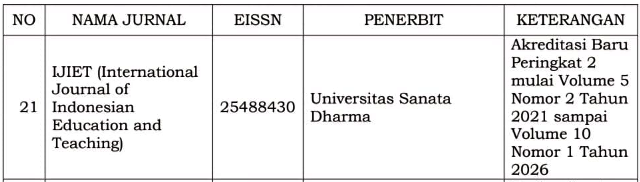

IJIET Sinta 2 Certificate (please click here)

This work is licensed under CC BY-SA.
This work is licensed under a Creative Commons Attribution-ShareAlike 4.0 International License.

IJIET DOI: https://doi.org/10.24071/ijiet
p-ISSN: 2548-8422 (since 5 January 2017); e-ISSN: 2548-8430 (since 5 January 2017)
IJIET (International Journal of Indonesian Education and Teaching) is published twice a year, namely in January and July, by the Institute for Research and Community Services of Sanata Dharma University, Yogyakarta, Indonesia.