



 Email this article

CRITICAL DISCOURSE ANALYSIS ON STUDENT PARTICIPATION IN BILINGUAL MATHEMATICS LEARNING
(1) Jember Islamic University, Indonesia
(2) Jember Islamic University, Indonesia
(3) Jember Islamic University, Indonesia
(4) Jember Islamic University, Indonesia
(5) Jember Islamic University, Indonesia
(*) Corresponding Author
Abstract
This research applied Critical Discourse Analysis to investigate how students engage in bilingual mathematics classes at two Islamic boarding schools (pesantrens) in Jember. It aimed to understand how language is used by both students and teachers throughout the learning process and the ways it impacts student involvement. Data were gathered through classroom observations, audio recordings, and field notes. The Initiation-Response-Follow-up (IRF) model was used for analysis. The study revealed that students' ability to participate is closely tied to their confidence in speaking English and the encouragement they receive from teachers. These insights underscored the need for inclusive communication methods and psychological support to boost participation in bilingual classrooms. The research also offered a deeper look at how language functions in educational settings and what that meant for teaching practices in bilingual environments. Ultimately, the findings can help shape more effective teaching strategies within bilingual education, particularly in pesantrens, leading to improved learning experiences and greater student engagement.
Keywords
Full Text:
PDFReferences
Barnes, D. (1992). From communication to curriculum (2nd ed.). Portsmouth : Heinemann.
Chevalier, M. (2020). Fostering computational thinking through educational robotics: A model for creative computational problem solving. International Journal of STEM Education, 7(1), 39. https://doi.org/10.1186/s40594-020-00238-z
Creswell, J. W. (2010). Research design pendekatan kualitatif, kuantitatif, dan mixed. Yogyakarta: Pustaka Pelajar.
Crilly, N. (2021). The evolution of “co-evolution” (Part I): Problem solving, problem finding, and their interaction in design and other creative practices. She Ji, 7(3), 309–332. https://doi.org/10.1016/j.sheji.2021.07.003
Crismono, P. C. (2023). Statistik pendidikan: Untuk penelitian dengan pendekatan kuantitatif baik parametric maupun nonparametrik dan dilengkapi dengan penggunaan SPSS. Jember: UIJ Kyai Mojo.
Das, S., Dewhurst, Y., & Gray, D. (2011). A teacher’s repertoire: developing creative pedagogies. International Journal of Education & the Arts, 12(15), 1–39.
Dewi, G. A. C. (2019). The needs analysis on module development based on creative problem solving method to improve students’ problem solving ability. Journal of Physics: Conference Series, 1153(1). https://doi.org/10.1088/1742-6596/1153/1/012129
Djamarah, S. B., & Zain, A. (2002). Strategi belajar mengajar. Jakarta: Rineka Cipta.
Fairclough, N. (2013). Critical discourse analysis: The critical stady of language (2nd ed.). London: Routledge. https://doi.org/10.4324/9781315834368
Fffimore, L. W., & Snow, C. E. (2000). What teachers need to know about language University of California at Berkeley.
Firdaus, A., Zaenuri, Asih, & Noor, T. S. (2023). Analisis kemampuan literasi matematis ditinjau dari self confidence peserta didik pada pembelajaran PBL bernuansa etnomatematika. AKSIOMA: Jurnal Program Studi Pendidikan Matematika, 12(2), 2338-2350. https://doi.org/10.24127/ajpm.v12i2.7531
Goh, C. C. M., & Doyle, P. G. (2021). How do speaking and writing support each other? Language in Education, 105–124. https://doi.org/10.5040/9781350284890.ch-006
Hidayat, T., Darhim, D., & Herman, T. (2023). Kemampuan komunikasi matematis dan kemandirian belajar siswa dalam pembelajaran matematika. AKSIOMA: Jurnal Program Studi Pendidikan Matematika, 12(2), 1812-1826. https://doi.org/10.24127/ajpm.v12i2.6628
Julita, J. (2020). Mathematical Strategic thinking ability using quantum learning based on creative problem solving in terms of high school students gender. Journal of Physics: Conference Series, 1477(4). https://doi.org/10.1088/1742-6596/1477/4/042045
Leona, N. L., van Koert, M. J. H., van der Molen, M. W., Rispens, J. E., Tijms, J., & Snellings, P. (2021). Explaining individual differences in young English language learners’ vocabulary knowledge: The role of extramural English exposure and motivation. System, 96, 102402. https://doi.org/10.1016/j.system.2020.102402
Lorusso, L. (2021). Design thinking for healthcare: Transliterating the creative problem-solving method into architectural practice. Health Environments Research and Design Journal, 14(2), 16–29. https://doi.org/10.1177/1937586721994228
Maker, C. J. (2020). Identifying exceptional talent in science, technology, engineering, and mathematics: increasing diversity and assessing creative problem-solving. Journal of Advanced Academics, 31(3), 161–210. https://doi.org/10.1177/1932202X20918203
Mercer, N. (2002). Developing dialogues. In G. Wells & G. Claxton (Eds.), Learning for life in 21st century: Sociocultural perspectives on the future of education. Oxford: Blackwell. http://dx.doi.org/10.1002/9780470753545.ch11.
Mercer, N., Warwick, P., Kershner, R., & Staarman, J. K. (2010). Can the interactive whiteboard help to provide “dialogic space” for children’s collaborative activity? Language and Education, 24(5), 367–384. https://doi.org/10.1080/09500781003642460
Moje, B. (2008). Foregrounding the disciplines in secondary literacy teaching and learning: A call for change. Journal of Adolescent & Adult Literacy, 52, 96–107. https://doi.org/10.1598/JAAL.52.2.1
Musfiqon. (2012). Pengembangan media dan sumber pembelajaran. Jakarta: PT Prestasi Pustakaraya.
Ramadania, F., Wulandari, N. I., & Nahlini, N. (2018). Peranan komunikasi bahasa dalam pembelajaran matematika pada siswa kelas V SDN Keraton 3 Martapura. Math Didactic: Jurnal Pendidikan Matematika, 3(1), 23–32. https://doi.org/10.33654/math.v3i1.52
Rubenstein, L. D. V. (2019). Students’ strategic planning and strategy use during creative problem solving: The importance of perspective-taking. Thinking Skills and Creativity, 34, 100556. https://doi.org/10.1016/j.tsc.2019.02.004
Shanahan, T., & Shanahan, C. (2008). Teaching disciplinary literacy to adolescents: Rethinking content-area literacy. Harvard Educational Review, 78(1), 40–59. https://doi.org/10.17763/haer.78.1.v62444321p602101
Silver R. E., & Raslinda A.R. (2014). How is language used for learning. London: Bloomsbury.
Silver R. E., & Lwin, S. M. (Eds.) (2014). Language in education: Social implications. London: Bloomsbury. https://doi.org/10.1080/00131911.2017.1312918
Sinclair, J. M., & Coulthard, M. (1975). Towards an analysis of discourse: The English used by teachers and pupils. Oxford: Oxford University Press.
Vygotsky, L. (1978). Mind in society: The development of higher psychological processes. Cambridge, MA: Harvard University Press. https://doi.org/https://doi.org/10.2307/j.ctvjf9vz4
Wodak, R., & Meyer, M. (2009). Methods of critical discourse analysis (2nd ed.). London: Sage.
DOI: https://doi.org/10.24071/ijiet.v9i2.9122
Refbacks
- There are currently no refbacks.
Copyright (c) 2025 Prima Cristi Crismono, Endah Nur Tjendani, Beby Dwi Febriyanti, Mely Agustin Reni Pitasari, Fitriyatul Hanifiyah

This work is licensed under a Creative Commons Attribution-ShareAlike 4.0 International License.
Indexed and abstracted in:






IJIET Sinta 2 Certificate (S2 = Level 2)
We would like to inform you that IJIET (International Journal of Indonesian Education and Teaching):has been nationally re-accredited Sinta 2 by the Ministry of Higher Education, Science and Technology of the Republic of Indonesia based on the decree No. Surat Keputusan 355/DST/D.D1/HM.01.01/2026. Validity for 5 years: Vol 9 No 2, 2025 until Vol 14 No 1, 2030.
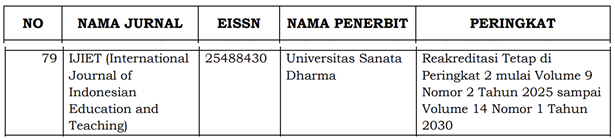
The new certificate is to upload when it is available. Thank you

IJIET Sinta 2 Certificate (please click here)

This work is licensed under CC BY-SA.
This work is licensed under a Creative Commons Attribution-ShareAlike 4.0 International License.

IJIET DOI: https://doi.org/10.24071/ijiet
p-ISSN: 2548-8422 (since 5 January 2017); e-ISSN: 2548-8430 (since 5 January 2017)
IJIET (International Journal of Indonesian Education and Teaching) is published twice a year, namely in January and July, by the Faculty of Teacher Training and Education of Sanata Dharma University, Yogyakarta, Indonesia.