




 Email this article

A DECADE (2014–2024) OF MTB-MLE IN THE PHILIPPINES: WHERE IT WORKED, WHERE IT STRUGGLED, AND WHAT COMES NEXT
(1) Benguet State University, Philippines
(2) Benguet State University, Philippines
(3) Benguet State University, Philippines
(4) Benguet State University, Philippines
(5) Benguet State University, Philippines
(6) Benguet State University, Philippines
(7) Benguet State University, Philippines
(8) Benguet State University, Philippines
(9) Benguet State University, Philippines
(10) Benguet State University, Philippines
(11) Benguet State University, Philippines
(12) Benguet State University, Philippines
(*) Corresponding Author
Abstract
Capturing a full decade of language program implementation offers a valuable opportunity to reflect on the evolution, strengths, and limitations of one of the country’s most transformative language-in-education reforms. With the introduction of Mother Tongue-Based Multilingual Education (MTB-MLE) under the Philippine K–12 Curriculum, interest has grown in assessing its accomplishments and ongoing challenges. Therefore, this study aims to review key developments in MTB-MLE implementation from 2014 to 2024. A systematic literature review (SLR) was conducted using peer-reviewed articles and Department of Education documents from academic databases and government archives. Following PRISMA guidelines, 14 documents were selected and analyzed thematically. Findings reveal that strong policy backing, language mapping, and teacher training improved early literacy and student engagement through first language (L1) instruction. However, challenges include limited teacher proficiency, lack of localized materials, policy–practice mismatches, and weak support for second language development. Besides, standardization pressures also clashed with the multilingual realities of classrooms. In conclusion, while MTB-MLE remains a promising reform, it has yet to fulfill its potential due to systemic constraints. Future efforts should adopt more flexible and linguistically responsive strategies, and if unrealized in basic education, MTB-MLE may find greater traction within higher education.
Keywords
Full Text:
PDFReferences
Alieto, E. (2018). Language shift from English to mother tongue: Exploring language attitude and willingness to teach among pre-service teachers. TESOL International Journal, 13(3), 134–146. https://animorepository.dlsu.edu.ph/faculty_research/4228
Besa, L. (2014). Language use in the university: A clash of policies. Procedia - Social and Behavioral Sciences, 134, 92–100. https://doi.org/10.1016/j.sbspro.2014.04.226
Clarke, V., & Braun, V. (2013). Teaching thematic analysis: Overcoming challenges and developing strategies for effective learning. The Psychologist, 26(2), 120–123. https://uwe-repository.worktribe.com/output/937596
De Guzman, W. G. L., & De Vera, P. V. (2018). English language performance and difficulties of pupils in the mother tongue-based (MTB) medium of instruction. Journal of English as an International Language, 13(2.2), 106–132. https://files.eric.ed.gov/fulltext/EJ1247323.pdf
De Lemios, R. (2023). From Tagalog to English: Pupils’ writing proficiency levels after three years in mother tongue‑based multilingual education. Journal of Community Development Research (Humanities and Social Sciences), 16(3), 115–133. https://doi.org/10.14456/jcdr-hs.2023.29
Department of Education. (1987). DepEd Order 52, s. 1987 – The 1987 policy on bilingual education. https://www.deped.gov.ph/1987/05/21/do-52-s-1987-the-1987-policy-on-bilingual-education/
Department of Education. (2009a). DO 72, s. 2009 – Inclusive education as strategy for increasing participation rate of children. https://www.deped.gov.ph/2009/07/06/do-72-s-2009-inclusive-education-as-strategy-for-increasing-participation-rate-of-children/
Department of Education. (2009b). DepEd order 74 s. 2009: Institutionalizing mother tongue-based multilingual education (MLE).
https://www.deped.gov.ph/wp-content/uploads/2018/10/DO_s2009_74.pdf
Department of Education. (2012). DepEd order No. 16, s. 2012: Guidelines on implementing the mother tongue-based multilingual education (mtb-mle). https://www.deped.gov.ph/wp-content/uploads/2012/02/DO_s2012_16.pdf
Department of Education. (2015). DO 55, s. 2015 – Utilization of language mapping data for mother tongue-based multilingual education (MTB-MLE) program implementation. https://www.deped.gov.ph/2015/12/08/do-55-s-2015-utilization-of-language-mapping-data-for-mother-tongue-based-multilingual-education-mtb-mle-program-implementation/
Department of Education. (2016). Mother tongue-based learning makes lessons more interactive and easier for students [Press release]. https://www.deped.gov.ph/2016/10/24/mother-tongue-based-learning-makes-lessonsmore-interactive-and-easier-for-students/
Harden, K., Punjabi, M., & Fernandez, M. (2022). Influences on teachers’ use of the prescribed language of instruction: Evidence from four language groups in the Philippines. Education Quarterly Reviews, 5(1), 516–530. https://ssrn.com/abstract=4067232
Kibiten. G. P. (2023, September 30). Steps and tips in doing quality literature review [Lecture Notes]. Saint Louis University.
Marquez, F., & Bandril, L. (2015). Development and validation of a wordlist translated from English to Filipino of academic-administrative terms: An attempt at formulating guidelines for policy making. Procedia - Social and Behavioral Sciences, 192, 327–338. https://doi.org/10.1016/j.sbspro.2015.06.047
Medilo, C. G. Jr. (2016). The experience of mother tongue-based multilingual education teachers in Southern Leyte, Philippines. International Forum Journal, 19(2), 64–79. https://journals.aiias.edu/info/article/view/98
Moher, D., Shamseer, L., Clarke, M., Ghersi, D., Liberati, A., Petticrew, M., Shekelle, P., & Stewart, L. A. (2015). Preferred reporting items for systematic review and meta-analysis protocols (PRISMA-P) 2015 statement. Systematic Reviews, 4(1). https://doi.org/10.1186/2046-4053-4-1
Nolasco, R. M. D. (2024). 21 reasons why Filipino children learn better while using their mother tongue. Asia Pacific Journal of Social Innovation, 21(2) 129–152. https://journals.msuiit.edu.ph/tmf/article/view/281
Page, M. J., McKenzie, J. E., Bossuyt, P. M., Boutron, I., Hoffmann, T. C., Mulrow, C. D., Shamseer, L., Tetzlaff, J. M., Akl, E. A., Brennan, S. E., Chou, R., Glanville, J., Grimshaw, J. M., Hróbjartsson, A., Lalu, M. M., Li, T., Loder, E. M., Mayo-Wilson, E., MacDonald, S., McGuinness, L. A., Stewart, L. A., Thomas, J., Tricco, A. C., Welch, V. A., Whiting, P., & Moher, D. (2021). The PRISMA 2020 statement: An updated guideline for reporting systematic reviews. BMJ, 372, 71. https://doi.org/10.1136/bmj.n71
Pelila, J. R. O. (2025). Kankanaey over time: A dyadic comparison of 1966 and 2023 translations. Journal of Language and Culture, 44(2), 1–16. https://so03.tci-thaijo.org/index.php/JLC/article/view/281640
Philippines. (2013). Republic Act 10533: Enhanced Basic Education Act of 2013. Official Gazette. https://www.officialgazette.gov.ph/2013/05/15/republic-act-no-10533/
Pugong, A. J. C., Pelila, J. R. O., Moling, M. E. P., Dolo, J. T., & Usman, N. A. (2024). A scoping review of language programs and policies in ASEAN countries. Indonesian Journal of Research and Educational Review, 3(2), 82–102. https://doi.org/10.51574/ijrer.v3i2.1181
Rosero, M. W. I. (2022). Assessing the usability of the draft Minasbate working orthography vis-à-vis An Maayo na Barita Hali sa Dios and the actual usage of Masbatenyo K to 3 teachers. The Archive, 3(1–2), 82–102. https://journals.upd.edu.ph/index.php/archive/article/view/9334/8248
Sanchez, G. G., Tomas, C. L., & Pe, S. N. (2023). Mother tongue–based multilingual education: The case of Cervantes District. Journal of Humanities and Social Sciences Studies, 5(4), 87–99. https://doi.org/10.32996/jhsss.2023.5.4.12
Wakat, G. S., Paulino, F. B., Cagaoan, S. T., & Ulla, M. B. (2023). Of tongues and ties: Surfacing inclusive strategies in linguistically diverse classrooms. Cogent Education, 10(2), Article 2268462. https://doi.org/10.1080/2331186X.2023.2268462
DOI: https://doi.org/10.24071/ijiet.v9i2.8861
Refbacks
- There are currently no refbacks.
Copyright (c) 2025 Micah P. Lawangen, John Rey O. Pelila, Mary Grace M. Itorma, Mica C. Ago, Charlene M. Nacod-am, John Rey N. Macasieb, Ledy S. Garcia, Jessie James S. Alawas, Liza G. Libalib, Gail P. Bansan, Emily J. Buyay, Eurelle Joyce W. Osting

This work is licensed under a Creative Commons Attribution-ShareAlike 4.0 International License.
Indexed and abstracted in:





IJIET Sinta 2 Certificate (S2 = Level 2)
We would like to inform you that IJIET (International Journal of Indonesian Education and Teaching):has been nationally re-accredited Sinta 2 by the Ministry of Higher Education, Science and Technology of the Republic of Indonesia based on the decree No. Surat Keputusan 355/DST/D.D1/HM.01.01/2026. Validity for 5 years: Vol 9 No 2, 2025 until Vol 14 No 1, 2030.
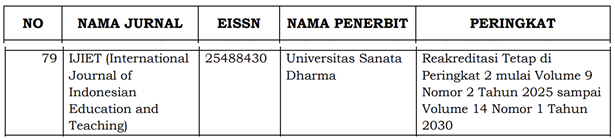
The new certificate is to upload when it is available. Thank you

IJIET Sinta 2 Certificate (please click here)

This work is licensed under CC BY-SA.
This work is licensed under a Creative Commons Attribution-ShareAlike 4.0 International License.

IJIET DOI: https://doi.org/10.24071/ijiet
p-ISSN: 2548-8422 (since 5 January 2017); e-ISSN: 2548-8430 (since 5 January 2017)
IJIET (International Journal of Indonesian Education and Teaching) is published twice a year, namely in January and July, by the Faculty of Teacher Training and Education of Sanata Dharma University, Yogyakarta, Indonesia.