





 Email this article
GAME-CHANGING LEARNING: HOW DIGITAL GAMES BOOST LEARNING ENGAGEMENT
(1) Universitas Sembilanbelas November Kolaka, Indonesia
(2) Universitas Sembilanbelas November Kolaka, Indonesia
(3) Universitas Sembilanbelas November Kolaka, Indonesia
(*) Corresponding Author
Abstract
The research examines how Digital Game-Based Learning (DGBL) offers some advantages for secondary school students’ Engagement in the EFL classroom in Indonesia. It also investigates some drawbacks encountered during DGBL implementation and provides refutations to disprove the counterarguments. The methodology undertaken is a synthesis research methodology. Relevant literature was obtained through peer-reviewed articles from reliable journals such as Google Scholar, ERIC, ProQuest Education Journal, and other relevant sources. The findings further reveal that teaching EFL classrooms under the framework of DGBL benefits students in three ways. Firstly, digital games can engage students’ emotions in the learning process by promoting a psychological state that is commonly known as a flow condition. It refers to playing a digital game with fun, interest, and deep concentration. Secondly, DGBL can engage students’ cognition by providing problem-solving activities that help students think critically to decipher the challenges of the games. Lastly, DGBL can also promote behavioral engagement by situating students in cooperative learning activities, which, with guidance from teachers, encourage students to participate collaboratively as a team during the gameplay. In this study, the investigation only focuses on which aspects of DGBL can significantly leverage students’ engagement in the EFL learning classroom. Therefore, further analysis is required to examine how DGBL can be an effective instructional strategy to meet the English standard competencies in the Indonesian national curriculum.
Keywords
Full Text:
PDFReferences
Anderson, T. A., Reynolds, B. L., Yeh, X.-P., & Huang, G.-Z. (2008). Video games in the English as a foreign language classroom. 2008 Second IEEE International Conference on Digital Game and Intelligent Toy Enhanced Learning, 188-192. https://doi.org/10.1109/DIGITEL.2008.39
Bado, N., & Franklin, T. (2014). Cooperative game-based learning in the English as a foreign language classroom. Issues and Trends in Educational Technology, 2(2). https://doi.org/10.2458/azu_itet_v2i2_bado
Barzilai, S., & Blau, I. (2014). Scaffolding game-based learning: Impact on learning achievements, perceived learning, and game experiences. Computers & Education, 70, 65-79. http://dx.doi.org/10.1016/j.compedu.2013.08.003
Blume, C. (2019). Games people (don’t) play: An analysis of pre-service EFL teachers’ behaviors and beliefs regarding digital game-based language learning. Computer Assisted Language Learning, 33(1–2), 109–132. https://doi.org/10.1080/09588221.2018.1552599
Chu, S. T., Hwang, G. J., Chien, S. Y., & Chang, S. C. (2023). Incorporating teacher intelligence into digital games: An expert system‐guided self‐regulated learning approach to promoting EFL students' performance in digital gaming contexts. British Journal of Educational Technology, 54(2), 534-553. https://doi.org/10.1111/bjet.13260
Csikszentmihalyi, M. (1997). Finding flow: The psychology of engagement with everyday life. New York: Basic Books.
Hamari, J., Shernoff, D. J., Rowe, E., Coller, B., Asbell-Clarke, J., & Edwards, T. (2016). Challenging games help students learn: An empirical study on engagement, flow and immersion in game-based learning. Computers in Human Behavior, 54, 170-179. http://dx.doi.org/10.1016/j.chb.2015.07.045
Hanafiah, W., Aswad, M., Sahib, H., Yassi, A. H., & Mousavi, M. S. (2022). The impact of CALL on vocabulary learning, speaking skill, and foreign language speaking anxiety: The case study of Indonesian EFL learners. Education Research International, 2022(1), 5500077. https://doi.org/10.1155/2022/5500077
Jabbar, A. I. A., & Felicia, P. (2016). Towards a conceptual framework of GBL design for engagement and learning of curriculum-based content. International Journal of Game-Based Learning, 6(4), 87-108. https://doi.org/10.4018/IJGBL.2016100106
Jong, B.-S., Lai, C.-H., Hsia, Y.-T., Lin, T.-W., & Lu, C.-Y. (2013). Using game-based cooperative learning to improve learning motivation: A study of online game use in an operating systems course. IEEE Transactions on Education, 56(2), 183-190. https://doi.org/10.1109/TE.2012.2207959
Li, R., Meng, Z., Tian, M., Zhang, Z., & Xiao, W. (2021). Modelling Chinese EFL learners’ flow experiences in digital game-based vocabulary learning: The roles of learner and contextual factors. Computer Assisted Language Learning, 34(4), 483-505. http://dx.doi.org/10.1080/09588221.2019.1619585
Lin, C. J., Hwang, G. J., Fu, Q. K., & Cao, Y. H. (2020). Facilitating EFL students’ English grammar learning performance and behaviors: A contextual gaming approach. Computers & Education, 152, 103876. https://doi.org/10.1016/j.compedu.2020.103876
Mahayanti, N. W. S., Kusuma, I. P. I., & Wibawa, S. (2020). Digital game–based learning in EFL: Its effect on young learners’ self-regulated learning. The Asian ESP Journal, 5, 5-30.
Mattarima, K., & Hamdan, A. R. (2011). The teaching constraints of English as a foreign language in Indonesia: The context of school based curriculum. Sosiohumanika, 4(2), 288-300. https://doi.org/10.2121/sosiohumanika.v4i2.452
Moreno, R. (2004). Decreasing cognitive load for novice students: Effects of explanatory versus corrective feedback in discovery-based multimedia. Instructional Science, 32(1), 99-113. https://doi.org/10.1023/B:TRUC.0000021811.66966.1d
Nasir, A., Yawan, H., & Saifullah, S. (2023). A comparative study: Similarities and differences between Indonesia’s Curriculum and Philippine’s curriculum. International Journal of Education, Social Studies, and Management (IJESSM), 2(3), 64–75. https://doi.org/10.52121/ijessm.v2i3.121
Oxford, R. L. (1997). Cooperative learning, collaborative learning, and interaction: Three communicative strands in the language classroom. The Modern Language Journal, 81(4), 443-456. https://doi.org/10.1111/j.1540-4781.1997.tb05510.x
Pavlas, D. (2010). A model of flow and play in game-based learning: The impact of game characteristics, player traits, and player states (Doctoral dissertation, University of Central Florida). University of Central Florida. http://purl.fcla.edu/fcla/etd/CFE0003425
Peterson, M., White, J., Mirzaei, M. S., & Wang, Q. (2022). A review of research on the application of digital games in foreign language education. Research Anthology on Developments in Gamification and Game-Based Learning, 1948-1971.
Prensky, M. (2001). Digital natives, digital immigrants part 1. On the horizon, 9(5), 1-6. https://doi.org/10.1108/10748120110424816
Sardone, N. B., & Devlin-Scherer, R. (2010). Digital games for English classrooms. Teaching English with Technology, 10(1), 35-50.
Slavin, R. E. (1990). Point-counterpoint: Ability grouping, cooperative learning and the gifted. Journal for the Education of the Gifted, 14(1), 3-8. https://doi.org/10.1177/016235329001400102
Suriaman, S., Ramly, A., Rachman, F., Sukmawati, S., Yawan, H., & Haris, I. N. (2022). Model blended learning: Cross-sectional efektivitas di masa post-pandemi Covid-19. Jurnal Kewarganegaraan, 6(2), 3248-3260. https://journal.upy.ac.id/index.php/pkn/article/view/3321/pdf
Tham, R., & Tham, L. (2014). The effectiveness of game-based learning as an instructional strategy to engage students in higher education in Singapore. International Journal on E-Learning, 13(4), 483-496. https://www.learntechlib.org/p/40444/.
Trowler, V. (2010). Student engagement literature review. The higher education academy, 11, 1-15.
Wang, H., Shen, C., & Ritterfeld, U. (2009). Enjoyment of digital games: What makes them "seriously" fun? In U. Ritterfeld, M. Cody, & P. Vorderer (Eds.), Serious games: Mechanisms and effects (pp. 25–44). London: Routledge.
Yang, Y. F., Goh, A. P. I., Hong, Y. C., & Chen, N. S. (2021). Primary school students’ foreign language anxiety in collaborative and individual digital game-based learning. Computer Assisted Language Learning, 36(8), 1587–1607. https://doi.org/10.1080/09588221.2021.2008979
Yawan, H. (2022). Augmented reality application: Current status, opportunities, and challenges of Indonesian secondary education context. Edutec, 5(3), 652-663. https://doi.org/10.29062/edu.v5i3.327
Yip, F. W. M., & Kwan, A. C. M. (2006). Online vocabulary games as a tool for teaching and learning English vocabulary. Educational Media International, 43(3), 233–249. https://doi.org/10.1080/09523980600641445DOI: https://doi.org/10.24071/ijiet.v9i2.8622
Refbacks
- There are currently no refbacks.
Copyright (c) 2025 Hendri Yawan, Marhamah Marhamah, Hariadi Syam

This work is licensed under a Creative Commons Attribution-ShareAlike 4.0 International License.
Indexed and abstracted in:








IJIET Sinta 2 Certificate (S2 = Level 2)
We would like to inform you that IJIET (International Journal of Indonesian Education and Teaching):has been nationally re-accredited Sinta 2 by the Ministry of Higher Education, Science and Technology of the Republic of Indonesia based on the decree No. Surat Keputusan 355/DST/D.D1/HM.01.01/2026. Validity for 5 years: Vol 9 No 2, 2025 until Vol 14 No 1, 2030.
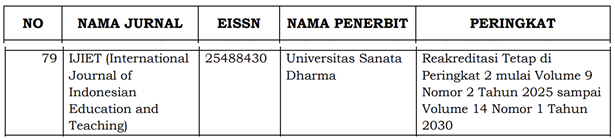
The new certificate is to upload when it is available. Thank you

IJIET Sinta 2 Certificate (please click here)

This work is licensed under CC BY-SA.
This work is licensed under a Creative Commons Attribution-ShareAlike 4.0 International License.

IJIET DOI: https://doi.org/10.24071/ijiet
p-ISSN: 2548-8422 (since 5 January 2017); e-ISSN: 2548-8430 (since 5 January 2017)
IJIET (International Journal of Indonesian Education and Teaching) is published twice a year, namely in January and July, by the Faculty of Teacher Training and Education of Sanata Dharma University, Yogyakarta, Indonesia.