




 Email this article
HARMONIZING PEDAGOGY AND MANAGEMENT: AN INTEGRATED SONG-BASED MODEL FOR EARLY LITERACY IN A MULTILINGUAL CONTEXT
(1) Sekolah Tinggi Agama Kristen Protestan Negeri, Sentani, Papua, Indonesia
(2) Sekolah Tinggi Agama Kristen Protestan Negeri, Sentani, Papua, Indonesia
(3) Sekolah Tinggi Agama Kristen Protestan Negeri, Sentani, Papua, Indonesia
(*) Corresponding Author
Abstract
This study examines the issue of low proficiency in Indonesian among young children in Sentani, which is attributed to the dominance of local dialects and low self-confidence among the children. The primary objective of this study is to identify gaps in school operational management that are often overlooked in research on language literacy in early childhood. Specifically, this study analyses the strategic role of teachers as facilitators, language models, and motivators in song-based learning, as well as identifying managerial factors that support literacy success in multilingual areas. This qualitative study, which employs a single-case study design, was conducted at the Alethea Sentani Early Childhood Education Centre. Research participants included the headteacher, teachers, and pupils selected through purposive sampling. Data were collected through participant observation, in-depth interviews, and document analysis, and were subsequently analysed interactively using the model proposed by Miles, Huberman, and Saldaña, with verification through member checking. The research findings indicate that the success of language development is largely determined by the optimisation of teachers’ managerial roles and institutional support. This study validates the Integrated Song-Based Language Learning Management Model (ISBLLM) as a harmonious ecosystem that integrates pedagogical and managerial aspects to address literacy barriers in remote and multilingual areas.
Keywords
Full Text:
PDFReferences
Apriani, A., Sari, H. M., & Pebriani, E. (2025). Peran guru dalam mengembangkan rasa percaya diri anak melalui metode bernyanyi dengan gerakan. Jurnal Multidisiplin, 1(3), 141–150. https://doi.org/10.70963/jm.v1i3.159
Arifin, A. W. (2019). Peran guru terhadap aspek perkembangan bahasa anak usia dini. Jambura Early Childhood Education Journal, 1(2), 37-45. https://doi.org/10.37411/jecej.v1i2.57
Bautista, A., Yeung, J., McLaren, M. L., & Ilari, B. (2024). Music in early childhood teacher education: Raising awareness of a worrisome reality and proposing strategies to move forward. Arts Education Policy Review, 125(3), 139–149. https://doi.org/10.1080/10632913.2022.2043969
Behrens, H. (2021). Constructivist approaches to first language acquisition. Journal of Child Language, 48(5), 959–983. https://doi.org/10.1017/S0305000921000556
Budianto, S., Tobing, V., Brumadyadisty, G., Huda, N., & Budianto, S. P. (2024). The use of songs as a tool for language education in multilingual populations. Eralingua: Jurnal Pendidikan Bahasa Asing dan Sastra, 8(2), 332-350. https://doi.org/10.26858/eralingua.v8i2.59597
Creswell, J. W. (2019). Research design: Pendekatan metode kualitatif, kuantitatif dan campuran. Yogyakarta: Pustaka pelajar.
Cucu Atikah, N. D. A. (2025). Profesionalisme guru PAUD. Jurnal PAUD Agapedia, 9(1), 11–20.
Darling-Hammond, L. (2017). Teacher education around the world: What can we learn from international practice? European Journal of Teacher Education, 40(3), 291–309. https://doi.org/10.1080/02619768.2017.1315399
Denzin, N. K., Lincoln, Y. S., MacLure, M., Otterstad, A. M., Torrance, H., Cannella, G. S., Koro-Ljungberg, M., & McTier, T. (2017). Critical qualitative methodologies: Reconceptualizations and emergent construction. International Review of Qualitative Research, 10(4), 482–498. https://doi.org/10.1525/irqr.2017.10.4.482
Goddard, R. D., Hoy, W. K., & Woolfolk Hoy, A. (2000). Collective teacher efficacy: Its meaning, measure, and impact on student achievement. American Educational Research Journal, 37(2), 479–507. https://doi.org/10.3102/00028312037002479
Hallinger, P. (2018). Principal instructional leadership: From prescription to theory to practice. In G. E. Hall, L.F. Quinn, & D. M. Gollnick (Eds.), The Wiley handbook of teaching and learning (pp. 505–528). Hoboken, NJ: John Wiley & Sons, Inc. https://doi.org/10.1002/9781118955901.ch21
Heikkilä, M., & Lillvist, A. (2023). Multilingual educational teaching strategy in a multi-ethnic preschool. Intercultural Education, 34(5), 516–531. https://doi.org/10.1080/14675986.2023.2213657
Hu, R. (2025). Analysis of the development status and countermeasures of music education for special children in remote areas. International Journal of Educational Development, 1(1), 60–68. https://doi.org/10.63313/IJED.9009
Hulme, C., Snowling, M. J., West, G., Lervåg, A., & Melby-Lervåg, M. (2020). Children’s language skills can be improved: Lessons from psychological science for educational policy. Current Directions in Psychological Science, 29(4), 372–377. https://doi.org/10.1177/0963721420923684
Juita, D. P., Priya, P., Azwardi, M., & Amra, A. (2024). Pentingnya pengembangan sumber daya manusia pada lembaga pendidikan. Indo-MathEdu Intellectuals Journal, 5(3), 3068–3077. https://doi.org/10.54373/imeij.v5i3.1243
Khairani, A., Hakiki, N. I., & Yopan, M. (2025). Analisis faktor penyebab angka putus sekolah di tingkat SD dan SMP di Papua: Kajian studi pustaka berbasis teori struktural. JIIP - Jurnal Ilmiah Ilmu Pendidikan, 8(1), 45–51. https://doi.org/10.54371/jiip.v8i1.6510
Miles, M. B., Huberman, A. M., & Saldana, J. (2014). Qualitative data analysis. Thousand Oaks, CA: Sage Publications.
Mustakim, M. (2023). Peran guru dalam meningkatkan kemampuan berbahasa anak usia dini dengan metode bernyanyi di TK Yazida Nw Tangar. Realita : Jurnal Bimbingan Dan Konseling, 8(1), 1887-1896. https://doi.org/10.33394/realita.v8i1.7339
Ngadni, I., & Hui, W. Z. (2025). Exploring the challenges of implementing music in enhancing preschool children’s English language acquisition. International Journal of Academic Research in Progressive Education and Development, 14(2), 185–194. https://doi.org/10.6007/ijarped/v14-i2/25048
Oshchepkova, E., Bukhalenkova, D., Veraksa, A., & Yakupova, V. (2025). Language development and quality of classroom interactions in kindergarten among five-to-six-year-old children/Desarrollo del lenguaje y calidad de las interacciones en el aula en niños de cinco a seis años de edad en la etapa preescolar. Culture and Education, 37(3), 761–780.
Pattipeiluhu, K., Yuslainiwati, S. H., Novaria, I. E., & Herdiani, R. (2026). Panduan metodologis penelitian kualitatif (dari konsepsi hingga interpretasi data). Lombok: Penerbit P4I.
Patton, M. Q. (2015). Qualitative research & evaluation methods: Integrating theory and practice (4th ed.). Thousand Oaks, CA: Sage.
Rahmi, N. A., & Sari, L. K. (2022). Variabel-variabel yang memengaruhi ketuntasan wajib belajar di provinsi Papua tahun 2020. Seminar Nasional Official Statistics, 2022(1), 917–926. https://doi.org/10.34123/semnasoffstat.v2022i1.1285
Song, C., Shin, S. Y., & Shin, K. S. (2023). Optimizing foreign language learning in virtual reality: A comprehensive theoretical framework based on constructivism and cognitive load theory (VR-CCL). Applied Sciences, 13(23). https://doi.org/10.3390/app132312557
Wulandari, A., & Imania, H. (2022). Upaya guru dalam mengembangkan bahasa melalui metode bernyanyi pada anak usia dini di TK Sahabat Qur’an. Indonesian Journal of Islamic Early Childhood Education, 7(1), 84–93. https://doi.org/10.51529/ijiece.v7i1.333
Yin, R. K. (2018). Case study research and applications (Vol. 6). Thousand Oaks, CA: Sage.
DOI: https://doi.org/10.24071/ijiet.v10i2.14801
Refbacks
- There are currently no refbacks.
Copyright (c) 2026 Dorce Butu

This work is licensed under a Creative Commons Attribution-ShareAlike 4.0 International License.
Indexed and abstracted in:








IJIET Sinta 2 Certificate (S2 = Level 2)
We would like to inform you that IJIET (International Journal of Indonesian Education and Teaching):has been nationally re-accredited Sinta 2 by the Ministry of Higher Education, Science and Technology of the Republic of Indonesia based on the decree No. Surat Keputusan 355/DST/D.D1/HM.01.01/2026. Validity for 5 years: Vol 9 No 2, 2025 until Vol 14 No 1, 2030.
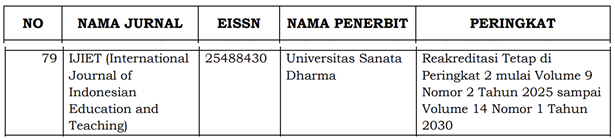
The new certificate is to upload when it is available. Thank you

IJIET Sinta 2 Certificate (please click here)

This work is licensed under CC BY-SA.
This work is licensed under a Creative Commons Attribution-ShareAlike 4.0 International License.

IJIET DOI: https://doi.org/10.24071/ijiet
p-ISSN: 2548-8422 (since 5 January 2017); e-ISSN: 2548-8430 (since 5 January 2017)
IJIET (International Journal of Indonesian Education and Teaching) is published twice a year, namely in January and July, by the Faculty of Teacher Training and Education of Sanata Dharma University, Yogyakarta, Indonesia.