




 Email this article
BOOK REVIEW: TEACHING TRANSLATION IN THE AGE OF GENERATIVE AI, NEW PARADIGM, NEW LEARNING?
(1) Universitas Negeri Semarang, Indonesia
(2) Universitas Negeri Semarang, Indonesia
(*) Corresponding Author
Abstract
This book review looks at Teaching Translation in the Age of Generative AI: New Paradigm, New Learning? an open-access edited volume that talks about one of the most important problems in translator education today: how to use generative artificial intelligence (GenAI) in translation classrooms in ways that are critical, ethical, and long-lasting. The volume is edited by JC Penet, Joss Moorkens, and Masaru Yamada. It has twelve chapters by top researchers from Europe, North America, the Middle East, and East Asia. The chapters are divided into three parts: new skills and competences, new knowledge, and new ways of teaching. Since ChatGPT was made public in November 2022, GenAI has been seen as a major disruptor. The contributors offer specific classroom strategies, reflective frameworks, and case studies that cover specialized translation, subtitling, interpreting, and second language (L2) translation. The volume successfully repositions the human translator as a vital agent in what the editors call human-centered augmented translation by consistently focusing on AI literacy, deliberate practice, and the ethical aspects of automated translation. It is a timely, easy-to-use, and pedagogically rich resource for language teachers, applied linguists, and translator educators all over the world.
Keywords
Full Text:
PDFReferences
Kenny, D. (Ed.). (2022). Machine translation for everyone: Empowering users in the age of artificial intelligence. Berlin: Language Science Press. https://doi.org/10.5281/zenodo.6653406
Koskinen, K. (2020). Translation and affect: Essays on sticky affects and translational affective labour. Amsterdam & Philadelphia: John Benjamins.
Lambert, J., & Walker, C. (2024). Because we're worth it: Disentangling freelance translation, status, and rate-setting in the United Kingdom. Translation Spaces, 13(1), 9-36. https://doi.org/10.1075/ts.23028.lam
O'Brien, S. (2024). Human-centered augmented translation: Against antagonistic dualisms. Perspectives, 32(3), 391-406. https://doi.org/10.1080/0907676X.2023.2247423
Penet, J. C., Moorkens, J., & Yamada, M. (Eds.). (2026). Teaching translation in the age of generative AI: New paradigm, new learning?. Berlin: Language Science Press.
Pym, A., & Hao, Y. (2025). How to augment language skills: Generative AI and machine translation in language learning and translator training (1st ed.). London: Routledge. https://doi.org/10.4324/9781032648033
DOI: https://doi.org/10.24071/ijiet.v10i2.14601
Refbacks
- There are currently no refbacks.
Copyright (c) 2026 Imam Shofwan, Nuzulia Nur Farida

This work is licensed under a Creative Commons Attribution-ShareAlike 4.0 International License.
Indexed and abstracted in:





IJIET Sinta 2 Certificate (S2 = Level 2)
We would like to inform you that IJIET (International Journal of Indonesian Education and Teaching):has been nationally re-accredited Sinta 2 by the Ministry of Higher Education, Science and Technology of the Republic of Indonesia based on the decree No. Surat Keputusan 355/DST/D.D1/HM.01.01/2026. Validity for 5 years: Vol 9 No 2, 2025 until Vol 14 No 1, 2030.
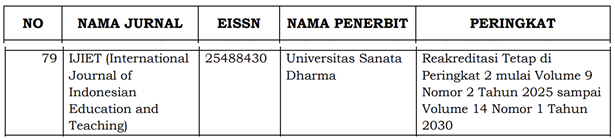
The new certificate is to upload when it is available. Thank you

IJIET Sinta 2 Certificate (please click here)

This work is licensed under CC BY-SA.
This work is licensed under a Creative Commons Attribution-ShareAlike 4.0 International License.

IJIET DOI: https://doi.org/10.24071/ijiet
p-ISSN: 2548-8422 (since 5 January 2017); e-ISSN: 2548-8430 (since 5 January 2017)
IJIET (International Journal of Indonesian Education and Teaching) is published twice a year, namely in January and July, by the Faculty of Teacher Training and Education of Sanata Dharma University, Yogyakarta, Indonesia.