




 Email this article

THE REPRODUCTION OF EDUCATIONAL INEQUALITY IN INDONESIA: AN EXAMINATION OF HINDERING FACTORS AND DIGITAL ACCESS IN RURAL AND URBAN SCHOOL SETTINGS
(1) Universitas Muhammadiyah Sumatera Utara, Indonesia
(2) Universitas Muhammadiyah Sumatera Utara, Indonesia
(*) Corresponding Author
Abstract
This study investigates factors contributing to educational disparities in Indonesia, particularly concerning school location and status. Employing a correlational research design, the study analyzed data from the 2022 Programme for International Student Assessment (PISA), focusing on the Indonesian school questionnaire dataset. The sample comprised 410 Indonesian schools, including 237 public and 173 private institutions. Pearson's chi-square test was utilized for statistical analysis to examine associations between categorical variables. Findings reveal significant relationships between school location and learning impediments related to teacher availability, physical infrastructure availability and quality, and digital resource availability. These issues are predominantly concentrated in public schools in rural areas, indicating a systematic disadvantage. While some challenges are also present in private schools, the impact is more pronounced in public institutions. The results suggest that educational inequality in Indonesia is structurally reproduced, perpetuating social and economic hierarchies. This necessitates comprehensive policy interventions that address both resource provision and underlying systemic issues.
Keywords
Full Text:
PDFReferences
Afrianti, N., & Aditia, R. (2020). Online learning readiness in facing the Covid-19 pandemic at MTS Manunggal Sagara Ilmi, Deli Serdang, Indonesia. Journal of International Conference Proceedings, 3(2), 59–66. https://doi.org/10.32535/jicp.v0i0.905
Ainscow, M. (2020). Promoting inclusion and equity in education: Lessons from international experiences. Nordic Journal of Studies in Educational Policy, 6(1), 7–16. https://doi.org/10.1080/20020317.2020.1729587
Apple, M. W. (2017). Cultural and economic reproduction in education: Essays on class, ideology and the state (Vol. 53). London: Routledge.
Arends, R. I. (2012). Learning to teach. New York: McGraw-Hill.
Asrowi, A., Hadaya, A., & Hanif, M. (2019). The impact of using the interactive e-book on students’ learning outcomes. International Journal of Instruction, 12(2), 709–722. https://doi.org/10.29333/iji.2019.12245a
Bourdieu, P. (2018a). Cultural reproduction and social reproduction. In R. Brown (Ed.), Knowledge, education, and cultural change (pp. 71–112). London: Routledge. https://doi.org/10.4324/9781351018142
Bourdieu, P. (2018b). Distinction a social critique of the judgement of taste. In D. Grusky (Ed.), Inequality: Classic readings in race, class, and gender (pp. 287–318). Routledge.
Bourdieu, P. (2018c). The forms of capital. In The sociology of economic life (pp. 78–92). New York: Routledge. https://doi.org/10.4324/9780429499838
Bowles, S. (1971). Class power and mass education: A study of social structure and resource allocation in schooling. Harvard Educational Reviews, 41(4), 472-501.
Bowles, S., Gintis, H., & others. (1976). Schooling in capitalist America (Vol. 57). New York: Basic Books.
Cole, M. (2007). Marxism and educational theory: Origins and issues. London: Routledge. https://doi.org/10.4324/9780203397329
Creswell, J. W. (2012). Educational reserach: Planning, conducting and evaluating (4th ed.). Boston, MA: Pearson.
Field, A. (2009). Discovering statistics using SPSS (3rd ed.). London: Sage publications.
Fisher, R. A. (1922). On the interpretation of $χ$ 2 from contingency tables, and the calculation of P. Journal of the Royal Statistical Society, 85(1), 87–94. https://doi.org/10.2307/2340521
Freire, P. (2020). Pedagogy of the oppressed. In J. Beck, C. Jenks, N. Keddie, & M. F. D. Young (Eds.), Toward a sociology of education (pp. 374–386). New York: Routledge. https://doi.org/10.4324/9780429339530
Gordon, C. A., & Cicchetti, R. (2023). New perspectives of equity, access, and meaningful use of school library resources and services. Peabody Journal of Education, 98(1), 100–131. https://doi.org/10.1080/0161956X.2023.2160117
Kawuryan, S. P., Sayuti, S. A., Aman, A., & Dwiningrum, S. I. A. (2021). Teachers quality and educational equality achievements in Indonesia. International Journal of Instruction, 14(2), 811–830. https://doi.org/10.29333/iji.2021.14245a
Kharizmi, M. (2015). Kesulitan siswa sekolah dasar dalam meningkatkan kemampuan literasi. JUPENDAS (Jurnal Pendidikan Dasar), 2(2), 11-21.
Kormos, E. M. (2018). The unseen digital divide: Urban, suburban, and rural teacher use and perceptions of web-based classroom technologies. Computers in the Schools, 35(1), 19–31. https://doi.org/10.1080/07380569.2018.1429168
Love, M. L., & Ewoldt, K. B. (2021). Implementing asynchronous instructional materials for students with learning disabilities. Intervention in School and Clinic, 57(2), 132–137. https://doi.org/10.1177/10534512211001847
Macasawang, E. M. A., Guimba, W. D., & Alico, J. C. (2019). Analysis on an English textbook for grade 7: Focus on compliance to the K-12 grade level standards and competencies. Education Quarterly Reviews, 2(1), 41–51. https://doi.org/10.31014/aior.1993.02.01.37
Maunah, B. (2020). Social and cultural capital and learners’ cognitive ability: issues and prospects for educational relevance, access and equity towards digital communication in Indonesia. Journal of Social Studies Education Research, 11(1), 163–191.
Newhouse, D., & Beegle, K. (2006). The effect of school type on academic achievement: Evidence from Indonesia. Journal of Human Resources, 41(3), 529–557. https://doi.org/10.2139/ssrn.753544
OECD. (2016). Sampling in PISA. Prague: OECD.
OECD. (2018a). Equity in education. In Pisa. OECD. https://doi.org/10.1787/9789264073234-en
OECD. (2018b). School questionnaire for PISA 2018 main survey version.
Pratiwi, M. A., Suhartika, I. P., & Ginting, R. T. (2022). Identifikasi faktor-faktor penyebab kerusakan koleksi di perpustakaan dan strategi pencegahannya. Jurnal Ilmiah Perpustakaan dan Informasi (JIPUS), 2(1).
Selwyn, N. (2009). The ‘new’connectivities of digital education. In M. W. Apple, S. J. Ball, & L. A. Gandin (Eds.), The Routledge international handbook of the sociology of education (pp. 90–98). London: Routledge. https://doi.org/10.4324/9780203863701
Shieh, J.-J., Reynolds, B. L., & Ha, X. V. (2023). Using a design-based approach to develop a checklist for evaluating preservice teacher learning materials. TESOL Journal, e717. https://doi.org/10.1002/tesj.717
Sidauruk, J. M., Susilowati, M., & Akbar, K. K. (2025). Indonesia’s struggle with education inequality: Is reform the answer? Indonesia Discourse, 2(1). https://doi.org/10.15294/indi.v2i1.23035
Siegel, S. (1956). Nonparametric statistics for the behavioral sciences. Singapore: McGraw-Hill.
Stern, J. M. B., & Smith, T. M. (2016). Private secondary schools in Indonesia: What is driving the demand? International Journal of Educational Development, 46, 1–11. https://doi.org/10.1016/j.ijedudev.2015.11.002
Thamrin, T., Aditia, R., & Hutasuhut, S. (2023). Key factors to foster academic performance in online learning environment: Evidence from Indonesia during COVID-19 pandemic. Cogent Education, 10(1), 0–23. https://doi.org/10.1080/2331186X.2023.2174726
Wang, P.-Y. (2013). Examining the digital divide between rural and urban schools: Technology availability, teachers’ integration level and students’ perception. Journal of Curriculum and Teaching, 2(2), 127–139. https://doi.org/10.5430/jct.v2n2p127
Wihardja, M. M., Pradana, A. T., Wibisana, P. S., & Swarnata, A. (2024). The heterogeneous impacts of digital transformation and investment on Indonesia’s labour market. Jakarta: Economic Research Institute for ASEAN and East Asia (ERIA).
DOI: https://doi.org/10.24071/ijiet.v10i1.12907
Refbacks
- There are currently no refbacks.
Copyright (c) 2026 Faisal Rahman Dongoran, Reza Aditia

This work is licensed under a Creative Commons Attribution-ShareAlike 4.0 International License.
Indexed and abstracted in:








IJIET Sinta 2 Certificate (S2 = Level 2)
We would like to inform you that IJIET (International Journal of Indonesian Education and Teaching):has been nationally re-accredited Sinta 2 by the Ministry of Higher Education, Science and Technology of the Republic of Indonesia based on the decree No. Surat Keputusan 355/DST/D.D1/HM.01.01/2026. Validity for 5 years: Vol 9 No 2, 2025 until Vol 14 No 1, 2030.
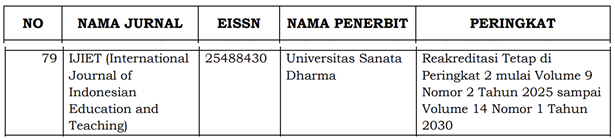
The new certificate is to upload when it is available. Thank you

IJIET Sinta 2 Certificate (please click here)

This work is licensed under CC BY-SA.
This work is licensed under a Creative Commons Attribution-ShareAlike 4.0 International License.

IJIET DOI: https://doi.org/10.24071/ijiet
p-ISSN: 2548-8422 (since 5 January 2017); e-ISSN: 2548-8430 (since 5 January 2017)
IJIET (International Journal of Indonesian Education and Teaching) is published twice a year, namely in January and July, by the Faculty of Teacher Training and Education of Sanata Dharma University, Yogyakarta, Indonesia.