







 Email this article
AN EXPLORATION OF WEST SUMBA SENIOR HIGH SCHOOL STUDENTS’ READING INTERESTS, HABITS, AND DIFFICULTIES
(1) Universitas Kristen Satya Wacana, Indonesia
(*) Corresponding Author
Abstract
Reading is important for students to enrich knowledge and collect important information useful not only for their academic life but also for their social, economic, and civic life. A good reading habit can be initiated by engaging students with reading materials which arouse their interests. Even if students have good interests and habits in reading, they may face difficulties in reading which may decrease their reading interests and habits. In rural areas in Indonesia, there are many obstacles affecting students’ reading interests and habits. The objective of this study is to investigate English reading interests, habits, and difficulties of West Sumba senior high school students. This study uses a descriptive quantitative approach with a survey design. The results of this study showed that the students have a good interest in reading Indonesian and English texts, and they have a quite good reading habit even though the texts that they read on a daily basis in Indonesian language cannot be categorized as appropriate reading materials. The common difficulties faced by the students in their reading activities are unsupportive parents and teachers, lack of English reading sources, and their preference to watch TV or play with their gadgets rather than to read.
Keywords
Full Text:
PDFReferences
Abbott, R., Mickail, T., Richards, T., Renninger, K. A., Hidi, S. E., Beers, S., & Berninger, V. (2017). Understanding interest and self-efficacy in the reading and writing of students with persisting specific learning disabilities during middle childhood and early adolescence. International Journal of Educational Methodology, 3(1), 41–64. https://doi.org/10.12973/ijem.3.1.41
Agustine, Z. M., Jinan, M., & Hamidah, E. (2023). Gerakan literasi sekolah untuk meningkatkan prestasi belajar siswa di SMP Al-Firdaus Sukoharjo. Attractive: Innovative Education Journal, 5(2), 573–585.
Akmal, S., Ikhwanna, D., & Mulia. (2020). Investigating students’ interest on reading journal articles: Materials, reasons and strategies. Studies in English Language and Education, 7(1), 194–208. https://doi.org/10.24815/siele.v7i1.15358
Al-Ghazo, A. (2015). The effect of SQ3R and semantic mapping strategies on reading comprehension learning among Jordanian university students. International Journal of English and Education, 4(3), 92–106.
Ameyaw, S. K., & Anto, S. K. (2018). Read or perish: Reading habit among students and its effect on academic performance: A case study of Eastbank Senior High School-Accra. Library Philosophy and Practice, 1–25.
Aspar, M., Mujtaba, I., Mutiarani, M., & Zulfita, A. (2020). Efektivitas implementasi mendongeng terhadap literasi bagi anak usia sekolah dasar. Seminar Nasional Pengabdian Masyarakat 2020 Universitas Muhammadiyah Jakarta, 1–10.
Balan, S., Katenga, J. E., & Simon, A. (2019). Reading habits and their influence on academic achievement among students at Asia Pacific International University. Proceedings International Scholars Conference, 7(1), 1490–1516. https://doi.org/10.35974/isc.v7i1.928
Chairanissa, N., & Wirza, Y. (2019). The portrait of reading habit among junior high school students. Advances in Social Science, Education and Humanities Research, 257, 206–210. https://doi.org/10.2991/icollite-18.2019.45
Dafit, F., Mustika, D., & Melihayatri, N. (2020). Pengaruh program pojok literasi terhadap minat baca mahasiswa PGSD FKIP UIR. Jurnal Basicedu, 4(1), 117–130. https://doi.org/10.31004/basicedu.v4i1.307
Davidovitch, N., Yavich, R., & Druckman, E. (2016). Don’t throw out paper and pens yet: On the reading habits of students what is the reading list For? Journal of International Education Research, 12(4), 129–144. https://doi.org/10.19030/jier.v12i4.9799
Day, R. R., & Bamford, J. (1998). Extensive reading in the second language classroom. RELC Journal, 29(2), 187. Cambridge: Cambridge University Press. https://doi.org/10.1177/003368829802900211
Esteria, A. (2016). The role of PQRST strategy to improve reading comprehension in Indonesia. Graduate School Conference, 1–14.
Haifa, H. (2024a, November 4). Young Indonesians’ interest in reading: Part 1. Snapcart. Retrieved from https://snapcart.global/young-indonesians-interest-in-reading-part-1/
Haifa, H. (2024b, November 7). Young Indonesians’ interest in reading: Part 2. Snapcart. Retrieved from https://snapcart.global/young-indonesians-interest-in-reading-part-2/
Hamalik, O. (2017). Proses belajar mengajar (nineteenth). Yogyakarta: Bumi Aksara. https://balaiyanpus.jogjaprov.go.id/opac/detail-opac?id=304186
Hargreaves, L., & Kvalsund, R. (2009). Reviews of research in rural schools and their communities: Analytical perspectives and a new agenda. International Journal of Educational Research, 48, 140–149. https://doi.org/10.1016/j.ijer.2009.02.002
Harmer, J. (2007). The practice of English language teaching (4th ed.). London: Pearson Education Limited.
Indrayadi, T. (2021). Indonesian EFL learners’ reading motivation. IJELTAL (Indonesian Journal of English Language Teaching and Applied Linguistics), 5(2), 335–346. https://doi.org/10.21093/ijeltal.v5i2.745
Khairuddin, Z. (2013). A study of students’ reading interests in a second language. International Education Studies, 6(11), 160–170. https://doi.org/10.5539/ies.v6n11p160
Khan, Z. N. (2016). Factors effecting on study habits. World Journal of Educational Research, 3(1), 145–150. https://doi.org/10.22158/wjer.v3n1p145
Kingsford-Smith, A. A., Collie, R. J., Loughland, T., & Nguyen, H. T. M. (2023). Teacher wellbeing in rural, regional, and metropolitan schools: Examining resources and demands across locations. Teaching and Teacher Education, 132, 1–17. https://doi.org/10.1016/j.tate.2023.104229
Kurniasih, N. (2016, September 26). Reading habit in digital era: Indonesian people do not like reading, is it true? Web Culture Forum’s Site. Retrieved from https://worldcultureforum-bali.org/reading-habit-in-digital-era-indonesian-people-do-not- like-reading/
Kurniati, R., Daud, A., & Masyhur, M. (2023). Reading interest and reading comprehension ability: The correlational study in secondary education. Journal of Education, Language Innovation, and Applied Linguistics, 2(1), 41–50. https://doi.org/10.37058/jelita.v2i1.6547
Leasa, M., Batlolona, J. R., Titaley, E., & Batlolona, T. (2024). The social landscape of education in rural areas: Evening study program, study irregularities and academic achievement. Jurnal Penelitian Dan Pengembangan Pendidikan, 8(3), 481–492. https://doi.org/10.23887/jppp.v8i3.77359
Mukhasonah, D., & Azah, N. (2022). Implementasi program gerakan literasi madrasah (Gelem) dalam peningkatkan budaya membaca dan menulis siswa di MTsN 3 Jombang. Ilmuna: Jurnal Studi Pendidikan Agama Islam, 4(2), 131–154. https://doi.org/10.54437/ilmuna.v4i2.610
Nguyen, T. T. H. (2022). The effects of reading habits on writing performance: A case study at Van Lang University. International Journal of TESOL & Education, 2(4), 105–133. https://doi.org/10.54855/ijte.22247
Nihayah, R. W., & Revina, S. (2020, September 11). Shortage of libraries and quality readings causes Indonesia’s literacy crisis. Rise.Smeru.or.Id. Retrieved from https://rise.smeru.or.id/en/blog/shortage-libraries-and-quality-readings-causes-indonesia’s-literacy-crisis
OECD/Asian Development Bank. (2015). Education in Indonesia: Rising to the challenge (Reviews of national policies for education). Paris: OECD. https://doi.org/10.1787/9789264230750-en
Palani, K. K. (2012). Promoting reading habits and creating literate society. Journal of Arts, Science & Commerce, 3(2 (1)), 90–94.
Parnawi, A. (2020). Psikologi belajar (2nd ed.). Sleman: Deepublish.
Pitoyo, A. (2020). A meta-analysis: Factors affecting students’ reading interest in Indonesia. International Journal of Multicultural and Multireligious Understanding, 7(7), 83–92. https://doi.org/10.18415/ijmmu.v7i7.1727
Putri, G. A. T., & Rati, N. W. (2022). Reading problems in grade II elementary school students. Jurnal Ilmiah Sekolah Dasar, 6(2), 244–252. https://doi.org/10.23887/jisd.v6i2.42584
Sakinah, S. (2018). The correlation between students’ reading habits and reading achievement in English education study program at Jambi University [Unpublished Undergraduate Thesis, Universitas Jambi, Indonesia].
Salikin, H., Bin-Tahir, S. Z., Kusumaningputri, R., & Yuliandari, D. P. (2017). The Indonesian EFL learners’ motivation in reading. English Language Teaching, 10(5), 81–90. https://doi.org/10.5539/elt.v10n5p81
Shintia, D., Arafat, Y., & Setiawan, A. A. (2021). The influence of school library utilization and reading interest on student achievement. Journal of Social Work and Science Education, 2(2), 127–136. https://doi.org/10.52690/jswse.v2i2.235
Solihin, L. (2017, September 6). Disadvantaged Indonesians defy the perception that they’re not interested in reading. The Conversation. Retrieved from https://theconversation.com/disadvantaged-indonesians-defy-the-perception-that-theyre-not-interested-in-reading-83315
Tahmidaten, L., & Krismanto, W. (2020). Permasalahan budaya membaca di Indonesia (studi pustaka tentang problematika dan solusinya). Scholaria: Jurnal Pendidikan dan Kebudayaan, 10(1), 22–33. https://doi.org/10.24246/j.js.2020.v10.i1.p22-33
Ujiie, J., & Krashen, S. D. (1996). Comic book reading, reading enjoyment, and pleasure reading among middle class and Chapter I middle school students. Reading Improvement, 33(1), 51–54.
Westwood, P. S., & Westwood, P. (2008). What teachers need to know about reading and writing difficulties. Camberwell: ACER Press.
Wiranatha, P. A., & Santosa, M. H. (2024). Systematic literature review on students’ reading habits in Indonesia in the era of technology. Gagasan Pendidikan Indonesia, 5(1), 27–38. https://doi.org/10.30870/gpi.v5i1.26677
Yenn, T. Y. (2018). This is what inequality looks like (1st ed.). Midview City: Ethos Books.
Zur, S., Zulkifli, M., & Hestiana, H. (2022). Students’ interest in reading English texts. KnE Social Sciences, 7(8), 148–157. https://doi.org/10.18502/kss.v7i8.10733
DOI: https://doi.org/10.24071/ijiet.v10i1.12335
Refbacks
- There are currently no refbacks.
Copyright (c) 2026 Antonina Anggraini Setiamunadi

This work is licensed under a Creative Commons Attribution-ShareAlike 4.0 International License.
Indexed and abstracted in:








IJIET Sinta 2 Certificate (S2 = Level 2)
We would like to inform you that IJIET (International Journal of Indonesian Education and Teaching):has been nationally accredited Sinta 2 by the Ministry of Education, Culture, Research and Technology of the Republic of Indonesia based on the decree No. Surat Keputusan 158/E/KPT/2021. Validity for 5 years: Vol 5 No 2, 2021 until Vol 10 No 1, 2026.
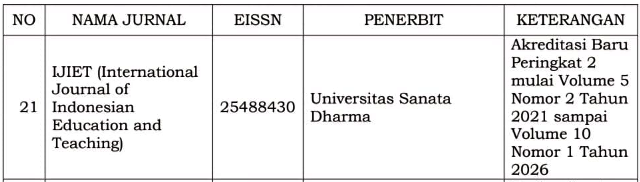

IJIET Sinta 2 Certificate (please click here)

This work is licensed under CC BY-SA.
This work is licensed under a Creative Commons Attribution-ShareAlike 4.0 International License.

IJIET DOI: https://doi.org/10.24071/ijiet
p-ISSN: 2548-8422 (since 5 January 2017); e-ISSN: 2548-8430 (since 5 January 2017)
IJIET (International Journal of Indonesian Education and Teaching) is published twice a year, namely in January and July, by the Institute for Research and Community Services of Sanata Dharma University, Yogyakarta, Indonesia.