





 Email this article
LEARNERS’ PERSPECTIVES ON THE APPLICATION OF ROLE-PLAYING ACTIVITIES IN LEGAL ENGLISH CLASSES
(1) Hanoi Law University, Vietnam
(*) Corresponding Author
Abstract
Role-play, an integrated language teaching method, is highly recommended in English-for-specific-purposes classes for its valuable benefits. This paper focuses on investigating learners’ perspectives on role-play activity utilization in legal English lessons at Hanoi Law University. To achieve the aim, a 15-week study was carried out with the participation of sixty-seven second-year law students who were instructed with role-playing activities in legal English lessons. Data were collected through survey questionnaires and in-depth semi-structured interviews, which addressed the benefits of role-play in terms of enhancing learners’ legal English skills and legal English terms, as well as fostering their learning motivation. Accordingly, instructors might consider such findings to maximize the efficacy of role-playing activities in teaching legal English.
Keywords
Full Text:
PDFReferences
Ahmada, A., & Munawaroh, L. (2022). The use of role-play method to improve speaking skills. Darussalam English Journal (DEJ), 2(1), 55–82. https://doi.org/10.30739/dej.v2i1.1506
Alabsi, T. (2016). The effectiveness of role play strategy in teaching vocabulary. Theory and Practice in Language Studies, 6(2), 227-234. https://doi.org/10.17507/tpls.0602.02
Alghamdy, R. (2022). How do EFL learners interact and learn English communication skills during a role-play strategy? World Journal of English Language, 12(1), 313–320. https://doi.org/10.5430/wjel.v12n1p313
Amir, M. A., Rachmaniar, A., Rismayadi, H., & Julius, A. (2021). Improving students’ achievement motivation through role-play. International Journal of Global Operations Research, 1(3), 96-102. https://doi.org/10.47194/ijgor.vli3.52
Amirbayeva, D. (2021). Enhancing the acquisition of legal English through role-play. Journal for Research Scholars and Professionals of English Language Teaching, 5(27), 1-11.
Ashok, A. M. (2015, April). Effectiveness of role play in enhancing communication skills of English language learners. Language in India, 15(4), 4-13.
Baca, L. S., Rivera, J. L., Andía, H. D., & Alarcón-Diaz, M. A. (2020). Role play: Quasi-experiment for the development of social skills. International Journal of Early Childhood Special Education, 12(1), 496-502. https://doi.org/10.9756/INT- JECSE/V12I1.201030.
Brown, H. D., & Lee, H. (2015). Teaching by principles: An interactive approach to language pedagogy (4th ed.). White Plains, NY: Pearson Education.
Chaitanya, E. K., & Ramana, K. V. (2013). Role play - An integrated approach to enhance language skills (LSRW) of the ESL learners - A collaborative action research report. Language in India, 13(1), 469-482.
Elouali, F. Z. (2023). Incorporating role-play as an innovative approach to fostering English foreign language students’ creativity and critical thinking. Global Journal of Foreign language teaching, 13(2), 142-155. https://doi.org/10.18844/gjflt.v13i2.8718
Fahim, M., & Sabah, S. (2012). An ecological analysis of the role of role-play games as affordances in Iranian EFL pre-university students' vocabulary learning. Theory and Practice in Language Studies, 2(6), 1276-1284. https://www.academypublication.com/issues/past/tpls/vol02/06/26.pdf
Gusmuliana, P., Apriani, E., & Syafryadin, S. (2021). Improving students speaking motivation by using role play technique at institute Islamic in Indonesia. Proceedings of the International Conference on Educational Sciences and Teacher Profession (ICETeP 2020) (pp. 356-361). Dordrecht: Atlantis Press. https://doi.org/10.2991/assehr.k.210227.060
Ishak, S. A., & Aziz, A. A. (2022). Role play to improve ESL learners’ communication skills: A systematic review. International Journal of Academic Research in Business and Social Sciences, 12(10), 884-892. https://doi.org/10.6007/ijarbss/v12-i10/14851
Jayanti, L. N. (2022). Role play for fostering young learner’s soft skill in speaking English. Vivid: Journal of Language and Literature, 11(2), 127-131. https://doi.org/10.25077/vj.11.2.127-131.2022
Krois-Lindner, A., Firth, M., & TransLegal. (2008). Introduction to international legal English. Cambridge: Cambridge University Press.
Lahbibi, K., & Farhane, H. (2023). The impact of role play on enhancing learners’ interaction in speaking. International Journal of Language and Literary Studies, 5(1), 28–51. https://doi.org/10.36892/ijlls.v5i1.1155
Ly, C. K. (2020). The importance of grammar in language teaching and learning. workshop on innovation in language teaching and learning (pp. 186-195). Ho Chi Minh City: Ze- nodox. http://dx.doi.org/10.5281/zenodo.3947215
Neupane, B. (2019). Effectiveness of role play in improving speaking skill. Journal of NELTA Gandaki, 1, 11–18. https://doi.org/10.3126/jong.v1i0.24454
Nguyen, T. A. C. (2023). The use of role-play activities to improve speaking skills of the first year English-major Students at University of Khanh Hoa. TNU Journal of Science and Technology, 228(03), 138-145.
Nikmah, A., & Zami, M. A. N. Z. (2019). The implementation of role play to improve speaking skill of students at IAIN Kudus. Journal of English Teaching and Learning Issues, 2(2), 159-170.
Phan, T. T. V., Cao, T. C. T., & Nguyen, D. K. (2022). the effectiveness of role-play techniques in improving English as a foreign language learners’ speaking skills. Special Education, 1(43), 2522-2534. https://www.sumc.lt/index.php/se/article/view/292
Richards, J. C. (2015). Key issues in language teaching. Cambridge: Cambridge University Press. https://doi.org/10.1017/9781009024600
Sarwat, S., Hamza, A., & Wazeer, M. A. (2023). Investigating the impact of role play games on vocabulary building of ESL learners at intermediate level. Pakistan Languages and Humanities Review (PLHR), 7(1), 20-33. https://doi.org/10.47205/plhr.2023(7-I)03
Sayed, A. R., Khafagy, M. H., Ali, M., & Hussien, M. (2024). Predict student learning styles and suitable assessment methods using click stream. Egyptian Informatics Journal, 26, 1-10.
Soori, A., Kafipour, R., Dakhil, T. A., Khojasteh, L., & Behrosi, B. (2023). The effect of role-play on vocabulary learning and retention in Iranian EFL learners. Forum for Linguistic Studies, 5(2), 1835. https://doi.org/10.59400/fls.v5i2.1835
Tandipayuk, Y. T., Amin, F. H., Al-Lateef, G. T., & Vargheese, K. J. (2023). Exploring the fluency and comprehensibility of a role-play-based speaking in a tourism university. International Journal of Humanities and Innovation (IJHI), 6(2), 42-48. https://doi.org/10.33750/ijhi.v6i2.180
Yu, J. (2023). Rethinking role-play and simulation in negotiation pedagogy. Education, Language and Sociology Research, 4(2), 149-160. https://doi.org/10.22158/elsr.v4n2p149
DOI: https://doi.org/10.24071/ijiet.v9i2.11914
Refbacks
- There are currently no refbacks.
Copyright (c) 2025 Hương Thanh Nhạc

This work is licensed under a Creative Commons Attribution-ShareAlike 4.0 International License.
Indexed and abstracted in:








IJIET Sinta 2 Certificate (S2 = Level 2)
We would like to inform you that IJIET (International Journal of Indonesian Education and Teaching):has been nationally re-accredited Sinta 2 by the Ministry of Higher Education, Science and Technology of the Republic of Indonesia based on the decree No. Surat Keputusan 355/DST/D.D1/HM.01.01/2026. Validity for 5 years: Vol 9 No 2, 2025 until Vol 14 No 1, 2030.
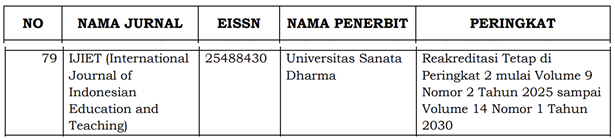
The new certificate is to upload when it is available. Thank you

IJIET Sinta 2 Certificate (please click here)

This work is licensed under CC BY-SA.
This work is licensed under a Creative Commons Attribution-ShareAlike 4.0 International License.

IJIET DOI: https://doi.org/10.24071/ijiet
p-ISSN: 2548-8422 (since 5 January 2017); e-ISSN: 2548-8430 (since 5 January 2017)
IJIET (International Journal of Indonesian Education and Teaching) is published twice a year, namely in January and July, by the Faculty of Teacher Training and Education of Sanata Dharma University, Yogyakarta, Indonesia.