







 Email this article
REALISTIC MATHEMATICS EDUCATION (RME) ASSISTED WITH SCAFFOLDING TO ENHANCE MATHEMATICAL REASONING
(1) Universitas Muhammadiyah Sidoarjo, Indonesia
(2) Universitas Muhammadiyah Sidoarjo, Indonesia
(*) Corresponding Author
Abstract
Until recently, the educational curriculum has led to the need for problem-solving through adequate mathematical reasoning. In addition, there is much evidence that problem-solving is achieved through mathematical reasoning. The problem is that primary students' mathematical reasoning is still low. Meanwhile, many empirical studies state that Realistic Mathematics Education (RME) can enhance mathematical reasoning. On the other hand, scaffolding is a solution that helps achieve learning outcomes, including mathematical reasoning. This study examines the impact of RME assisted with scaffolding toward students' mathematical reasoning. The research method was quasi-experimental with a non-equivalent (pre-test and post-test) control-group design. The study sample involved fifth-grade students using a purposive sampling technique. The data analysis used was an independent sample t-test. The study's findings showed that RME assisted with scaffolding, which affected students' mathematical reasoning. Another finding was that students' primary mathematical manipulation as part of mathematical reasoning increased significantly. Therefore, integrating RME and scaffolding can be a new alternative learning strategy to enhance primary students' mathematical reasoning.
Keywords
Full Text:
PDFReferences
Akbaş, E. E., & Alan, K. (2022). Examining 6th grade students’ learning of the subject of volume with geogebra software within the framework of RME approach. Open Journal for Educational Research, 6(1), 89–104. https://doi.org/10.32591/coas.ojer.0601.07089e
Akbaş, E. E., & Yildirim, L. (2024). Examining 5th grade students’ learning on surface area calculations with realistic mathematics education approach. International E-Journal of Educational Studies, 8(16), 14–31. https://doi.org/10.31458/iejes.1354835
Aksu, H. H. (2021). The effect of realistic mathematics education on student achievement in 8th grades geometric objects teaching. African Educational Research Journal, 9(1), 20–31. https://doi.org/10.30918/AERJ.91.20.205
Amir, F., & Amir, F. M. (2021). Action proof: Analyzing elementary school students' informal proving stages through counter-examples. International Journal of Elementary Education, 5(3), 401–408. https://doi.org/10.23887/ijee.v5i3.35089
Anggani, R. Y., Syaripudin, T., & Fitriani, A. D. (2019). Penerapan model pembelajaran RME untuk meningkatkan kemampuan penalaran matematis siswa kelas III SD. Jurnal Pendidikan Guru Sekolah Dasar, 4(III), 318–328. https://doi.org/10.17509/jpgsd.v4i3.22938
Barnes, A. (2019). Perseverance in mathematical reasoning: The role of children’s conative focus in the productive interplay between cognition and affect. Research in Mathematics Education, 21(3), 271–294. https://doi.org/10.1080/14794802.2019.1590229
Basir, M. A., & Wijayanti, D. (2020). Strategies to provide scaffolding when teaching mathematical reasoning. Proceedings of the 1st International Conference on Islamic Civilization. Semarang: EAI. https://doi.org/10.4108/eai.27-8-2020.2303266
Bikmaz, F. H., Çeleb, Ö., Ata, A., Özer, E., Soyak, Ö., & Reçber, H. (2010). Scaffolding strategies applied by student teachers to teach mathematics. Educational Research Association The International Journal of Research in Teacher Education, 1(3), 25–36.
Calor, S. M., Dekker, R., van Drie, J. P., & Volman, M. L. L. (2022). Scaffolding small groups at the group level: Improving the scaffolding behavior of mathematics teachers during mathematical discussions. Journal of the Learning Sciences, 31(3), 369–407. https://doi.org/10.1080/10508406.2021.2024834
Creswell, J. W., & Creswell, J. D. (2018). Research design: Qualitative, quantitative, and mixed methods approaches (5th ed.). Los Angeles: SAGE Publications, Inc.
Dreher, J. H. (2020). Descartes on mathematical reasoning and the truth principle. Open Journal of Philosophy, 10(03), 388–410. https://doi.org/10.4236/ojpp.2020.103026
Ekowati, D. W., Azzahra, F. Z., Saputra, S. Y., & Suwandayani, B. I. (2021). Realistic mathematics education (RME) approach for primary school students’ reasoning ability. Premiere Educandum : Jurnal Pendidikan Dasar dan Pembelajaran, 11(2), 269-279. https://doi.org/10.25273/pe.v11i2.8397
Ghani, W. R. A., Utami, A. S., & Hidayah, N. (2023). Enhancing mathematical reasoning in primary school with the strategic board game othello. TERAMPIL Jurnal Pendidikan dan Pembelajaran Dasar, 10(2), 281–296. https://doi.org/10.3390/su12104306
Gubbuk, E., & Uygun, T. (2024). The effects of realistic mathematics education on students’ achievement and attitudes towards mathematics on integer operations. Acta Didactica Napocensia, 16(2), 83–97. https://doi.org/10.24193/adn.16.2.7
Gultom, C. I., Triyanto, T., & Saputro, D. R. S. (2022). Students’ mathematical reasoning skills in solving mathematical problems. JPI (Jurnal Pendidikan Indonesia), 11(3), 542–551. https://doi.org/10.23887/jpiundiksha.v11i3.42073
Hansen, E. K. S. (2022). Students’ agency, creative reasoning, and collaboration in mathematical problem solving. Mathematics Education Research Journal, 34(4), 813–834. https://doi.org/10.1007/s13394-021-00365-y
Hughes, E. M., Riccomini, P. J., & Lee, J. Y. (2020). Investigating written expressions of mathematical reasoning for students with learning disabilities. Journal of Mathematical Behavior, 58, 100775. https://doi.org/10.1016/j.jmathb.2020.100775
Inci, A. M., Peker, B., & Kucukgencay, N. (2023). Realistic mathematics education. In O. Cardak & S. A. Kiray (Eds.), Current studies in educational disciplines 2023 (pp. 66-83). Konya: ISRES Publishing.
Jensen, E. O., Madeline, E., Nehammer, H., & Eriksen, A. L. (2023). Enhancing mathematical reasoning in primary school with the strategic board game othello. Proceedings of the 17th European Conference on Games Based Learning, 289–295. https://doi.org/10.34190/ecgbl.17.1.1524
Kaitera, S., & Harmoinen, S. (2022). Developing mathematical problem-solving skills in primary school by using visual representations on heuristics. LUMAT: International Journal on Math, Science and Technology Education, 10(2), 111–146. https://doi.org/10.31129/LUMAT.10.2.1696
Khoirunnisa, M., & Putri, R. I. I. (2022). Junior high school students’ mathematical reasoning skills on integer using PMRI and collaborative learning. Jurnal Elemen, 8(2), 352–372. https://doi.org/10.29408/jel.v8i2.4779
Liang, C. P., & She, H. C. (2023). Investigate the effectiveness of single and multiple representational scaffolds on mathematics problem solving: Evidence from eye movements. Interactive Learning Environments, 31(6), 3882–3897. https://doi.org/10.1080/10494820.2021.1943692
Masinading, Z. M. B., & Gaylo, D. N. (2022). Differentiated scaffolding strategies in triangle congruence: Their effects on learners’ academic performance and confidence in mathematics. International Journal of Education and Literacy Studies, 10(2), 131–140. https://doi.org/10.7575/aiac.ijels.v.10n.2p.131
Melhuish, K., Thanheiser, E., & Guyot, L. (2020). Elementary school teachers’ noticing of essential mathematical reasoning forms: Justification and generalization. Journal of Mathematics Teacher Education, 23(1), 35–67. https://doi.org/10.1007/s10857-018-9408-4
Nabila, S., & Putri, R. I. I. (2022). Students’ mathematical reasoning skills on number pattern using PMRI and collaborative learning approach. Jurnal Elemen, 8(1), 290–307. https://doi.org/10.29408/jel.v8i1.4733
Nurlinda, E., Azis, Z., & Nasution, M.D. (2024). Students’ mathematical reasoning ability and self-efficacy viewed from the application of problem based learning and contextual teaching and learning models assisted. Journal of Mathematics Education and Application (JMEA), 3(2), 54–61. https://doi.org/10.30596/jmea.v3i2.20329
OECD. (2022). PISA 2022 student performance in mathematics. Retrieved from https://oe.cd/cyprus-disclaimer
Olivares, D., Lupiáñez, J. L., & Segovia, I. (2021). Roles and characteristics of problem solving in the mathematics curriculum: A review. International Journal of Mathematical Education in Science and Technology, 52(7), 1079–1096. https://doi.org/10.1080/0020739X.2020.1738579
Palinussa, A. L., Molle, J. S., & Gaspersz, M. (2021). Realistic mathematics education: Mathematical reasoning and communication skills in rural contexts. International Journal of Evaluation and Research in Education, 10(2), 522–534. https://doi.org/10.11591/ijere.v10i2.20640
Qomario, Q., Tohir, A., & Mashari, A. (2020). The effect of realistic mathematical approaches towards the students’ math learning outcomes. Jurnal Prima Edukasia, 8(1), 78–85. https://doi.org/10.21831/jpe.v8i1.32577
Revina, S., & Leung, F. K. S. (2021). Issues involved in the adoption of realistic mathematics education in Indonesian culture. Compare, 51(5), 631–650. https://doi.org/10.1080/03057925.2019.1650636
Romadhon, N. I., Amir, M. F., & Wardana, M. D. K. (2024). Assessing students’ mathematical reasoning in problem-based learning: A gender perspective. International Journal of Evaluation and Research in Education, 13(6), 3763–3774. https://doi.org/10.11591/ijere.v13i6.29580
Saleh, M., Prahmana, R. C. I., Isa, M., & Murni, M. (2018). Improving the reasoning ability of elementary school student through the Indonesian realistic mathematics education. Journal on Mathematics Education, 9(1), 41–54. https://doi.org/10.22342/jme.9.1.5049.41-54
Siswanto, E. (2024). Kemampuan pemecahan masalah pada pembelajaran matematika: Systematic literature review. Jurnal Riset Pembelajaran Matematika Sekolah, 8(1), 45–59. https://doi.org/10.21009/jrpms.081.06
Smit, R., Dober, H., Hess, K., Bachmann, P., & Birri, T. (2023). Supporting primary students’ mathematical reasoning practice: The effects of formative feedback and the mediating role of self-efficacy. Research in Mathematics Education, 25(3), 277–300. https://doi.org/10.1080/14794802.2022.2062780
Suparman, S., Jupri, A., Musdi, E., Amalita, N., Tamur, M., & Chen, J. (2021). Male and female students’ mathematical reasoning skills in solving trigonometry problems. Beta: Jurnal Tadris Matematika, 14(1), 34–52. https://doi.org/10.20414/betajtm.v14i1.441
Supriadi, N., Jamaluddin Z, W., & Suherman, S. (2024). The role of learning anxiety and mathematical reasoning as predictor of promoting learning motivation: The mediating role of mathematical problem solving. Thinking Skills and Creativity, 52, 101497. https://doi.org/10.1016/j.tsc.2024.101497
Suseelan, M., Chew, C. M., & Chin, H. (2022). Research on mathematics problem solving in elementary education conducted from 1969 to 2021: A bibliometric review. International Journal of Education in Mathematics, Science and Technology, 10(4), 1003–1029. https://doi.org/10.46328/ijemst.2198
Tong, D. H., Nguyen, T. T., Uyen, B. P., Ngan, L. K., Khanh, L. T., & Tinh, P. T. (2022). Realistic mathematics education’s effect on students’ performance and attitudes: A case of ellipse topics learning. European Journal of Educational Research, 11(1), 403–421. https://doi.org/10.12973/eu-jer.11.1.403
Ulya, K., Anggraini, R., Natasya, A.D., & Kunci, K. (2023). Strategi scaffolding dalam kemampuan pemecahan masalah siswa SMP: A quasi-experimental study. Journal Numeracy, 10(2), 94-105. https://doi.org/10.46244/numeracy.v10i2.2285
Walkington, C., Woods, D., Nathan, M. J., Chelule, G., & Wang, M. (2019). Does restricting hand gestures impair mathematical reasoning? Learning and Instruction, 64, 101225. https://doi.org/10.1016/j.learninstruc.2019.101225
Wibowo, S., Wangid, M. N., & Firdaus, F. M. (2025). The relevance of Vygotsky’s constructivism learning theory with the differentiated learning primary schools. Journal of Education and Learning, 19(1), 431–440. https://doi.org/10.11591/edulearn.v19i1.21197
DOI: https://doi.org/10.24071/ijiet.v10i1.11538
Refbacks
- There are currently no refbacks.
Copyright (c) 2026 Mutafarida Mutafarida, Mohammad Faizal Amir

This work is licensed under a Creative Commons Attribution-ShareAlike 4.0 International License.
Indexed and abstracted in:








IJIET Sinta 2 Certificate (S2 = Level 2)
We would like to inform you that IJIET (International Journal of Indonesian Education and Teaching):has been nationally accredited Sinta 2 by the Ministry of Education, Culture, Research and Technology of the Republic of Indonesia based on the decree No. Surat Keputusan 158/E/KPT/2021. Validity for 5 years: Vol 5 No 2, 2021 until Vol 10 No 1, 2026.
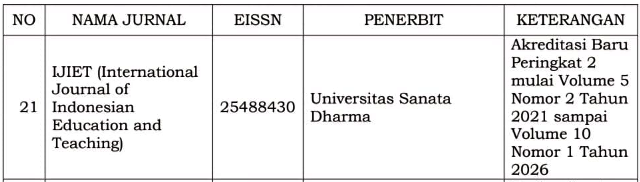

IJIET Sinta 2 Certificate (please click here)

This work is licensed under CC BY-SA.
This work is licensed under a Creative Commons Attribution-ShareAlike 4.0 International License.

IJIET DOI: https://doi.org/10.24071/ijiet
p-ISSN: 2548-8422 (since 5 January 2017); e-ISSN: 2548-8430 (since 5 January 2017)
IJIET (International Journal of Indonesian Education and Teaching) is published twice a year, namely in January and July, by the Institute for Research and Community Services of Sanata Dharma University, Yogyakarta, Indonesia.