




 Email this article
FRAMING INCLUSIVITY: A PHOTOVOICE EXPLORATION OF DISABILITY ACCOMMODATIONS IN SANATA DHARMA UNIVERSITY
(1) Scopus ID: 57204842926, Sanata Dharma University, Yogyakarta, Indonesia
(2) Sanata Dharma University, Yogyakarta, Indonesia
(3) Sanata Dharma University, Yogyakarta, Indonesia
(*) Corresponding Author
Abstract
The voices of students with disabilities in inclusive higher education have not been widely revealed. This study aims to capture the learning experience in inclusive higher education using the photovoice method involving students with disabilities (Deaf and autistic) and their student companions. The activities carried out are emphasized so that the subjects convey their aspirations. Subjects are asked to photograph, record, and reflect on their experiences of good practices in inclusive learning, concerns experienced, and suggestions for improvement. The problems experienced are problems regarding accessibility, availability of infrastructure, understanding of deaf and autistic culture, and career problems. Furthermore, a critical dialogue is carried out to reach policy makers at the university and efforts to provide better inclusive education services.
Keywords
Full Text:
PDFReferences
Alanazi, M. (2021). Communicating with deaf students in inclusive schools: Insights from saudi university faculty*. Eurasian Journal of Educational Research, 95(95), 188–209. https://doi.org/10.14689/EJER.2021.95.11
Amnesti, S. K. W., Jundiani, Zulaichah, S., Noh, M. S. M., & Fitriyah, L. (2023). Higher Education with Disabilities Policy: Ensuring Equality Inclusive Education in Indonesia, Singapore and United States. Journal of Human Rights, Culture and Legal System, 3(3), 412–440. https://doi.org/10.53955/jhcls.v3i3.135
Batista, M. Á. H., & García, N. S. (2023). Deaf students and the challenges they face in higher education. South Florida Journal of Development, 4(6), 2473–2491. https://doi.org/10.46932/sfjdv4n6-021
Butschi, C., & Hedderich, I. (2021). How to involve young children in a photovoice project. Experiences and results. Forum Qualitative Sozialforschung, 22(1), 1–26. https://doi.org/10.17169/fqs-22.1.3457
Capous-Desyllas, M., & Bromfield, N. F. (2018). Using an arts-informed eclectic approach to photovoice data analysis. International Journal of Qualitative Methods, 17(1). https://doi.org/10.1177/1609406917752189
Chinn, D., & Balota, B. (2023). A systematic review of photovoice research methods with people with intellectual disabilities. Journal of Applied Research in Intellectual Disabilities, 36(4), 725–738. https://doi.org/10.1111/jar.13106
Cluley, V. (2017). Using photovoice to include people with profound and multiple learning disabilities in inclusive research. British Journal of Learning Disabilities, 45(1), 39–46. https://doi.org/10.1111/bld.12174
Dassah, E., Aldersey, H. M., & Norman, K. E. (2017). Photovoice and Persons with Physical Disabilities: A Scoping Review of the Literature. In Qualitative Health Research (Vol. 27, Issue 9, pp. 1412–1422). SAGE Publications Inc. https://doi.org/10.1177/1049732316687731
Do, P. L., Frawley, P., Goldingay, S., & O’Shea, A. (2021). The Use of Photovoice in Research With People on the Autism Spectrum: A Meta-Synthesis of the Literature. Research in Autism Spectrum Disorders, 87(November 2020), 101828. https://doi.org/10.1016/j.rasd.2021.101828
Donnellan, L., & Mathews, E. S. (2021). Service providers’ perspectives on life skills and deaf and hard of hearing students with and without additional disabilities: transitioning to independent living. European Journal of Special Needs Education, 36(4), 547–561. https://doi.org/10.1080/08856257.2020.1776982
Hidayah, H., Sarwoprasodjo, S., & Matindas, K. (2020). Photovoice as a Participatory Extension Approaches Method in Expressing Youth Views of Agricultural Work. Jurnal Penyuluhan, 16(2), 303–322. https://doi.org/10.25015/16202031773
Mabruroh, A. F., Gunarhadi, G., & Widyastono, H. (2022). A Photovoice Study Exploring Deaf Students Experiences during The COVID-19 Pandemic. AL-ISHLAH: Jurnal Pendidikan, 14(1), 631–642. https://doi.org/10.35445/alishlah.v14i1.1120
McKeown, C., & McKeown, J. (2019). Accessibility in Online Courses: Understanding the Deaf Learner. TechTrends, 63(5), 506–513. https://doi.org/10.1007/s11528-019-00385-3
O’ Malley, L., & Munsell, S. (2020). Photovoice: An innovative qualitative method in research and classroom teaching. Educational Research: Theory and Practice, 31(1), 26–32. https://files.eric.ed.gov/fulltext/EJ1250278.pdf
Overmars-Marx, T., Thomése, F., & Moonen, X. (2018). Photovoice in research involving people with intellectual disabilities: A guided photovoice approach as an alternative. Journal of Applied Research in Intellectual Disabilities, 31(1), e92–e104. https://doi.org/10.1111/jar.12329
Ronzi, S., Pope, D., Orton, L., & Bruce, N. (2016). Using photovoice methods to explore older people’s perceptions of respect and social inclusion in cities: Opportunities, challenges and solutions. SSM - Population Health, 2, 732–745. https://doi.org/10.1016/j.ssmph.2016.09.004
Scott, P. (2020). Encyclopedia of International Higher Education Systems and Institutions. Encyclopedia of International Higher Education Systems and Institutions, December. https://doi.org/10.1007/978-94-017-9553-1
Shaw, A. (2024). Inclusion of disabled Higher Education students: why are we not there yet? International Journal of Inclusive Education, 28(6), 820–838. https://doi.org/10.1080/13603116.2021.1968514
Strack, B. R. W., Aronson, R. E., Orsini, M. M., Seitz, C. M., & Using, R. (2018). Journal of College Student Development, 59 (4), 491-498.
Sutton-Brown, C. A. (2014). Photovoice: A Methodological Guide. Photography and Culture, 7(2), 169–185. https://doi.org/10.2752/175145214X13999922103165
Teti, M., Cheak-Zamora, N., Lolli, B., & Maurer-Batjer, A. (2016). Reframing Autism: Young Adults With Autism Share Their Strengths Through Photo-Stories. Journal of Pediatric Nursing, 31(6), 619–629. https://doi.org/10.1016/j.pedn.2016.07.002
Tsang, K. K. (2020). Photovoice Data Analysis: Critical Approach, Phenomenological Approach, and Beyond. Beijing International Review of Education, 2(1), 136–152. https://doi.org/10.1163/25902539-00201009
Wang, C., & Burris, M. A. (1997). Photovoice: Concept, Methodology, and Use for Participatory Needs Assessment. Health Education and Behavior, 24(3), 369–387. https://doi.org/10.1177/109019819702400309
Wang, C. C. (1999). Photovoice: A participatory action research strategy applied to women’s health. Journal of Women’s Health, 8(2), 185–192. https://doi.org/10.1089/jwh.1999.8.185
Wass, R., Anderson, V., Rabello, R., Golding, C., Rangi, A., & Eteuati, E. (2020). Photovoice as a research method for higher education research. Higher Education Research and Development, 39(4), 834–850. https://doi.org/10.1080/07294360.2019.1692791
DOI: https://doi.org/10.24071/ijiet.v9i2.11528
Refbacks
- There are currently no refbacks.
Copyright (c) 2025 Irine Kurniastuti, Ignatia Esti Sumarah, Eny Winarti

This work is licensed under a Creative Commons Attribution-ShareAlike 4.0 International License.
Indexed and abstracted in:








IJIET Sinta 2 Certificate (S2 = Level 2)
We would like to inform you that IJIET (International Journal of Indonesian Education and Teaching):has been nationally re-accredited Sinta 2 by the Ministry of Higher Education, Science and Technology of the Republic of Indonesia based on the decree No. Surat Keputusan 355/DST/D.D1/HM.01.01/2026. Validity for 5 years: Vol 9 No 2, 2025 until Vol 14 No 1, 2030.
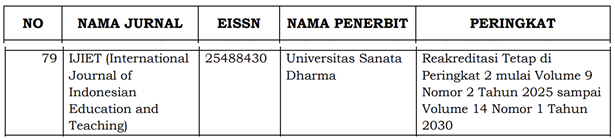
The new certificate is to upload when it is available. Thank you

IJIET Sinta 2 Certificate (please click here)

This work is licensed under CC BY-SA.
This work is licensed under a Creative Commons Attribution-ShareAlike 4.0 International License.

IJIET DOI: https://doi.org/10.24071/ijiet
p-ISSN: 2548-8422 (since 5 January 2017); e-ISSN: 2548-8430 (since 5 January 2017)
IJIET (International Journal of Indonesian Education and Teaching) is published twice a year, namely in January and July, by the Faculty of Teacher Training and Education of Sanata Dharma University, Yogyakarta, Indonesia.