




 Email this article

INVESTIGATING STUDENTS’ SELF-EFFICACY IN SPEAKING THROUGH THE USE OF PROJECT-BASED LEARNING
(1) Sanata Dharma University, Indonesia
(2) Sanata Dharma University, Indonesia
(*) Corresponding Author
Abstract
This research explored the role of podcast-making project within project-based learning (PBL) framework in enhancing students' self-efficacy in speaking English. Fifty-three second-semester students from two intermediate listening and speaking classes at a private university in Yogyakarta's English Language Education Study Program (ELESP) participated. A sequential explanatory mixed-method approach was employed. To provide robust findings, the data were collected using questionnaires, interviews, and classroom observations to provide more comprehensive findings. Quantitative data were examined using paired sample t-tests, while thematic analysis was leveraged for the qualitative data. The findings disclosed a significant improvement in students' self-efficacy, as evidenced by an increase in mean scores and a decrease in variance, indicating greater consistency of confidence levels. In addition, the qualitative insights identified four major themes as the factors in enhancing students' self-efficacy: growth through personal challenge, modelling success as vicarious learning, collaborative environment, and emotional regulation and coping strategies. These findings suggested that integrating PBL, such as podcast-making, into language education can effectively foster students' self-efficacy and ability to communicate in real-world scenarios. Further implications are provided, suggesting that educators can adopt similar PBL activities to help learners overcome psychological barriers and develop a positive mindset toward speaking in English.
Keywords
Full Text:
PDFReferences
Ary, D., Jacobs, L. C., Sorensen, C. K., & Walker, D. A. (2014). Introduction to research in education (9th edition). Boston, MA: Wadsworth Cengage Learning.
Bandura, A. (1995). Self-efficacy in changing societies. Cambridge: Cambridge University Press.
Bender, W. N. (2012). Project-based learning differentiating instruction for the 21st century. Thousand Oaks, CA: Corwin.
Braun, V., & Clarke, V. (2006). Using thematic analysis in psychology. Qualitative Research in Psychology, 3(2), 77–101.
Braun, V., & Clarke, V. (2020). Can I use TA? Should I use TA? Should I not use TA? Comparing reflexive thematic analysis and other pattern-based qualitative analytic approaches. Counselling and Psychotherapy Research, 21(1), 37-47. https://doi.org/10.1002/capr.12360
Buwono, S. A., & Surono. (2024). Exploring students’ voices in creating podcast as project based learning in speaking class. PROJECT (Professional Journal of English Education), 7(4), 866–873.
Chen, G., Gully, S. M., & Eden, D. (2001). Validation of a new general self-efficacy scale. Organizational Research Methods, 4(1), 62–83.
Christou, P. A. (2024). Thematic analysis through artificial intelligence (AI). Qualitative Report, 29(2), 560–576. https://doi.org/10.46743/2160-3715/2024.7046
Creswell, J. W., & Creswell, J. D. (2022). Research design qualitative, quantitative, and mixed methods approaches (6th ed.). Thousand Oaks, CA: SAGE Publications, Inc.
Darmawan, D., Alam, S. P., & Nirma, O. N. (2021). Speaking self-efficacy of EFL students of pre-service teaching program in EFL classroom setting. JET (Journal of English Teaching), 7(2), 150–162. https://doi.org/10.33541/jet.v7i2.2582
Djahimo, S. E. P. (2018). Student anxiety and their speaking performance: teaching EFL to Indonesian student. International Journal of Social Sciences and Humanities, 2(3), 187–195. https://doi.org/10.29332/ijssh.v2n3.235
EF Global Site. (2023). EF English proficiency index. 2023. https://www.ef.com/wwen/epi/regions/asia/indonesia/
Etikan, I., Musa, S. A., & Alkassim, R. S. (2015). Comparison of convenience sampling and purposive sampling. American Journal of Theoretical and Applied Statistics, 5(1), 1-4. https://doi.org/10.11648/j.ajtas.20160501.11
Franscy, F., & Ramli, R. (2022). Problems encountered by Indonesian EFL learners in mastering speaking skills. Pioneer: Journal of Language and Literature, 14(1), 1-14. https://doi.org/10.36841/pioneer.v14i1.1176
Giri, O. P. (2024). Choosing sampling techniques and calculating sample size. Indonesian Journal of Teaching in Science, 4(2), 165–176. https://doi.org/10.17509/ijotis.v4i2.75472
Guest, G., Namey, E., & Chen, M. (2020). A simple method to assess and report thematic saturation in qualitative research. PLoS ONE, 15(5), 1–17. https://doi.org/10.1371/journal.pone.0232076
Hansen, C. B. (2019). The heart and science of teaching: Transformative applications that integrate academic and social-emotional learning. New York: Teachers College Press.
Ifwandi, M., Asra, F., Zuhri, M., & Muliardi, M. (2024). Improving English speaking skills through the project based learning model. International Conference on Education and Innovation, 1(June), 159–169.
Indahyanti, R., Rahman, A. W., & Mursidin, M. (2023). Measuring language anxiety of EFL students in public speaking. Klasikal: Journal of Education, Language Teaching and Science, 5(1), 196–203. https://doi.org/10.52208/klasikal.v5i1.666
Kuntariati, U., & Paramita, P. D. Y. (2024). IPPL’s strategies for improving English speaking skills among students at IPB Internasional. Stilistika : Jurnal Pendidikan Bahasa Dan Seni, 13(1), 120–128. https://doi.org/10.59672/stilistika.v13i1.4116
Laksana, I. P. Y., Yuliantini, N. N., Suciani, N. K., Purandina, I. P. Y., & Boyce, G. P. (2021). Employing e-portfolio based learning in improving self-efficacy of student’s speaking ability. Journal of Applied Studies in Language, 5(2), 229–236. https://doi.org/10.31940/jasl.v5i2.229-236
Laksanasut, S. (2024). Enhancing English language skills of EFL students in Thailand’s EEC context through project-based learning. SEAQIL Journal of Language Education, 3(2), 186–197. https://www.journal.qiteplanguage.org/index.php/sjle/article/view/64
Maulidha, H., & Tiatri, S. (2023). The effectiveness of “speak up now” training with vicarious experience to improve public speaking self-efficacy. International Journal of Application on Social Science and Humanities, 1(2), 1503–1514. https://doi.org/10.24912/ijassh.v1i2.26397
Memon, M. A., Thurasamy, R., Ting, H., & Cheah, J. H. (2025). Purposive sampling: A review and guidelines for quantitative research. Journal of Applied Structural Equation Modeling, 9(1), 1–23. https://doi.org/10.47263/JASEM.9(1)01
Mulyanto, H., Azizam, E. S. H. B., & Jusoh, J. (2022). Self-efficacy of Indonesian English foreign language learners in speaking English. International Journal of English and Applied Linguistics (IJEAL), 2(3), 459–468. https://doi.org/10.47709/ijeal.v2i3.1884
Ningias, R. A., & Indriani, L. (2021). EFL students’ perspectives on their self-efficacy in speaking during online learning process. English Learning Innovation, 2(1), 28–34. https://doi.org/10.22219/englie.v2i1.14965
Omar, T. K. (2023). Students’ challenges in EFL speaking classrooms. Academic Journal of Nawroz University, 12(4), 957–963. https://doi.org/10.25007/ajnu.v12n4a1809
Poedjiastutie, D., Amrin, Z. A., & Setiawan, Y. (2018). English communication competence: Expectations and challenges (A case in Indonesia). International Journal of Applied Linguistics and English Literature, 7(6), 184. https://doi.org/10.7575/aiac.ijalel.v.7n.6p.184
Pramerta, I. G. P. A. (2023). The impact of self-efficacy towards speaking performance. Journal of Psychology and Instruction, 5(3), 101–108. https://doi.org/10.23887/jpai.v5i3.65001
Pratolo, B., Habibie, A., & Setiawan, A. (2019). Speaking skill challenges encountered by Indonesian EFL Learners’. 370, 28–32. https://doi.org/10.2991/adics-elssh-19.2019.7
Rahimi, S., & khatooni, M. (2024). Saturation in qualitative research: An evolutionary concept analysis. International Journal of Nursing Studies Advances, 6(January), 100174. https://doi.org/10.1016/j.ijnsa.2024.100174
Rahmat, N. H., Abu Bakar, A. M., Zamri, A. H., Roslan, A. N., Zakaria, A. Z., Sabandi, D. T. A., & Zaki, M. A. I. M. (2021). A study of speech anxiety among ESL learners. European Journal of English Language Teaching, 6(4), 34–47. https://doi.org/10.46827/ejel.v6i4.3736
Ramadhanty, F., Mandalika, D., & Sumarni, S. (2023). The effectiveness of self-directed learning for English language education: A systematic literature review. English Language & Literature International Conference (EELiC), 6(1), 348–356.
Sah, F., Sasikirana, H. N., & Pujiani, T. (2024). The role of project-based learning in developing 21st century skills in EFL classes. Jadila: Journal of Development and Innovation in Language and Literature Education, 4(4), 257-272. https://doi.org/10.52760/jadila.v4i4.797
Santoso, D. R., Affandi, G. R., & Basthomi, Y. (2024). ‘Getting stuck’: A study of Indonesian EFL learners’ self-efficacy, emotional intelligence, and speaking achievement. Studies in English Language and Education, 11(1), 384–402. https://doi.org/10.24815/siele.v11i1.30969
Sharma, S. K., Mudgal, S. K., Gaur, R., Chaturvedi, J., Rulaniya, S., & Sharma, P. (2024). Navigating sample size estimation for qualitative research. Journal of Medical Evidence, 5(2), 133–139. https://doi.org/10.4103/jme.jme_59_24
Shin, M.-H. (2018). Effects of project-based learning on students’ motivation and self-efficacy. English Teaching, 73(1), 95–114. https://doi.org/10.15858/engtea.73.1.201803.95
Siregar, F. S., Ramadhan, A., Daulay, E., Islam, U., Sumatera, N., & Medan, U. (2024). Project- based learning: enhancing EFL students’ speaking skill through vlog. Jurnal Nakula : Pusat Ilmu Pendidikan, Bahasa Dan Ilmu Sosial, 2(5), 346–361. https://doi.org/10.61132/nakula.v2i5.1109
Sudarso, H., Nurhikmah, A., Deiniatur, M., Megawati, & Syam, A. F. (2024). Analyzing the use of project-based learning in English education: Enhancing student engagement and communications skills. Edu Cendikia: Jurnal Ilmiah Kependidikan, 4(01), 161–168. https://doi.org/10.47709/educendikia.v4i01.4305
Suharja, S. (2020). The correlation of self-efficacy to the students’ speaking performance in EFL context at University of Dayanu Ikhsanuddin Baubau. English Education Journal, 17–25. https://doi.org/10.55340/e2j.v6i1.285
Sulistyo, T., & Lutviana, R. (2023). How far can I go? Video project-based learning as a meaning-making process to promote students’ speaking proficiency. VELES (Voices of English Language Education Society), 7(2), 253–264. https://doi.org/10.29408/veles.v7i2.21141
Sumarsono, D., Muliani, M., & Bagis, A. K. (2020). The forecasting power of task-based language teaching and self-efficacy on students’ speaking performance. Journal of Languages and Language Teaching, 8(4), 412. https://doi.org/10.33394/jollt.v8i4.2848
Tauchid, A. (2023). English speaking strategies by EFL learners to enhance self-efficacy. Jurnal Ilmiah Pendidik Indonesia, 2(2), 48–61. https://doi.org/10.56916/jipi.v2i2.663
Touzard, L. I. M., Noriega, M. A. C., & Rugel, L. H. B. (2023). Developing 21st-century skills through PBL in a public university. Podium, 43, 111–128. https://doi.org/10.31095/podium.2023.43.7
Tyas, N. K., & Fitriani, N. (2021). Enhancing students speaking skills by making video tutorial as project based learning. IDEAS: Journal on English Language Teaching and Learning, Linguistics and Literature, 9(2), 233–244. https://doi.org/10.24256/ideas.v9i2.2262
Wijayanti, F., & Budi, A. B. (2023). Project-based learning in EFL classroom: strategies for success. Journal of English in Academic and Professional Communication, 9(2), 108–117. https://doi.org/10.25047/jeapco.v9i2.4086
Winnie, W., Leong, H. J., Badiozaman, I. F., & Yap, A. (2023). Negotiating the challenges in speaking English for Indonesian undergraduate students in an ESL university. Studies in English Language and Education, 10(2), 822–840. https://doi.org/10.24815/siele.v10i2.26563
Yuan, J., Huang, M., & Shi, X. (2024). Correlation between English speaking self-efficacy and proficiency: A case study of English at modern college of Northwest University. Journal of Education and Educational Research, 8(3), 88-93. https://doi.org/10.54097/05z8db75
Zhou, C. (2023). The impact of the project-based learning method on students. BCP Education & Psychology, 9, 20–25. https://doi.org/10.54691/bcpep.v9i.4603
DOI: https://doi.org/10.24071/ijiet.v9i2.11365
Refbacks
- There are currently no refbacks.
Copyright (c) 2025 Regina Putri Nernere

This work is licensed under a Creative Commons Attribution-ShareAlike 4.0 International License.
Indexed and abstracted in:








IJIET Sinta 2 Certificate (S2 = Level 2)
We would like to inform you that IJIET (International Journal of Indonesian Education and Teaching):has been nationally re-accredited Sinta 2 by the Ministry of Higher Education, Science and Technology of the Republic of Indonesia based on the decree No. Surat Keputusan 355/DST/D.D1/HM.01.01/2026. Validity for 5 years: Vol 9 No 2, 2025 until Vol 14 No 1, 2030.
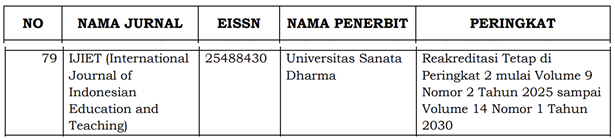
The new certificate is to upload when it is available. Thank you

IJIET Sinta 2 Certificate (please click here)

This work is licensed under CC BY-SA.
This work is licensed under a Creative Commons Attribution-ShareAlike 4.0 International License.

IJIET DOI: https://doi.org/10.24071/ijiet
p-ISSN: 2548-8422 (since 5 January 2017); e-ISSN: 2548-8430 (since 5 January 2017)
IJIET (International Journal of Indonesian Education and Teaching) is published twice a year, namely in January and July, by the Faculty of Teacher Training and Education of Sanata Dharma University, Yogyakarta, Indonesia.