




 Email this article
DYNAMICS OF BIOSTATISTICS LEARNING: CHALLENGES AND OPPORTUNITIES TO IMPROVE TEACHING EFFECTIVENESS FOR NURSING STUDENTS
(1) Tanjungpura University, Indonesia
(2) Tanjungpura University, Indonesia
(3) Tanjungpura University, Indonesia
(4) Tanjungpura University, Indonesia
(5) Tanjungpura University, Indonesia
(6) Tanjungpura University, Indonesia
(*) Corresponding Author
Abstract
Biostatistics is an important subject in nursing education because it contributes to clinical decision-making and health research. However, many nursing students find biostatistics difficult because they are not directly used in nursing practice. This study aims to explore the dynamics of biostatistical learning to improve teaching approaches in the future. The study uses a Mixed Methods Research (MMR) design with an explanatory sequential approach which is carried out in two stages. The first stage involved 94 nursing students to measure satisfaction and concentration in learning. Quantitative results revealed that 80.9% of students were satisfied, although dissatisfaction arose from unclear goals and inappropriate lecture times. In addition, 72.3% of students had moderate concentration, with peer conversation invitations being the main challenge. In the second stage, a Focus Group Discussion (FGD) with 8 students explored these findings further. The integration of qualitative and quantitative data identifies key themes, namely clarity of learning objectives, lecture time, classroom atmosphere, technology support, and teaching effectiveness. These findings emphasize the need for better teaching strategies and time management to improve student satisfaction, focus, and understanding of biostatistics. Addressing this dimension will increase the effectiveness of biostatistics education for nursing students.
Keywords
Full Text:
PDFReferences
Alaagib, N. A., Musa, O. A., & Saeed, A. M. (2019). Comparison of the effectiveness of lectures based on problems and traditional lectures in physiology teaching in Sudan. BMC Medical Education, 19(1), 1–8. https://doi.org/10.1186/s12909-019-1799-0
Ali, S. I., & Khan, A. S. (2018). Effect of a course of biostatistics in an integrated curriculum. Journal of Medical Diagnostic Methods, 07(01), 7–8. https://doi.org/10.4172/2168-9784.1000268
Anthony, B., Kamaludin, A., Romli, A., Raffei, A. F. M., Nincarean A/L Eh Phon, D., Abdullah, A., Ming, G. L., Shukor, N. A., Nordin, M. S., & Baba, S. (2019). Exploring the role of blended learning for teaching and learning effectiveness in institutions of higher learning: An empirical investigation. Education and Information Technologies, 24(6), 3433–3466. https://doi.org/10.1007/s10639-019-09941-z
Babaahmadi, A., Maraghi, E., Moradi, S., & Younespour, S. (2021). Comparison between peer learning and conventional methods in biostatistics course among postgraduate nursing students’ final score, statistics and test anxiety: A quasi-experimental study with a control group. Shiraz E Medical Journal, 22(11), 111984. https://doi.org/10.5812/SEMJ.111984
Behnagh, R. F., & Yasrebi, S. (2020). An examination of constructivist educational technologies: Key affordances and conditions. British Journal of Educational Technology, 51(6), 1907–1919. https://doi.org/10.1111/bjet.13036
Bernacki, M. L., Greene, J. A., & Crompton, H. (2019). Mobile technology, learning, and achievement: Advances in understanding and measuring the role of mobile technology in education. Contemporary Educational Psychology, 60, 101827. https://doi.org/10.1016/j.cedpsych.2019.101827
Coronado-Vázquez, V., Canet-Fajas, C., Delgado-Marroquín, M. T., Magallón-Botaya, R., Romero-Martín, M., & Gómez-Salgado, J. (2020). Interventions to facilitate shared decision-making using decision aids with patients in primary health care a systematic review. Medicine (United States), 99(32), E21389. https://doi.org/10.1097/MD.0000000000021389
Ibrahim, S. A., Mas, S. R., Suking, A., & Rahim, N. K. (2022). Perbandingan sistem pendidikan sarjana keperawatan Indonesia dan Inggris. Edukatif : Jurnal Ilmu Pendidikan, 4(4), 5558–5563. https://doi.org/10.31004/edukatif.v4i4.3054
Iqbal, F., Perveen, K., Ashraf, T., & Sarwar, H. (2021). Bio-statistical learning needs: A qualitative study on perceptions of post graduate nursing students and experts. Pakistan Journal of Medical and Health Sciences, 15(9), 2425–2428. https://doi.org/10.53350/pjmhs211592425
Kelleci, M., Yilmaz, F. T., & Aldemir, K. (2018). The effect of high fidelity simulation training on critical thinking and problem solving skills in nursing students in Turkey. Educational Research in Medical Sciences, 7(2), e83966. https://doi.org/10.5812/erms.83966
König, J., Krepf, M., Bremerich-Vos, A., & Buchholtz, C. (2021). Meeting cognitive demands of lesson planning: Introducing the CODE-PLAN model to describe and analyze teachers’ planning competence. Teacher Educator, 56(4), 466–487. https://doi.org/10.1080/08878730.2021.1938324
Lai, J. W. M., & Bower, M. (2019). How is the use of technology in education evaluated? A systematic review. Computers & Education, 133, 27-42. https://doi.org/10.1016/j.compedu.2019.01.010
Lazarides, R., Watt, H. M. G., & Richardson, P. W. (2020). Teachers’ classroom management self-efficacy, perceived classroom management and teaching contexts from beginning until mid-career. Learning and Instruction, 69(April), 101346. https://doi.org/10.1016/j.learninstruc.2020.101346
Lee-Robbins, E., & Adar, E. (2023). Affective learning objectives for communicative visualizations. IEEE Transactions on Visualization and Computer Graphics, 29(1), 1–11. https://doi.org/10.1109/TVCG.2022.3209500
Li, C., Zhang, Y., Qin, W., Xia, J., Shang, L., & Wang, L. (2024). Assessing attitudes towards biostatistics education among medical students: Adaptation and preliminary evaluation of the Chinese version survey of attitudes towards statistics (SATS-36). BMC Medical Education, 24(1), 1–15. https://doi.org/10.1186/s12909-024-05548-2
Makinde, S. O., Atotileto, A. A., & Sulyman, M. B. (2024). Proposal to develop and validate a Moodle-based flipped learning platform for enhancing arabic communication skills. International Journal of Indonesian Education and Teaching, 8(2), 207–222. https://doi.org/10.24071/ijiet.v8i2.8075
Ocakoğlu, G., Kaya, M. O., Can, F. E., Atış, S., & Macunluoğlu, A. C. (2019). Nursing professionals’ attitudes toward biostatistics: An international web-based survey. The European Research Journal, 5(2), 326–334. https://doi.org/10.18621/eurj.383180
Ordak, M. (2024). Enhancing biostatistics education for medical students in Poland: factors influencing perception and educational recommendations. BMC Medical Education, 24(1), 1–9. https://doi.org/10.1186/s12909-024-05389-z
Otache, I. (2019). Enhancing the effectiveness of entrepreneurship education: The role of entrepreneurial lecturers. Education and Training, 61(7–8), 918–939. https://doi.org/10.1108/ET-06-2018-0127
Rebele, J. E., & St. Pierre, E. K. (2019). A commentary on learning objectives for accounting education programs: The importance of soft skills and technical knowledge. Journal of Accounting Education, 48, 71–79. https://doi.org/10.1016/j.jaccedu.2019.07.002
Tang, K. N. (2020). The importance of soft skills acquisition by teachers in higher education institutions. Kasetsart Journal of Social Sciences, 41(1), 22–27. https://doi.org/10.1016/j.kjss.2018.01.002
Tomak, L., & Cıvanbay, H. (2022). Evaluation of biostatistics knowledge and skills of medical faculty students. Journal of Experimental and Clinical Medicine (Turkey), 39(3), 620–627. https://doi.org/10.52142/omujecm.39.3.5
Troy, J. D., Neely, M. L., Grambow, S. C., & Samsa, G. P. (2021). The biomedical research pyramid: A model for the practice of biostatistics. Journal of Curriculum and Teaching, 10(1), 10–17. https://doi.org/10.5430/jct.v10n1p10
Truglio-Londrigan, M., & Slyer, J. T. (2018). Shared decision-making for nursing practice: An integrative review. The Open Nursing Journal, 12(1), 1–14. https://doi.org/10.2174/1874434601812010001
Uzir, N.A., Gašević, D., Matcha, W., Jovanović, J., & Pardo, A. (2020). Analytics of time management strategies in a flipped classroom. Journal of Computer Assisted Learning, 36(1), 70–88. https://doi.org/10.1111/jcal.12392
Wieman, C. E. (2019). Expertise in university teaching & the implications for teaching effectiveness, evaluation & training. Daedalus, 148(4), 47–78. https://doi.org/10.1162/DAED_a_01760
Winahyu, K. M. (2023). Beyond citation counts: Dampak penerbitan artikel terhadap pengembangan karir peneliti keperawatan. Jurnal Ilmiah Keperawatan Indonesia (JIKI), 6(2), 121. https://doi.org/10.31000/jiki.v6i2.8259
Wolff, C. E., Jarodzka, H., & Boshuizen, H. P. A. (2021). Classroom management scripts: A theoretical model contrasting expert and novice teachers’ knowledge and awareness of classroom events. Educational Psychology Review, 33(1), 131–148. https://doi.org/10.1007/s10648-020-09542-0
DOI: https://doi.org/10.24071/ijiet.v9i2.11281
Refbacks
- There are currently no refbacks.
Copyright (c) 2025 Yuyun Tafwidhah, Mita Mita, Muhammad Ali Maulana, Yoga Pramana, Hanafi Hanafi, Muhammad Agung Krisdianto

This work is licensed under a Creative Commons Attribution-ShareAlike 4.0 International License.
Indexed and abstracted in:








IJIET Sinta 2 Certificate (S2 = Level 2)
We would like to inform you that IJIET (International Journal of Indonesian Education and Teaching):has been nationally re-accredited Sinta 2 by the Ministry of Higher Education, Science and Technology of the Republic of Indonesia based on the decree No. Surat Keputusan 355/DST/D.D1/HM.01.01/2026. Validity for 5 years: Vol 9 No 2, 2025 until Vol 14 No 1, 2030.
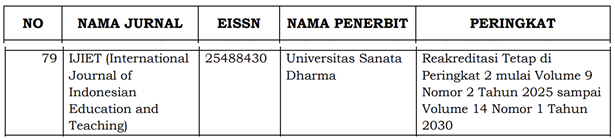
The new certificate is to upload when it is available. Thank you

IJIET Sinta 2 Certificate (please click here)

This work is licensed under CC BY-SA.
This work is licensed under a Creative Commons Attribution-ShareAlike 4.0 International License.

IJIET DOI: https://doi.org/10.24071/ijiet
p-ISSN: 2548-8422 (since 5 January 2017); e-ISSN: 2548-8430 (since 5 January 2017)
IJIET (International Journal of Indonesian Education and Teaching) is published twice a year, namely in January and July, by the Faculty of Teacher Training and Education of Sanata Dharma University, Yogyakarta, Indonesia.