


 Email this article
 MOTIVATION-IN-CONTEXT: A STUDY OF L2 IDENTITY FORMATION IN A DOMINANTLY L1 UNIVERSITY ENVIRONMENT
(1) Northern Uni, Sri Lanka
(*) Corresponding Author
Abstract
This study was conducted to identify the interplay between the formation of self-image and the perception of learners about their identity as Sri Lankan English speakers. Motivation in language learning has been associated with various factors (motives) that play a role in persuading the learners to learn a language. Recent research in motivation have picturised motivation as a crucial element in language learning which is affected by a host of other factors that are contextually unique. In Sri Lankan tertiary learning environment, the need for English language has been felt mostly in the higher education and employment of the graduates. Thus, I aimed at obtaining answer to the question whether and how the learning experiences learners gain in the university of Jaffna motivate them to accomplish their language goals. I wanted to examine the role of their perception of their identity English speakers since this realisation is significant in pushing a learner forward to achieve their language goals. I used mixed methods research and gathered data from forty participants using questionnaire and selected five among them for semi-structured interview. Results revealed that compared to their school learning experiences, university provided them with adequate opportunities to be in English speaking environment and factors like their self-confidence, social expectations, and socioeconomic background supported in this process. However, since most of these opportunities were provided outside their language classroom, they benefitted only a few learners. Therefore, it is recommended that language classrooms provide more such opportunities relevant to learners' proficiency.
Keywords
Full Text:
PDFReferences
Aloysius, M. (2015). Problems of English teaching in Sri Lanka: How they affect teaching efficacy [Dissertation, University of Bedfordshire, Luton].
Arman, A., Paida, A., & Dahlan, M. (2023). Menggali kekayaan linguistik: Variasi penyapaan dalam interaksi verbal siswa menengah pertama. Jurnal Bintang Pendidikan Indonesia, 1(4), 177-200.
Darwin, D., & Evizariza, E. (2024). The role of language in identity formation: A linguistic perspective in education. Jurnal of Pedagogi: Jurnal Pendidikan, 1(6), 50-55. https://doi.org/10.62872/65fmp546
De Silva, R., & Devendra, D. (2014). Responding to english language needs of undergraduates: Challenges and constraints. OUSL Journal, 7, 1-24. https://doi.org/10.4038/ouslj.v7i0.7305
Dornyei, Z. (2019). Towards a better understanding of the L2 learning experience, the Cinderella of the L2 motivational self system. Studies in Second Language Learning and Teaching, 9(1), 19-30. https://doi.org/10.14746/ssllt.2019.9.1.2
Dornyei, Z., & Otto, I. (1998). Motivation in action: A process model of L2 motivation. Working Papers in Applied Linguistics, 4, 43-69.
Dornyei, Z., & Ushioda, E. (2011). Teaching and researching motivation (2nd ed.). Harlow: Pearson.
Evans, M., & Fisher, L. (2022). The relevance of identity in languages education. The Language Learning Journal, 50(2), 218–222. https://doi.org/10.1080/09571736.2022.2046693
Gunaratne, M., Chamalika, H., Fernando, S., & Jeganathan, T. (2021). English language teaching in Sri Lanka: Issues, concerns and remedies. International Journal of Scientific Research and Engineering Development, 4(5), 1211-1222.
Perera, M. (2006). “Why not? But I can’t” – Influence of a ‘culture of poverty’ on learning - a case study. Sabaragamuwa University Journal, 6(1), 23-34. https://doi.org/10.4038/suslj.v6i1.1687
Perera, M. E. (2001). The role of classroom interaction in second language acquisition in Sri Lanka. University of Wollongong Thesis Collections, 1-367.
Prasangani, K.S.N. (2014). Global English: A study of factors that affect English language learning motivation in Sri Lankan undergraduates. Global Conference on Business & Social Science, 172, 794-800. Kula Lampur: Elsevier Ltd. https://doi.org/10.1016/j.sbspro.2015.01.434
Prasangani, K.S.N. (2019). L2 learners’ expected ideal English as a second language (ESL) teacher. The Asian Journal of English Language & Pedagogy, 7(2), 10-17. https://doi.org/10.37134/ajelp.vol7.2.2.2019
Prasangani, K.S.N. (2018). Investigation of L2 motivational self system: a comparative study of undergraduates from displaced and resettled regions in Sri Lanka. Sabaragamuwa University Journal, 16(1), 58-67. https://doi.org/10.4038/suslj.v16i1.7719
Prasangani, K.S.N., & Natarajan, S. (2015). Sri Lankan urban and rural undergraduates' motivation to learn English. International Journal of Technical Research and Applications, 26-33.
Premalal, K.K.D. (2004, October 12). Rural school teacher presents novel technique. Sunday Observer. Post: archieves.sundaybserver.lk
Rameez, A. (2019). English language proficiency and employability of university students: A sociological study of undergraduates at the faculty of arts and culture, South Eastern University of Sri Lanka (SEUSL). International Journal of English Linguistics, 9(2), 199-209. https://doi.org/10.5539/ijel.v9n2p199
Ratwatte, H. (2012). Kaduva, Karawila or Giraya? Orientation towards English in 21st century Sri Lanka. Journal of Humanities & Social Sciences, 7(8), 180-203.
Sugianto, A. (2022). [Book Review] Systemic functional linguistics (SFL) and teacher education in EFL context by Wawan Gunawan. JLA (Jurnal Lingua Applicata), 5(2), 145-150.
Sumanasekara, D.G. (2010, July 18). Problems lies with the teaching methods rather than the syllabus itself. The Sunday Times. Post: www.sundaytimes.lk
Wijeratne, W. H. (2015). A study of second language identity and motivation among undergraduates in Sri Lankan universities [Thesis, St. Cloud State, Minnesota]. Retrieved from https://repository.stcloudstate.edu/engl_etds/21
Wijesekera, H. D. (2012). Dreams deferred: English language teaching in Sri Lanka. SSRN Electronic Journal, 1-12. https://doi.org/10.2139/ssrn.2438893
DOI: https://doi.org/10.24071/uc.v6i2.13512
Refbacks
- There are currently no refbacks.
Copyright (c) 2025 Sharmi Shanmuganathan

This work is licensed under a Creative Commons Attribution-ShareAlike 4.0 International License.
UC Journal is indexed in:







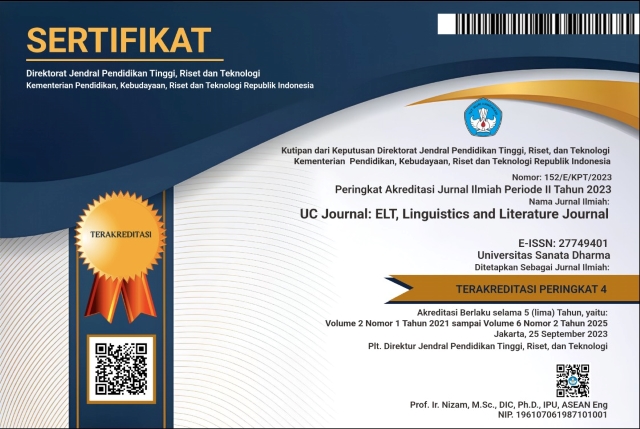
UC Journal Sinta 4 Certificate (S4 = Level 4)
We would like to inform you that UC Journal: ELT, Linguistics and Literature Journal, or UC Journal has been nationally accredited Sinta 4 by the Ministry of Education, Culture, Research and Technology of the Republic of Indonesia based on the decree No. Surat Keputusan 152/E/KPT/2023. Validity for 5 years: Vol 2 No 1, 2021 till Vol 6 No 2, 2025
DOI: https://doi.org/10.24071/uc
e-ISSN (validity starting Vol 1, No 2, November 2020): 2774-9401

This work is licensed under CC BY-SA.
Creative Commons Attribution-ShareAlike 4.0 International License
 UC Journal: ELT, Linguistics and Literature Journal, a scientific peer-reviewed journal, was established in 20 May 2020 and is published twice a year, namely in May and November, by the English Language Education Study Programme (S1/Sarjana PBI) in collaboration with the English Education Master's Programme (S2/Magister PBI) of Sanata Dharma University, Yogyakarta, Indonesia.