


 Email this article
NECESSITY OF PROPER EVALUATION IN EAP (ENGLISH FOR ACADEMIC PURPOSES) COURSES
(1) Lecturer, Department of English, R. P. Shaha University, Narayanganj, Bangladesh
(*) Corresponding Author
Abstract
The paper shows the necessity of proper evaluation in EAP courses. It focuses on the roles of different stakeholders (learners, instructors, administrators) in evaluating EAP courses and settings, drawing on previously published articles. Further, it focuses on the impacts of evaluation on different stakeholders. This study emphasizes the positive impacts of proper evaluation and the negative impacts of improper evaluation, simultaneously considering the overall academic settings and organizational goals; to identify different variables; a rigorous analysis of the opinions of the participants is made. Besides, different spectacles are added in this paper by analyzing different literature and documents regarding EAP evaluation. Mainly, the focus of the paper is to show how the evaluation of EAP courses acts as a vital factor in academic contexts. As evaluation is one of the pillars of ESP, and proper evaluation can directly show the performances of the learners and instructors and can also show the viability of running a course or program in an academy, all the stakeholders, including administrators, need to remain careful to evaluate the other stakeholders properly and in a well-maintained academic manner. For this research, the qualitative descriptive method was employed. The analysis shows the impact of evaluation on different stakeholders of EAP courses.
Keywords
Full Text:
PDFReferences
Amin, M. A., & Greenwood, J. (2018). The examination system in Bangladesh and its impact: On curriculum, students, teachers and society. SpringerOpen,8(4). https://doi.org/10.1186/s40468-018-0060-9
Anthony, L. (2018). Introducing English for specific purposes. London, England: Routledge.
Barkaoui, K., Holmes, J., & Van Viegen, S. (2025). Pre-admission EAP course completion as evidence of English language proficiency for university admission: A longitudinal evaluation study. Journal of English for Academic Purposes, 77, 1-17. https://doi.org/10.1016/j.jeap.2025.101555
Basak, A. (2016). Challenges of English for academic purposes (EAP) in Bangladeshi universities. Feni University Journal, 1(1), 42–52.
Bilal, S., & Gul, S. (2014). Grading and student evaluation: Challenges and consequences. Excellence International Journal of Scientific Research, 1(2), 23-27.
Çelik, H. (2018). A closer look into an ESP course through students’ end-of-course evaluations: A case study. The Journal of Teaching English for Specific and Academic Purposes, 6(1), 125-139. https://doi.org/10.22190/JTESAP1801125C
Cheng, L. (2017). Assessment in the language classroom: Teachers supporting student learning. London: Palgrave Macmillan.
Das, E. (2019). Testing and evaluation: An effective process of learning language. International Journal of English Learning and Teaching Skills, 1(1), 27–34.
Elder, C., & Davies, A. (2006). Assessing English as a lingua franca. In C. Elder & A. Davies (Eds.), Annual review of applied linguistics (pp. 282–301). Cambridge: Cambridge University Press.
Farid, M., Fakhruddin, Z., & Dalle, A. (2024). Assessment practice in EFL classroom: Purpose, methods and scoring. JELITA: Journal of English Language Teaching and Literature, 5(2), 408–420. https://doi.org/10.56185/jelita.v5i2.758
Floris, F. D. (2008). Developing English for general academic purposes (EGAP) course in an Indonesian university. Kata: A Biannual Publication on the Study of Language and Literature, 10(1), 53-62. https://doi.org/10.9744/kata.10.1.53-62
Graves, K. (2000). Designing language courses: A guide for teachers. Boston, MA: Heinle and Heinle. https://www.tesl-ej.org/ej16/r8.html
Islam, M. S., Hasan, M. K., Sultana, S., Karim, A., & Rahman, M. M. (2021). English language assessment in Bangladesh today: Principles, practices, and problems. Language Testing in Asia, 11(1), 1–21. https://doi.org/10.1186/s40468-020-00116-z
Maizatulliza, M., & Kiely, R. (2017). Students' evaluation of their English language learning experience. DINAMIKA ILMU, 17(2), 205–222. http://dx.doi.org/10.21093/di.v17i2.837
Manikamma, M. (2019). IQAC role in quality assurance of higher education. International Journal of Advance Research, Ideas and Innovations in Technology, 5(3), 1262–1266.
O’Grady, S., Rotsinger, A., & Carver, M. (2025). Prioritising authenticity in live lecture comprehension pre-sessional assessment task design. Journal of English for Academic Purposes, 77, 1–14. https://doi.org/10.1016/j.jeap.2025.101554
Pandey, G. P. (2019). English for academic purposes: Theory, trends and practices. Education and Development, 1(1), 1–14. https://doi.org/10.3126/ed.v29i0.32562
Pešić, T., & Jokanović, V. (2024). English for specific purposes: English language as a platform for courses on academic writing in higher education. In Proceedings of the International Multidisciplinary Conference “Challenges of Contemporary Higher Education” –CCHE 2024 (pp. 889–894).
Schmitz, J. R. (2012). To ELF or not to ELF? (English as a lingua franca): That’s the question for applied linguistics in a globalized world. RBLA, 12(2), 249–284. https://doi.org/10.1590/S1984-63982012000200003
Sharndama, E. C., Samaila, Y., & Tsojon, Y. I. (2014). English for academic purpose: A tool for enhancing students’ proficiency in English language skills. International Journal of English Language Teaching, 1(2), 14–20. https://doi.org/10.5430/ijelt.v1n2p14
Taylor, L., & Geranpayeh, A. (2011). Assessing listening for academic purposes: Defining and operationalising the test construct. Journal of English for Academic Purposes, 10(2), 89–101. https://doi.org/10.1016/j.jeap.2011.03.002
Tsou, W., & Chen, F. (2014). ESP program evaluation framework: Description and application to a Taiwanese university ESP program. Elsevier, 33, 39-53. https://doi.org/10.1016/j.esp.2013.07.008
Umar, A. (2018). The impact of assessment for learning on students’ achievement in English for specific purposes a case study of pre-medical students at Khartoum University: Sudan. Canadian Center of Science and Education, 11(2), 15-25. http://doi.org/10.5539/elt.v11n2p15
Üstünel, E., & Kaplan, A. (2015). English for academic purposes course evaluation: Suggestion from students. International Journal of Humanities and Social Science, 5(10), 33-43.
Wang, G. (2022). Exploring evaluation principles for English for academic purposes (EAP) textbooks. 2022 11th International Conference on Educational and Information Technology (ICEIT), 134-138. https://ieeexplore.ieee.org/document/9690762
DOI: https://doi.org/10.24071/uc.v6i2.13358
Refbacks
- There are currently no refbacks.
Copyright (c) 2025 Md. Nuruddin Pier Shihab

This work is licensed under a Creative Commons Attribution-ShareAlike 4.0 International License.
UC Journal is indexed in:







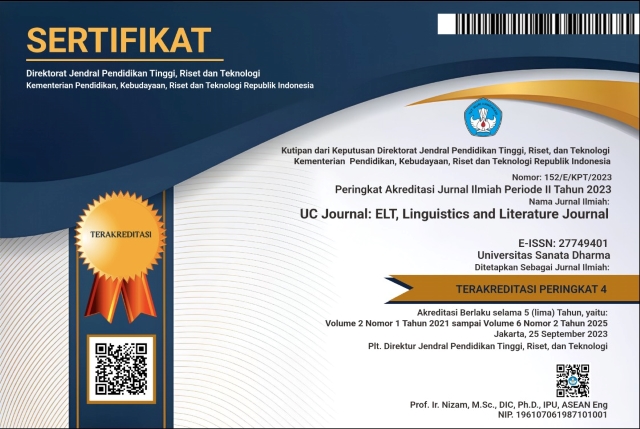
UC Journal Sinta 4 Certificate (S4 = Level 4)
We would like to inform you that UC Journal: ELT, Linguistics and Literature Journal, or UC Journal has been nationally accredited Sinta 4 by the Ministry of Education, Culture, Research and Technology of the Republic of Indonesia based on the decree No. Surat Keputusan 152/E/KPT/2023. Validity for 5 years: Vol 2 No 1, 2021 till Vol 6 No 2, 2025
DOI: https://doi.org/10.24071/uc
e-ISSN (validity starting Vol 1, No 2, November 2020): 2774-9401

This work is licensed under CC BY-SA.
Creative Commons Attribution-ShareAlike 4.0 International License
 UC Journal: ELT, Linguistics and Literature Journal, a scientific peer-reviewed journal, was established in 20 May 2020 and is published twice a year, namely in May and November, by the English Language Education Study Programme (S1/Sarjana PBI) in collaboration with the English Education Master's Programme (S2/Magister PBI) of Sanata Dharma University, Yogyakarta, Indonesia.