


 Email this article
CHINESE COMMUNITY LANGUAGE MAINTENANCE: PERCEPTIONS OF AND EFFORTS MADE BY YOUNG MALAYSIANS IN PENANG
(1) Singapore University of Social Sciences, Singapore
(*) Corresponding Author
Abstract
In the present era, minority/less dominant languages are spoken lesser and lesser due to language shift that is taking place. This situation is worrying because these languages are facing endangerment. Hence, it urges for a call to examine people’s perceptions of speaking them and efforts to maintain them. Using the Chinese community in Penang, Malaysia as a case study, this study investigates the stated issues. Data collection took place in 2016 with 22 young Malaysians aged 20-40 years old. A semi-structured interview was conducted with the participants and the transcripts were analysed using thematic analysis. The findings reveal that the participants are keen about the continuation of speaking Chinese community languages due to three main reasons: (i) Chinese community languages are a representation of history and family roots, (ii) speaking to them represents possessing multiple identities and (iii) they act as a living culture. They reported that many efforts were made to maintain the continuous usage of Chinese community languages. This study concludes that youth need to be engaged with those efforts to ensure that the Chinese community languages do not disappear in the future. This can be done by including the use of digital technology in those efforts.
Keywords
Full Text:
PDFReferences
Albury, N. J. (2017). Mother tongues and languaging in Malaysia: Critical linguistics under critical examination. Language in Society, 46(4), 567-589. https://doi.org/10.1017/S0047404517000239
Albury, N. J. (2021). Language policy, ideological clarification and theory of mind. Language Policy, 20, 193-214. https://doi.org/10.1007/s10993-020-09547-z
Albury, N. J., & Aye, K.K. (2016). Malaysia's national language policy in international theoretical context. Journal of Nusantara Studies (JONUS), 1(1), 71-84. https://doi.org/10.24200/jonus.vol1iss1pp71-84
Alia, V. (2010). The new media nation: Indigenous peoples and global communication. New York: Berghahn Books. https://doi.org/10.3167/9781845454203
Batibo, H. M. (2009). Language documentation as a strategy for the empowerment of the minority languages of Africa. In M. Matondo, F. M. Laughlin, & E. Potsdam (Eds.), Selected proceedings of the 38th Annual Conference on African Linguistics (pp. 193-203). Somerville, MA: Cascadilla Proceedings Project.
Braun, V., & Clarke, V. (2006). Using thematic analysis in psychology. Qualitative Research in Psychology, 3(2), 77-101. https://doi.org/10.1191/1478088706qp063oa
Chai, H. C. (1977). Education & nation building in plural societies: The West Malaysia experience. Canberra: The Australian National University Press.
Chin, H. S. (2025, February 15). Archives of Singapore Hokkien clan association made more accessible with new database. The Straits Times. Retrieved from https://www.straitstimes.com/singapore/archives-of-singapore-hokkien-clan-association-made-more-accessible-with-new-database
Daud, S., & Majid, N. A. (2019). Challenges of nation-building and the formation of Bangsa Malaysia. Southeast Asian Social Science Review, 4(1), 30-47. https://doi.org/10.29945/SEASSR.201905_4(1).0002
Denzin, N. K., & Lincoln, Y. S. (2000). Introduction: The discipline and practice of qualitative research. In Y. S. Lincoln & N. K. Denzin (Eds.), The landscape of qualitative research: Theories and issues (pp. 1-28). Thousand Oaks, CA: Sage Publications.
Department of Statistics Malaysia. (2025). Demographic statistics, fourth quarter 2024. Department of Statistics Malaysia.
Ding, S. L. (2016). The role of parents in heritage language maintenance in Malaysia. Malaysian Journal of Chinese Studies, 5(1), 15-27.
Eberhard, D. M., Simons, G. F., & Fennig, C. D. (Eds.) (2024). Ethnologue: Languages of the world (27th ed.). Dallas: SIL International.
Fishman, J. A. (1999). Concluding comments. In J. A. Fishman (Ed.), Handbook of language and ethnic identity (pp. 444-454). New York: Oxford University Press. https://doi.org/10.1525/jlin.2003.13.2.239
Fishman, J. A. (Ed.). (1989). Language and ethnicity in minority sociolinguistic perspective. Clevedon: Multilingual Matters.
Flick, U. (2014). An introduction to qualitative research (5th ed.). London:Sage.
Forde, S., Foxwell, K., & Meadows, M. (2009). Developing dialogues: Indigenous and ethnic community broadcasting in Australia. Bristol, UK: Intellect Books.
Gal, S. (1979). Language shift: Social determinants of linguistic change in bilingual Australia. New York: Academic Press.
Hall, S. (1997). Old and new ethnicities. In A. D. King (Ed.), Culture, globalisation and the world system (pp. 41-68). Minneapolis: University of Minnesota Press.
Kayad, F. G., & Ting, S. H. (2021, November 24-25). Perceptions of Bidayuh on importance of the Bidayuh language. Proceeding of the 2nd Auckland International Conference on Social Sciences, Education, Entrepreneurship and Technology 2021 (pp. 35-48). Auckland, New Zealand.
King, K. A., & Ganuza, N. (2005). Language, identity, education and transmigration: Chilean adolescents in Sweden. Journal of Language, Identity and Education, 4(3), 179-199. https://doi.org/10.1207/s15327701jlie0403_1
Leuner, B. (2007). Migration, multiculturalism and language maintenance in Australia: Polish migration to Melbourne in the 1980s. Bristol: Peter Lang.
Mansor, M. N. (2000). Crossing ethnic borders in Malaysia: Measuring the fluidity of ethnic identity and group formation. Akademika, 55(July), 61-82.
Moriaty, M. (2009). Normalising language through television: The case of the Irish language television channel, TG4. Journal of Multicultural Discourses, 4(2), 137-149. https://doi.org/10.1080/17447140902741288
Norahim, N. (2010). Language choice of Bidayuh graduates in Kuching-Samarahan division (Unpublished doctoral dissertation, University of Malaya, Malaysia).
Ong, T. W. S. (2018). Language maintenance in Malaysia: A case study of the Chinese community in Penang (Unpublished doctoral thesis, Griffith University, Queensland, Australia).
Ong, T. W. S. (2020). Why bother maintaining languages? A discussion based on diminishing Chinese dialects in Malaysia. Apples – Journal of Applied Language Studies, 14(1), 1-5. https://doi.org/10.17011/apples/urn.202001171301
Ong, T. W. S. (2021). Family language policy, language maintenance and language shift: Perspectives from ethnic Chinese single mothers in Malaysia. Issues in Language Studies, 10(1), 59-75. https://doi.org/10.33736/ils.3075.2021
Ong, T. W. S., & Ben Said, S. (2020). Selective language maintenance in multilingual Malaysia. In T. Okamura & M. Kai (Eds.), Indigenous language acquisition, maintenance, and loss and current language policies (pp. 207-228). Hershey, PA: IGI Global.
Ong, T. W. S., & Ting, S. H. (2023). Children deciding the family language in Chinese families in multiethnic Malaysia. NOTION: Journal of Linguistics, Literature, and Culture, 5(1), 32-46. https://doi.org/10.12928/notion.v5i1.6833
Ong, T. W. S., & Troyer, R. A. (2024). Language shift among middle-age and older Chinese descendants in Penang, Malaysia: A bitter sweet tale. UC: ELT, Linguistics and Literature Journal, 5(2), 64-83. https://doi.org/10.24071/uc.v5i2.8628
Pauwels, A. (2008). Language maintenance. In A. Davies & C. Elder (Eds.), The handbook of Applied Linguistics (pp. 719-737). Blackwell. https://doi.org/10.1002/9780470757000
Riget, P. N., & Wang, X. M. (2016). English for the indigenous people of Sarawak: Focus on the Bidayuhs. In T. Yamaguchi & D. Deterding (Eds.), English in Malaysia: Current use and status (pp. 102-122). Brill Publisher.
Shaw, A. (2017). Reproduced with permission from Astro Shaw Sdn. Bhd., www.astraoshaw.com.my © 2017, Astro Shaw.
Tan, J. (2017, May 5). Forget about it: An interview with Saw Teong Hin. Esquire. Retrieved from https://www.esquire.my/culture/saw-teong-hin-interview-you-mean-the-world-to-me
Ting, S. H., & Mahadhir, M. (2009). Towards homogeneity in home languages: Malay, Chinese Foochow and Indian Tamil families in Kuching, Sarawak, Malaysia. Australian Review of Applied Linguistics, 32(2), 11.1-11.22. https://doi.org/10.2104/aral0911
Ting, S. H., & Puah, Y. Y. (2010). Language attitudes of Hokkien speakers towards Hokkien and Mandarin. Proceedings of the Borneo International Conference on Language and Literature: Unity in Diversity. University Publication Centre.
Ting, S. H., Ong, T. W. S., & Kayad, F. G. (2025). The Bidayuh language of Sarawak, Malaysia: Language use and proficiency. In N. S. Dash, S. Arulmozi & N. Ramesh (Eds.), Handbook on endangered South Asian and Southeast Asian languages (pp. 365-381). Cham: Springer. https://doi.org/10.1007/978-3-031-80752-7_16
Wang, X. M. (2010). The sociolinguistic realignment in the Chinese community in Kuala Lumpur: Past, present and future. Journal of Multilingual and Multicultural Development, 31(5), 479-489. https://doi.og/10.1080/01434632.2010.505656
Wang, X. M. (2016). Language maintenance or language shift? The role of religion in a Hakka Catholic community in Malaysia. International Multilingual Research Journal, 10(4), 273-288. https://doi.org/10.1080/19313152.2016.1192850
Wang, X. M. (2017). Family language policy by Hakkas in Balik Pulau, Penang. International Journal of the Sociology of Language: Special Issue on Language Planning and Multilingual Malaysia, 224, 87-118. https://doi.org/10.1515/ijsl-2016-0058
Wiley, T. G. (1998). The imposition of World War I era English-only policies and the fate of German in North America. In T. Ricento & B. Burnaby (Eds.), Language and politics in the United States and Canada (pp. 211-241). New Jersey, NJ: Lawrence Erlbaum.
DOI: https://doi.org/10.24071/uc.v6i2.13205
Refbacks
- There are currently no refbacks.
Copyright (c) 2025 Teresa Wai See Ong

This work is licensed under a Creative Commons Attribution-ShareAlike 4.0 International License.
UC Journal is indexed in:







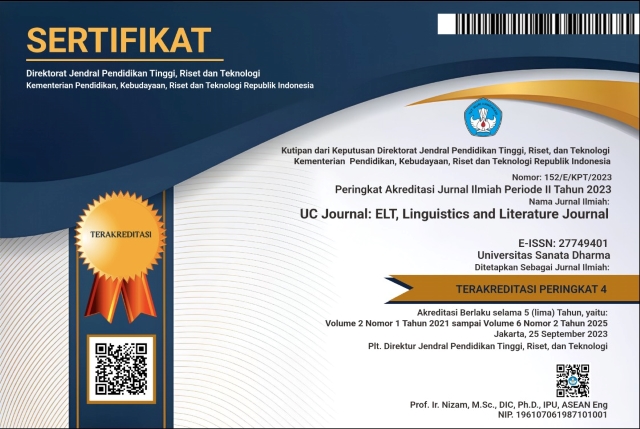
UC Journal Sinta 4 Certificate (S4 = Level 4)
We would like to inform you that UC Journal: ELT, Linguistics and Literature Journal, or UC Journal has been nationally accredited Sinta 4 by the Ministry of Education, Culture, Research and Technology of the Republic of Indonesia based on the decree No. Surat Keputusan 152/E/KPT/2023. Validity for 5 years: Vol 2 No 1, 2021 till Vol 6 No 2, 2025
DOI: https://doi.org/10.24071/uc
e-ISSN (validity starting Vol 1, No 2, November 2020): 2774-9401

This work is licensed under CC BY-SA.
Creative Commons Attribution-ShareAlike 4.0 International License
 UC Journal: ELT, Linguistics and Literature Journal, a scientific peer-reviewed journal, was established in 20 May 2020 and is published twice a year, namely in May and November, by the English Language Education Study Programme (S1/Sarjana PBI) in collaboration with the English Education Master's Programme (S2/Magister PBI) of Sanata Dharma University, Yogyakarta, Indonesia.