


 Email this article
CHALLENGES AND OPPORTUNITIES OF INDONESIAN AUTHORS FOR PUBLISHING ARTICLES IN ENGLISH JOURNALS: A MICROSTRUCTURE STUDY IN IHLRAMS
(1) Universitas Islam Makassar, Indonesia
(*) Corresponding Author
Abstract
The number of generic microstructure studies within English research articles (RAs) has recently increased worldwide. However, studies on this area in the Indonesian context are still limited, specifically in the method section. To address this need, in this paper, the researcher focuses on analyzing the microstructure of 30 Indonesian History and Law Research Article Methods (IHLRAMs) because these two disciplines have never been investigated earlier in the Indonesian context. For the analysis, an English model found by Zhang and Wannaruk (2016) was employed for the initial analytical framework in both corpora. However, both data sets only partially employ this English model; thus, further analysis employed a top-down approach. The results showed that the corpora have their own microstructure models, called Indonesian history research article methods (IHRAMs) and Indonesian law research article methods (ILRAMs) models. These two findings models imply that the microstructure of the Indonesian history and law RAMs is different from an English model. Thus, these differences become a challenge for Indonesian authors and possibly also those whose English is their foreign language (EFL) when they want to publish articles in English journals. On the other hand, comprehending these differences may improve their awareness, as well as their opportunities for publishing RAs in English journals.
Keywords
Full Text:
PDFReferences
Adnan, Z. (2011). ‘Ideal-problem-solution’(IPS) model: A discourse model of research article introductions (RAIS) in education. Australian Review of Applied Linguistics, 34(1), 75-103. https://doi.org/10.1075/aral.34.1.05adn
Amnuai, W. (2019). Analyses of rhetorical moves and linguistic realizations in accounting research article abstracts published in international and Thai-based journals. SAGE Open, 9(1), 1-9. https://doi.org/10.1177/2158244018822384
Andika, R. P., Arsyad, S., & Harahap, A. (2018). Rhetorical moves and linguistic features of journal article abstracts by postgraduate students, national and international authors in applied linguistics. JOALL (Journal of Applied Linguistics & Literature), 3(1), 129-142. https://doi.org/10.33369/joall.v3i1.6539
Anthony, P., & Sajed, S. I. (2017). Genre analysis of linguistics research introductions. University of Mindanao International Multidisciplinary Research Journal, 2(1), 1-12.
Arianto, M. A., & Basthomi, Y. (2021). The authors' research gap strategies in ELT research article introductions: Does scopus journal quartile matter? Journal of Language and Linguistic Studies, 17(4), 1743-1759. https://doi.org/10.52462/jlls.127
Arsyad, S. (2013). A genre-based analysis of Indonesian research articles in the social sciences and humanities written by Indonesian speakers. Journal of Multicultural Discourses, 8(3), 234-254. Retrived from https://doi.org/10.1080/17447143.2013.849711
Arsyad, S., & Adila, D. (2018). Using local style when writing in English: The citing behaviour of Indonesian authors in English research article introductions. Asian Englishes, 20(2), 170-185. https://doi.org/10.1080/13488678.2017.1327835
Arsyad, S., & Arono, A. (2016). Potential problematic rhetorical style transfer from first language to foreign language: A case of Indonesian authors writing research article introductions in English. Journal of Multicultural Discourses, 11(3), 315-330. https://doi.org/10.1080/17447143.2016.1153642
Arsyad, S., Purwo, B. K., & Adnan, Z. (2020). The argument style in research article discussions to support research findings in language studies. Studies in English Language and Education, 7(2), 290-307. https://doi.org/10.24815/siele.v7i2.16626
Arsyad, S., Zaim, M., Ramadhan, S., & Lubis, A. A. (2020). The argument style of research article discussions by non-native authors of English published in international journals. Journal of Applied Linguistics & Literature (JOALL), 5(2), 193-212. https://doi.org/10.33369/joall.v5i2.11268
Arsyad, S., & Zainil, Y. (2023). Research gap strategies in article introductions of different rank applied linguistics journals. Studies in English Language and Education, 10(1), 216-234. https://doi.org/10.24815/siele.v10i1.25302
Cotos, E., Huffman, S., & Link, S. (2017). A move/step model for methods sections: Demonstrating rigour and credibility. English for Specific Purposes, 46, 90-106. https://doi.org/10.1016/j.esp.2017.01.001
Dobakhti, L. (2013). Commenting on findings in qualitative and quantitative research articles’ discussion sections in applied linguistics. International Journal of Applied Linguistics and English Literature, 2(5), 145-154. https://doi.org/10.7575/aiac.ijalel.v.2n.5p.145
Fazilatfar, A. M., & Naseri, Z. S. (2014). Rhetorical moves in applied linguistics articles and their corresponding Iranian writer identity. Procedia-Social and Behavioral Sciences, 98, 489-498. https://doi.org/10.1016/j.sbspro.2014.03.444
Kurniawan, E., & Sabila, N. A. A. (2021). Another look at the rhetorical moves and linguistic realizations in international and Indonesian journal articles: A case of tourism research. Indonesian Journal of Applied Linguistics, 11(2), 318-329. https://doi.org/10.17509/ijal.v11i2.32055
Kutay, U. (2016). A genre analysis of the methodology sections of descriptive medical-surgical nursing articles. Journal of Computer and Education Research, 4(7), 65-81. https://doi.org/10.18009/jcer.09009
Lim, J. M.-H. (2006). Method sections of management research articles: A pedagogically motivated qualitative study. English for Specific Purposes, 25(3), 282-309. https://doi.org/10.1016/j.esp.2005.07.001
Loi, C. K., Lim, J. M. H., & Wharton, S. (2016). Expressing an evaluative stance in English and Malay research article conclusions: International publications versus local publications. Journal of English for Academic Purposes, 21, 1-16. https://doi.org/10.1016/j.jeap.2015.08.004
Lu, X., Casal, J. E., Liu, Y., Kisselev, O., & Yoon, J. (2021). The relationship between syntactic complexity and rhetorical move-steps in research article introductions: Variation among four social science and engineering disciplines. Journal of English for Academic Purposes, 52, 101006. https://doi.org/10.1016/j.jeap.2021.101006
Morales, R. C. (2016). Discourse features of methodology sections of research articles in high-impact and non-high-impact applied linguistics journals. Asian Journal of English Language Studies (AJELS), 4(2), 80-102. https://doi.org/doi.org/10.59960/4.a5
Mozaheb, M. A. (2015). A comparative genre-based study of research articles method and results sections authored by Iranian and English native speakers. International Journal of Arts & Sciences, 8(6), 139-151.
Peacock, M. (2011). The structure of the methods section in research articles across eight disciplines. The Asian ESP Journal, 7(2), 99-124.
Rochma, A. F., Triastuti, A., & Ashadi, A. (2020). Rhetorical styles of introduction in English language teaching (ELT) research articles. Indonesian Journal of Applied Linguistics, 10(2), 304-314. https://doi.org/10.17509/ijal.v10i2.28593
Suherdi, D., Kurniawan, E., & Lubis, A. H. (2020). A genre analysis of the research article ‘findings and discussion’ sections written by Indonesian undergraduate EFL students. Indonesian Journal of Applied Linguistics, 10(1), 59-72. https://doi.org/10.17509/ijal.v10i1.24989
Suryani, I., Yaacob, A., Abd Aziz, N. H., Abd Rashid, S., & Desa, H. (2013). Research publication output by academicians in public and private universities in Malaysia. International Journal of Higher Education, 2(1), 84-90. https://doi.org/10.5430/ijhe.v2n1p84
Tessuto, G. (2015). Generic structure and rhetorical moves in English-language empirical law research articles: Sites of interdisciplinary and interdiscursive cross-over. English for Specific Purposes, 37, 13-26. https://doi.org/10.1016/j.esp.2014.06.002
Warsidi, W. (2021). Rhetorical patterns of Indonesian research articles in law and history disciplines: A genre-based analysis [Dissertation, University of New England, Australia].
Warsidi, W. (2022). The study of research article abstracts in the applied linguistic discipline. Jurnal Sinestesia, 12(2), 806-818.
Warsidi, W. (2023). Promoting research through claiming centrality and explicit research contributions in applied linguistics research articles. JOALL (Journal of Applied Linguistics and Literature), 8(2), 264-280. https://doi.org/10.33369/joall.v8i2.26491
Warsidi, W. (2024). The rhetorical model of indonesian research article introductions (RAIs) in the law discipline: Problems and opportunities. Journal of Language and Literature, 24(2), 315-327. https://doi.org/10.24071/joll.v24i2.6455
Warsidi, W., & Adnan, Z. (2024). The rhetorical strategies to create incremental innovation in applied linguistics research articles. JOALL (Journal of Applied Linguistics and Literature), 9(1), 1-19. https://doi.org/10.33369/joall.v9i1.29780
Warsidi, W., Adnan, Z., & Maniam, V. (2024). A contrastive genre-based study of English and Indonesian RAIs in the history discipline. LEARN Journal: Language Education and Acquisition Research Network, 17(1), 467-488.
Warsidi, W., Adnan, Z., & Maniam, V. (2025). Rhetorical problems of Indonesian research article results and discussion in the history and law disciplines. LLT Journal: A Journal on Language and Language Teaching, 28(1), 1-19. https://doi.org/10.24071/llt.v28i1.9095
Warsidi, W., Halim, A., Kamal, A., Halim, N. M., Adnan, Z., Samad, I. A., & Irawan, A. M. (2025). Responses to earlier literature in research article introductions: A rhetorical study in applied linguistics. Studies in English Language and Education, 12(1), 398-411. https://doi.org/10.24815/siele.v12i1.35160
Warsidi, W., Irawan, A. M., Adnan, Z., & Samad, I. A. (2023). Citation studies in English vs. Indonesian research article introductions (RAIs) in the history discipline. Studies in English Language and Education, 10(2), 598-613. https://doi.org/10.24815/siele.v10i2.28343
Warsidi, W., & Maniam, V. (2024). Academic conflicts in research articles discussion: The case of Indonesian and Malaysian authors. Issues in Language Studies, 13(2), 1-16. https://doi.org/10.33736/ils.5865.2024
Xu, X., & Nesi, H. (2019). Evaluation in research article introductions: A comparison of the strategies used by Chinese and British authors. Text & Talk, 39(6), 797-818. https://doi.org/10.1515/text-2019-2046
Ye, Y. (2019). Macrostructures and rhetorical moves in energy engineering research articles written by Chinese expert writers. Journal of English for Academic Purposes, 38, 48-61. https://doi.org/10.1016/j.jeap.2019.01.007
Zainuddin, S. Z., & Shaari, A. H. (2021). A genre-inspired investigation of establishing the territory in thesis introductions by Malaysian ESL writers. 3L: Southeast Asian Journal of English Language Studies, 27(2), 144-160. https://doi.org/10.17576/3L-2021-2702-11
Zhang, B., & Wannaruk, A. (2016). Rhetorical structure of education research article methods sections. PASAA: Journal of Language Teaching and Learning in Thailand, 51, 155-184.
DOI: https://doi.org/10.24071/uc.v6i2.12952
Refbacks
- There are currently no refbacks.
Copyright (c) 2025 Warsidi Warsidi

This work is licensed under a Creative Commons Attribution-ShareAlike 4.0 International License.
UC Journal is indexed in:







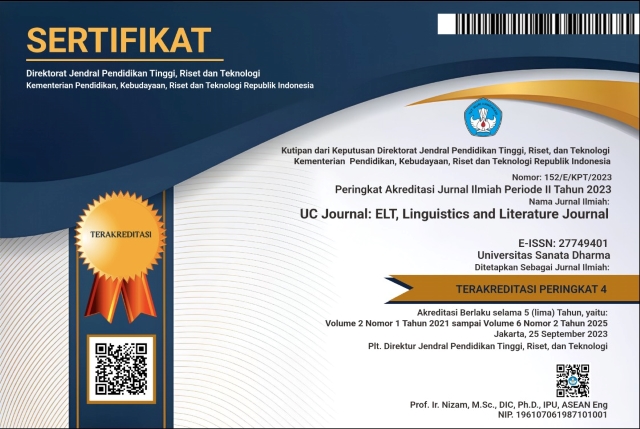
UC Journal Sinta 4 Certificate (S4 = Level 4)
We would like to inform you that UC Journal: ELT, Linguistics and Literature Journal, or UC Journal has been nationally accredited Sinta 4 by the Ministry of Education, Culture, Research and Technology of the Republic of Indonesia based on the decree No. Surat Keputusan 152/E/KPT/2023. Validity for 5 years: Vol 2 No 1, 2021 till Vol 6 No 2, 2025
DOI: https://doi.org/10.24071/uc
e-ISSN (validity starting Vol 1, No 2, November 2020): 2774-9401

This work is licensed under CC BY-SA.
Creative Commons Attribution-ShareAlike 4.0 International License
 UC Journal: ELT, Linguistics and Literature Journal, a scientific peer-reviewed journal, was established in 20 May 2020 and is published twice a year, namely in May and November, by the English Language Education Study Programme (S1/Sarjana PBI) in collaboration with the English Education Master's Programme (S2/Magister PBI) of Sanata Dharma University, Yogyakarta, Indonesia.