


 Email this article
AN EDUCATIONAL LANDSCAPE IN ENGLISH LANGUAGE TEACHING: A LITERATURE REVIEW ON CHALLENGES AND OPPORTUNITIES
(1) College of Liberal Arts, Technological University of the Philippines, Philippines
(*) Corresponding Author
Abstract
Technology has significantly influenced student learning and empowered them to cope with modern learning strategies. Technology will work if the implementation is done well, where students use digital tools to aid learning rather than become dependent on them. This paper is anchored by a qualitative library-research design to review the challenges and opportunities in English language teaching in terms of integrating research digital tools, content-based, classroom management, and cultural and social differences. Content-Based Instruction (CBI) is better for teaching English as a second language than other traditional conventional methods. Even though there are some challenges like financial limits and cultural barriers, CBI is very flexible and practical, and will be a nice way to learn, creativity, and participation. Furthermore, interactive techniques such as role-playing, debate exercises, and peer tutoring create an immersive learning environment, letting students learn by application instead of memorization. However, some challenges remain due to several factors such as large class size and limited resources. The government advocates for the accessibility of knowledge for everyone, particularly for the underprivileged, which allows all individuals to have equal access to English language education regardless of social and cultural status.
Keywords
Full Text:
PDFReferences
Abrams, Z. (2022). Student mental health is in crisis: Campuses are rethinking their approach. Monitor on Psychology, 53, 60. https://www.apa.org/monitor/2022/10/mental-health-campus-care
Afalla, B.T., & Fabelico, F.L. (2020). Sustaining academic success through effective classroom management. Humanities & Social Sciences Reviews, 8(4), 213-221. https://doi.org/10.18510/hssr.2020.8422
Akbari, O., & Sahibzada, J. (2020). Students’ self-confidence and its impacts on their learning process. American International Journal of Social Science Research, 5(1), 1-15. https://doi.org/10.46281/aijssr.v5i1.462
Aliwadang, C., Ongngad, J., Pintado, C., Torralba, B., Walang, L., Zarate, T., Zausa, C., Mariacos, J., & Dela Peña, M. (2024). Cultural sensitivity in English Language teaching: Understanding and addressing linguistic and cultural barriers. IRE Journals, 8(1), 556-572.
Alvarez, J.I., & Alberto, M.Z. (2024). Assessing readiness and knowledge on HyFlex learning: A needs assessment. Proceedings of the 4th International Conference on Education and Technology (ICETECH 2023), 152-171. https://doi.org/10.2991/978-94-6463-554-6_13
Anjarwati, R., & Kiswati, K. (2022). Concept mapping strategy through a hybrid flexible course: Its significance toward student achievement. English Learning Innovation, 3(1), 70-84. http://dx.doi.org/10.22219/englie.v3i1.19797
Anonuevo, I., Bajo, B.A., Dela Cruz, P., Evagelista, M., Velasco, S., & Cabutotan, V. (2022). Exploring classroom management: The experiences of English practice teachers. Asian Journal of Multidisciplinary Studies, 5(1), 22-34.
Aranda, M. (2022). Learning challenges in the new senior high school English curriculum in the Philippines. International Journal of Learning, Teaching and Educational Research, 21(11), 315-333. https://doi.org/10.26803/ijlter.21.11.18
Ascione, L. (2023). The impact of technology on education. ESchool News. Retrieved from https://www.eschoolnews.com/it-leadership/2023/12/11/the-impact-of-technology-on-education/
Bacolod, D. B. (2022). Mobile learning as a solution for restricted learning during the COVID-19 pandemic. Journal of Digital Educational Technology, 2(1), 1-7. https://doi.org/10.21601/jdet/11584
Barrot, J. S. (2018). English curriculum reform in the Philippines: Issues and challenges from a 21st century learning perspective. Journal of Language, Identity & Education, 18(3), 145-160. https://doi.org/10.1080/15348458.2018.1528547
Bartolata, A. C., Collado, R. C., & Mendoza, M. M. (2024). Hyflex vs online distance learning: Pandemic challenges, opportunities and academic performances of learners. International Journal of Multidisciplinary Research and Growth Evaluation, 5(2), 703-710. http://dx.doi.org/10.54660/.IJMRGE.2024.5.2.703-710
Blasco, R.N., & Elizalde, K. (2024). Analyzing the English language hierarchy: How globalization affects language inequality in the Philippines (Undergraduate thesis, University of Iceland).
Bondarchuk, J., Dvorianchykova, S., Shpeniuk, I., Yarova, L., & Vereshchak, Y. (2025). Strategic perspectives on the importance of English in the 21st century: Insights from first-year students. International Journal of Innovative Research and Scientific Studies, 8(1), 1245-1253.
Calderon, M. (2014). A critique of K-12 Philippine education system. International Journal of Education and Research, 2(10), 541-550.
Calixtro, A.M. (2023). The Philippine educational system in the 21st century: Challenges and opportunities. DepEd Bataan. Retrieved form https://depedbataan.com/wp-content/uploads/2023/11/the-philippine-educational-system-in-the-21st-century-challenges-and-opportunities.pdf
Candelaria, P. (2022). Influence of teaching methods on the social behavior of selected sixth-grade students in Victoria, Laguna, Philippines. International Journal of Education Technology and Science, 2(4), 519-543.
Chavez, J. (2022). Narratives of bilingual parents on the real-life use of English language: Materials for English language teaching curriculum. Arab World English Journals, 13(3), 1-13.
De La Fuente, J. (2022). Curriculum issues affecting student learning outcomes in the Philippines. Teacherph. Retrieved from https://www.teacherph.com/curriculum-issues-affecting-student-learning-outcomes/
De Ramos, B. (2024). Why Philippines speak English well compared to other neighboring countries. Pen Brothers. Retrieved from https://penbrothers.com/blog/why-philippines-speak-english/
English as a universal language. (n.d.). Retrieved from https://www.omniglot.com/language/articles/engunilang.php
Erstad, O., & Voogt, J. (2018). The twenty-first century curriculum: Issues and challenges. Springer International Handbooks of Education, 1-22. https://www.duo.uio.no/handle/10852/71882
Furner, J. (2004). Conceptual analysis: A method for understanding information as evidence, and evidence as information. Archival science, 4, 233-265. https://doi.org/10.1007/s10502-005-2594-8
Gamelo, L., & Roy, J. (2024). Code-switching practices of junior high school teachers and learners in English as a second language (ESL) classes: Basis for designing an intervention program. International Journal of Linguistics, Literature and Translation, 7(7), 75-92. https://doi.org/10.32996/ijllt.2024.7.7.9
Garcia, A., & Lau, S. (2022). The role of cultural ambivalence in language learning motivation. Journal of Multilingual Studies, 20(1), 50-67.
Ghafar, Z. (2023). Teaching English: The challenges teachers face and the various instructional techniques. Journal of Digital Learning and Distance Education, 2(2), 476-482. https://doi.org/10.56778/jdlde.v2i2.124
Halik, A., & Nusrath, R. (2020). Challenges faced by ESL teachers in teaching English to the students in rural schools: A study based on five rural schools in the Kinniya Education Zone, Trincomalee, Sri Lanka. International Journal of Scientific and Research Publications, 10(11), 358-366. http://dx.doi.org/10.29322/IJSRP.10.11.2020.p10744
Kodangos, J., Castro, M. P., & Taplin, M. T. (2023). Learning process interventions in HyFlex modality teaching. International Journal of Research Publication and Reviews, 4(9), 3458-3464.
Llego, M. (2024). Addressing educational challenges in the Philippines: DepEd’s learning recovery plan and house resolution no. 1805. Professional Learning Online Community of Teachers and for Teachers. Retrieved from https://www.teacherph.com/deped-learning-recovery-plan-house-resolution-1805-philippine-education-challenges/
Lock, J., Lakhal, S., Cleveland-Innes, M., Arancibia, P., Dell, D., & De Silva, N. (2021). Creating technology-enabled lifelong learning: A heutagogical approach. British Journal of Educational Technology, 52(4), 1646-1662. https://doi.org/10.1111/bjet.13122
Menozo, P. (2020). Reality bites: A systematic literature review of K to 12 English language teaching in the Philippines. International Journal of Linguistics, Literature and Translation, 3(12), 80-86. https://doi.org/10.32996/ijllt.2020.3.12.11
Oestar, J., & Oestar, R. (2022). Students' behavioral problems and teachers' discipline strategies in class. International Journal of Open-Access, Interdisciplinary & New Educational Discoveries of ETCOR Educational Research Center (iJOINED ETCOR), 1(2), 71-77.
Oktavia, D., Mukminin, A., Fridiyanto, N., Hadiyanto, N., Marzulina, L., Harto, K., Erlina, D., & Holandyah, M. (2022). Challenges and strategies used by English teachers in teaching English language skills to young learners. Theory and Practice in Language Studies, 11(2), 382-387. https://doi.org/10.17507/tpls.1202.22
Olabiyi, W., John, T., & Yusuf, Q. (2025). The influence of Filipino and English language proficiency on literacy achievement. Retrieved from https://www.researchgate.net/publication/389499999_The_Influence_of_Filipino_and_English_Language_Proficiency_on_Literacy_Achievement
Olobia, L. (2024). Utilizing social media in communicating in English as a second language. Studies in Self-Access Learning Journal, 15(1), 109–118. https://doi.org/10.37237/150103
Ortizano, E. (2024). Learning in an English content-based curriculum of the department of education: Issues and challenges from a 21st-century perspective. EPRA International Journal of Environmental Economics, Commerce and Educational Management, 11(12), 31-39. https://doi.org/10.36713/epra19342
Palines, K., Palines, K., Moreno, J., Tatlonghari, A., & Ortega-Dela Cruz, R. A. (2025). Integrating information and communication technologies to enhance high school students' research capabilities. Journal of Educational Research and Practice, 15(1), 1-12. https://doi.org/10.5590/JERAP.2025.15.1952
Parungao, A. (2023). PH is highly proficient in the English language — 2023 English Proficiency index. Inquirer. Retrieved from https://newsinfo.inquirer.net/1860493/ph-highly-proficient-in-english
Paschal, M., & Gougou, S. (2022). Promoting 21st century skills in English language teaching: A pedagogical transformation in Ivory Coast. Global Journal of Educational Studies, 8(2), 50-74. https://doi.org/10.5296/gjes.v8i2.20333
PISA 2022 Results (Volume I and II) - Country Notes: Philippines. (2023). OECD. Retrieved from https://www.oecd.org/en/publications/pisa-2022-results-volume-i-and-ii-country-notes_ed6fbcc5-en/philippines_a0882a2d-en.html?utm_source
Rabongue, S., Patadlas, R., Marilla, J., & Emperador, E. (2024). Leveraging social media for language acquisition: Exploring how high school students use Facebook for English Language Learning (ELL). International Journal of Science and Management Studies (IJSMS), 7(4) 185-191. https://doi.org/10.51386/25815946/ijsms-v7i4p124
Salazar, D. (2025). Introduction to Philippine English. OED. Retrieved from https://www.oed.com/discover/introduction-to-philippine-english/#content
Santos, A., Fernandez, V., & Ilustre, R. (2022). English language proficiency in the Philippines: An overview. International Journal of English Language Studies, 4(3), 46-51. https://doi.org/10.32996/ijels.2022.4.3.7
Science and Technology Academic and Research-Based Openly Operated KioskS (STARBOOKS). (2022). Development academy of the Philippines. Retrieved from https://coe-psp.dap.edu.ph/compendium-innovation/science-and-technology-academic-and-research-based-openly-operated-kiosks-starbooks/
Shan, L., & Aziz, A. (2022). A systematic review of teaching English in rural settings: Challenges and solutions. International Journal of Academic Research in Business & Social Sciences, 12(6), 1956-1977. http://dx.doi.org/10.6007/IJARBSS/v12-i6/14233
Shohani, M., Bastami, M., Gheshlaghi, L., & Nasrollahi, A. (2023). Nursing student’s satisfaction with two methods of CBL and lecture-based learning. BMC Medical Education, 23, 48. https://doi.org/10.1186/s12909-023-04028-3
Sibulkin, J. (2018). Analysis on content-based instruction methods influencing student outcomes in higher education. Open Journal of Social Sciences, 6(11), 176-194. https://doi.org/10.4236/jss.2018.611013
Suaco, T. P., & Sta.Maria, E. (2024). Analysis of constructivist learning management and scholastic satisfaction of secondary students in a Hyflex learning modality. Innovations, 77, 835-850.
Tang, K. (2020). Challenges and importance of teaching English as a medium of instruction in Thailand international college. English as an International Language, 15(2), 97-116.
The world’s largest ranking of countries and regions by English skills. (2024). EF English Proficiency Index. Retrieved from https://www.ef.com/wwen/epi/
Thim, A. (2025). The digital divide: Bridging connectivity gaps in rural Philippine communities. Richest Philippines. Retrieved from https://richestph.com/the-digital-divide-bridging-connectivity-gaps-in-rural-philippine-communities/
Vanichvasin, P. (2019). Effects of content-based instruction on English language performance of Thai undergraduate students in a non-English program. English Language Teaching, 12(8), 20-29.
Villanueva, E., & Caalim, J. (2024). Development and validation of a questionnaire to assess students’ perception of Hyflex learning modality. Recoletos Multidisciplinary Research Journal, 12(2), 43–60. https://doi.org/10.32871/rmrj2412.02.04
William, B., Hayes, D., & Freire, R. (2025). Digital literacy in the classroom: Exploring the effects of technology integration on literacy skills in Philippine elementary schools. Retrieved from https://www.researchgate.net/publication/388155633_Digital_Literacy_in_the_Classroom_Exploring_the_Effects_of_Technology_Integration_on_Literacy_Skills_in_Philippine_Elementary_SchoolsDOI: https://doi.org/10.24071/uc.v6i1.12017
Refbacks
- There are currently no refbacks.
Copyright (c) 2025 Cynic Tenedero

This work is licensed under a Creative Commons Attribution-ShareAlike 4.0 International License.
UC Journal is indexed in:







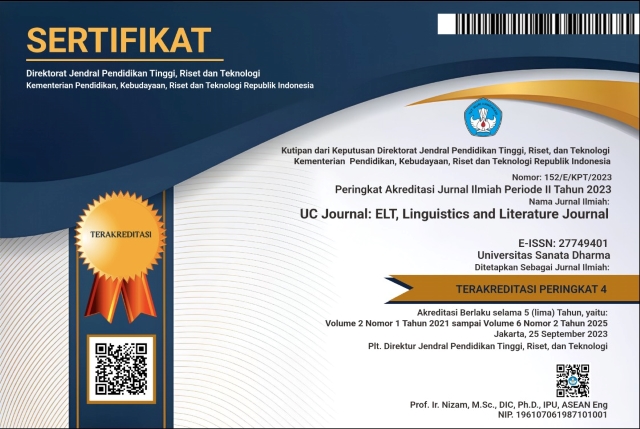
UC Journal Sinta 4 Certificate (S4 = Level 4)
We would like to inform you that UC Journal: ELT, Linguistics and Literature Journal, or UC Journal has been nationally accredited Sinta 4 by the Ministry of Education, Culture, Research and Technology of the Republic of Indonesia based on the decree No. Surat Keputusan 152/E/KPT/2023. Validity for 5 years: Vol 2 No 1, 2021 till Vol 6 No 2, 2025
DOI: https://doi.org/10.24071/uc
e-ISSN (validity starting Vol 1, No 2, November 2020): 2774-9401

This work is licensed under CC BY-SA.
Creative Commons Attribution-ShareAlike 4.0 International License
 UC Journal: ELT, Linguistics and Literature Journal, a scientific peer-reviewed journal, was established in 20 May 2020 and is published twice a year, namely in May and November, by the English Language Education Study Programme (S1/Sarjana PBI) in collaboration with the English Education Master's Programme (S2/Magister PBI) of Sanata Dharma University, Yogyakarta, Indonesia.