


 Email this article
 HOW TO WRITE A RESEARCH ARTICLE: A STRUCTURED APPROACH
(1) Jaypee University of Engineering and Technology, India
(2) Jaypee University of Engineering and Technology, India
(3) Jaypee University of Engineering and Technology, India
(*) Corresponding Author
Abstract
Writing a high-quality research article requires a structured and systematic approach to ensure the clarity, coherence, and scholarly impact. This paper provides a comprehensive guide for researchers aiming to publish in academic journals. It outlines the essential components such as topic selection, literature review, methodology formulation, results presentation, discussion, and conclusion writing. The methodology section emphasizes the significance of transparency and reproducibility by offering a sample case study to illustrate each step. The paper draws from established academic writing principles and integrates practical strategies for enhancing manuscript quality. Through a step-by-step framework, the study helps the beginner and experienced researchers to improve their writing efficiency and publication success. The article also highlights the common pitfalls and provides the tips for formatting, referencing, and submission processes. Overall, this structured guide aims to bridge the gap between research execution and effective communication, supporting authors in producing impactful scholarly articles that contribute meaningfully to their respective fields.
Keywords
Full Text:
PDFReferences
Alexandrov, A. V., & Hennerici, M. G. (2007). Writing good abstracts. Cerebrovascular Diseases, 23(4), 256–259. https://doi.org/10.1159/000098324
Article, O. (2020). Mfarniair-A-10-74-3-063ae2b_1. March, 1–18.
Basturkmen, H. (2012). A genre-based investigation of discussion sections of research articles in dentistry and disciplinary variation. Journal of English for Academic Purposes, 11(2), 134–144. https://doi.org/10.1016/j.jeap.2011.10.004
Bensimon, E. M., Polkinghorne, D., Bauman, G., & Vallejo, E. (2004). Doing research that makes a difference. The Journal of Higher Education, 75(1), 104–126. https://doi.org/10.1353/jhe.2003.0048
Butros, A., & Taylor, S. (2011). Managing information: Evaluating and selecting citation management software, a look at EndNote, RefWorks, Mendeley and Zotero. Proceedings of the 36th IAMSLIC Conference: Mar Del Plata, Argentina, 53–66. http://hdl.handle.net/1912/4595
Carroll, J. A., Wilson, E. E., & Hill, K. (2024). Technology and writing. In M. McConn (Ed.), Acts of teaching: How to teach writinmg (3rd ed., pp.113–122). Santa Barbara, CA: Libraries Unlimited. https://doi.org/10.5040/9798400606786.0147
Clarke, M., Alderson, P., & Chalmers, I. (2002). Discussion sections in reports of controlled trials published in general medical journals. JAMA, 287(21), 2799–2801. https://doi.org/10.1001/jama.287.21.2799
da Silva, J. A. T. (2020). Simplify manuscript submission and optimize authors’ resources by eliminating formatting and cover letters. European Science Editing, 46, 1–2. https://doi.org/10.3897/ese.2020.e52063
Dehdarirad, H., Ghazimirsaeid, J., & Jalalimanesh, A. (2020). Scholarly publication venue recommender systems. Data Technologies and Applications, 54(2), 169–191. https://doi.org/10.1108/DTA-08-2019-0135
Fitzgerald, J., & Shanahan, T. (2000). Reading and writing relations and their development. Educational Psychologist, 35(1), 39–50. https://doi.org/10.1207/S15326985EP3501_5
Grey, C., & Sinclair, A. (2006). Writing differently. Organization, 13(3), 443–453. https://doi.org/10.1177/1350508406063492
Hahn Fox, B., & Jennings, W. G. (2014). How to write a methodology and results section for empirical research. Journal of Criminal Justice Education, 25(2), 137–156. https://doi.org/10.1080/10511253.2014.888089
Juzwik, M. M., Curcic, S., Wolbers, K. D., Moxley, K. D., Dimling, L. M., & Shankland, R. K. (2006). Writing into the 21st century: An overview of research on writing, 1999 to 2004. Written Communication, 23(4), 451–476. https://doi.org/10.1177/0741088306291619
Lindgreen, A., Benedetto, C.A.D., & Beverland, M.B. (2021). How to write up case-study methodology sections. Industrial Marketing Management, 96, A7-A10. https://doi.org/10.1016/j.indmarman.2020.04.012
Muff, S., Nilsen, E. B., O’Hara, R. B., & Nater, C. R. (2022). Rewriting results sections in the language of evidence. Trends in Ecology and Evolution, 37(3), 203–210. https://doi.org/10.1016/j.tree.2021.10.009
Musa, N. F., Khamis, N., & Zanariah, J. (2015). The structure of method section in engineering research articles. Asian Social Science, 11(17), 74–82. https://doi.org/10.5539/ass.v11n17p74
Paltridge, B. (2004). Academic writing. Language Teaching, 37(2), 87–105. https://doi.org/10.1017/S0261444804002216
Rother, E. T. (2007). Systematic literature review X narrative review. ACTA Paulista de Enfermagem, 20(2), 7–8. https://doi.org/10.1590/s0103-21002007000200001
Thabah, M. M., & Currie, G. (2022). Uniform manuscript submission formats: The need and challenges. Indian Journal of Rheumatology, 17(6), S350–S356. https://doi.org/10.4103/0973-3698.364679
Tullu, M. (2019). Writing the title and abstract for a research paper: Being concise, precise, and meticulous is the key. Saudi Journal of Anaesthesia, 13(5), S12–S17. https://doi.org/10.4103/sja.SJA_685_18
Winchester, C. L., & Salji, M. (2016). Writing a literature review. Journal of Clinical Urology, 9(5), 308–312. https://doi.org/10.1177/2051415816650133
Yadav, D. (2022). Criteria for good qualitative research: A comprehensive review. Asia-Pacific Education Researcher, 31(6), 679–689. https://doi.org/10.1007/s40299-021-00619-0
DOI: https://doi.org/10.24071/uc.v6i1.11937
Refbacks
- There are currently no refbacks.
Copyright (c) 2025 Pankaj Dumka, Rishika Chauhan, Dhananjay R. Mishra

This work is licensed under a Creative Commons Attribution-ShareAlike 4.0 International License.
UC Journal is indexed in:







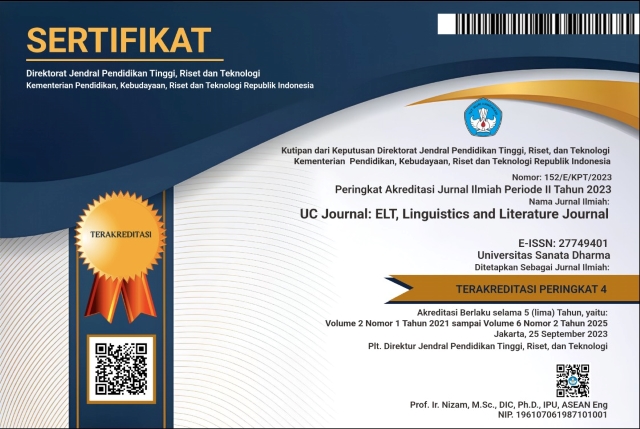
UC Journal Sinta 4 Certificate (S4 = Level 4)
We would like to inform you that UC Journal: ELT, Linguistics and Literature Journal, or UC Journal has been nationally accredited Sinta 4 by the Ministry of Education, Culture, Research and Technology of the Republic of Indonesia based on the decree No. Surat Keputusan 152/E/KPT/2023. Validity for 5 years: Vol 2 No 1, 2021 till Vol 6 No 2, 2025
DOI: https://doi.org/10.24071/uc
e-ISSN (validity starting Vol 1, No 2, November 2020): 2774-9401

This work is licensed under CC BY-SA.
Creative Commons Attribution-ShareAlike 4.0 International License
 UC Journal: ELT, Linguistics and Literature Journal, a scientific peer-reviewed journal, was established in 20 May 2020 and is published twice a year, namely in May and November, by the English Language Education Study Programme (S1/Sarjana PBI) in collaboration with the English Education Master's Programme (S2/Magister PBI) of Sanata Dharma University, Yogyakarta, Indonesia.