


 Email this article
LIMINAL SPACE IN WILLIAM BLAKE'S POETRY
(1) University of Ibadan, Nigeria
(*) Corresponding Author
Abstract
“Thresholds" between different states of consciousness, states of being, or fully cognitive and perceptive states are the essence of many poems by William Blake. This paper discusses how liminality is used by Blake to break limits and express the experience of change. Based on the close readings of the selected examples from Blake’s opus—‘Songs of Innocence and of Experience’—as well as his prophetic books, it is possible to define certain characteristics of the liminal space in his work. The liminal exploration of Blake's poetry possesses the quality of traversing those boundaries and questioning the societal conditions surrounding the event or, at the very least, taking the revisit of innocence by the experience into a different space designated for imagining further with respect to human existence. It should also be noted that there is a duality of the body and a duality of the spirit in Blake's works; they are Blake's pronouncements of a totality both outside the physical and the spiritual. Through his questioning of set norms, Blake empowers readers to reexamine their understanding of morality, spirituality, and identity and encourages their reincorporation into actual change.
Keywords
Full Text:
PDFReferences
Adams, R. (2020). Liminal spaces in Blake’s songs of experience. Manchester: Manchester University Press.
Assist Paper. (2016). Use of symbols and imagery in Blake’s poem. Retrieved from https://assistpaper.wordpress.com/2016/09/20/use-of-symbols-and-imagery-in-blakes-poem/
Blake, W. (1790/1988). The marriage of heaven and hell. In D. V. Erdman (Ed.), The complete poetry and prose of William Blake (Newly revised ed., pp. 33-45). New York: Anchor Books.
Blake, W. (1790/2008). The marriage of heaven and hell. In M. Eaves, R. N. Essick, and J. Viscomi (Eds.), The William Blake archive. Retrieved from http://www.blakearchive.org/
Blake, W. (1793/1988). America a prophecy. In D. V. Erdman (Ed.), The complete poetry and prose of William Blake (Newly revised ed., pp. 51-59). New York: Anchor Books.
Blake, W. (1794/1967). Songs of innocence and of experience. In G. Keynes (Ed.), Blake: Complete writings with variant readings (pp. 111-184). Oxford: Oxford University Press.
Blake, W. (1794/1988). Songs of experience. In D. V. Erdman (Ed.), The complete poetry and prose of william blake (Newly revised ed., pp. 18-32). New York: Anchor Books.
Blake, W. (1794/1988). The book of urizen. In D. V. Erdman (Ed.), The complete poetry and prose of William Blake (Newly revised ed., pp. 70-83). New York: Anchor Books.
Blake, W. (1794/1988). The tyger. In D. V. Erdman (Ed.), The complete poetry and prose of William Blake (Newly revised ed., p. 24). New York: Anchor Books.
Blake, W. (1794/1998.) The tyger. In R. N. Essick & J. Viscomi (Eds.), William Blake: The early illuminated books (pp. 147-148). Princeton: Princeton University Press.
Brown, M. (2021). Interpreting liminal zones in Blake’s prophetic works. Cambridge: Cambridge University Press.
Carter, E. (2022). Transcendence and transformation: Liminality in Blake's songs. Newcastle upon Tyne: Cambridge Scholars Publishing.
Damico, M. M. (2024). Finding liminality in literature: The decentered voice and its power to rewrite cultural narratives (Master’s thesis, Grand Valley State University, Allendale, Michigan). https://scholarworks.gvsu.edu/theses/1120
Damon, S. F. (1965). A Blake dictionary: The ideas and symbols of William Blake. Seattle: Magus Books
Erdman, D. V. (1977). Blake: Prophet against empire. New York: Princeton University Press.
Fisher, J. A. (2020). The liminal journey of William Blake: Transitioning between innocence and experience. Chicago: University of Chicago Press.
Font Paz, C. (2020). 'Che son la Pia': Liminal female figures of intercession in Blake's illustrations. Dante E L’Arte, 7, 155-172. https://doi.org/10.5565/rev/dea.140
Frye, N. (1947). Fearful symmetry: A study of William Blake. New York: Princeton University Press.
Graham, P. (2020). The role of liminality in Blake’s critique of society and religion. Manchester: Manchester University Press.
Green, S. (2022). Liminality and the otherworldly in Blake’s poetry. Cambridge: Cambridge University Press.
Harris, D. (2023). Between worlds: Liminality and the divine in Blake’s poetry. London/New York: Palgrave Macmillan.
Ibrahim, A. M. A. (2016). Symbolism in Blake’s animal poems: “Lamb and tyger.” ResearchGate.
Johnson, S. (2021). Blake's liminal spaces: Thresholds of vision. Oxford: Oxford University Press.
Keynes, G. (1972). Blake's Jerusalem: A critical edition. Oxford: Oxford University Press.
Khalili, I. D. (2024). Subject review on the use of the symbolisms and images in the literary works of William Blake: Romantic considerations. Manar Elsharq Journal for Literature and Language, 2(3), 11-15. http://dx.doi.org/10.56961/mejlls.v2i3.730
Kozlova, T., Shcherbakova, O., & Tuchkova, O. (2023). Self-illustrated poems: A multimodal approach to the interpretation of artistic vision. Vestnik Tomskogo Gosudarstvennogo Universiteta. Filologiya - Tomsk State University Journal of Philology, (82), 177-190.
Lee, J. (2019). Liminal imagery in Blake’s illuminated books. Chicago: University of Chicago Press.
Makdisi, S. (2003). William Blake and the impossible history of the 1790s. Chicago: University of Chicago Press.
Makdisi, S. (2015). Reading William Blake. Cambridge: Cambridge University Press.
Mitchell, L. (2021). Liminality and the sublime: Blake’s poetic thresholds. Berlin: Springer.
Mukesh, R. (2024). Symbolism in William Blake’s poetry. Retrieved from https://litgram.in/symbolism-in-william-blakes-poetry/
Poetry Foundation. (2024). William Blake. Retrieved from https://www.poetryfoundation.org/poets/william-blake
Raine, K. (1968). Blake and tradition. New York: Princeton University Press.
Reeve, L. (2023). Thresholds of rebellion: Liminality and Blake’s critique of authority. London: Palgrave Macmillan.
Sophonpanich, R. (2023). Nighttime and speculative realism in William Blake’s Milton. Thoughts, 1(1), 1-21. Retrieved from https://so06.tci-thaijo.org/index.php/thoughts/article/view/261708
SpunkyNotes. (2024). William Blake as a mystic poet. Retrieved from https://spunkynotes.com/william-blake-as-a-mystic-poet/
StudySmarter. (2024). William Blake: Poems, quotes, beliefs & facts. Retrieved from https://www.studysmarter.co.uk/explanations/english-literature/poets/william-blake/
Thompson, E. P. (1993). Witness against the beast: William Blake and the moral law. Cambridge: Cambridge University Press.
Thompson, S. (2021). Bridging the divine and the earthly: Liminal realms in Blake’s poetry. London: Routledge.
Van Gennep, A. (1909). The rites of passage (M. Vizedom & G. Caffee, Trans.). Chicago: University of Chicago Press. (Original work published 1909)
Williams, K. (2022). Blake’s liminality: An analysis of thresholds in his visual and poetic works. Oxford: Oxford University Press.
Yeats, W. B. (1903). William Blake and the imagination. In Ideas of good and evil. London: A. H. Bullen.
Zoamorphosis. (2019). William Blake: Visionary. Retrieved from https://zoamorphosis.com/william-blake-visionary/
DOI: https://doi.org/10.24071/uc.v6i1.11429
Refbacks
- There are currently no refbacks.
Copyright (c) 2025 CHIKODI ADEOLA OLASODE

This work is licensed under a Creative Commons Attribution-ShareAlike 4.0 International License.
UC Journal is indexed in:







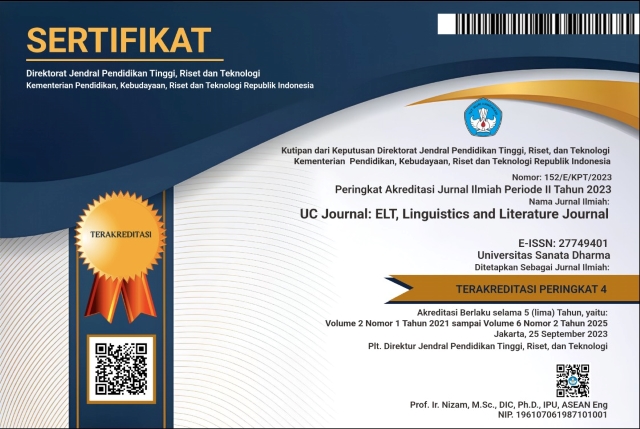
UC Journal Sinta 4 Certificate (S4 = Level 4)
We would like to inform you that UC Journal: ELT, Linguistics and Literature Journal, or UC Journal has been nationally accredited Sinta 4 by the Ministry of Education, Culture, Research and Technology of the Republic of Indonesia based on the decree No. Surat Keputusan 152/E/KPT/2023. Validity for 5 years: Vol 2 No 1, 2021 till Vol 6 No 2, 2025
DOI: https://doi.org/10.24071/uc
e-ISSN (validity starting Vol 1, No 2, November 2020): 2774-9401

This work is licensed under CC BY-SA.
Creative Commons Attribution-ShareAlike 4.0 International License
 UC Journal: ELT, Linguistics and Literature Journal, a scientific peer-reviewed journal, was established in 20 May 2020 and is published twice a year, namely in May and November, by the English Language Education Study Programme (S1/Sarjana PBI) in collaboration with the English Education Master's Programme (S2/Magister PBI) of Sanata Dharma University, Yogyakarta, Indonesia.