


 Email this article
 ARTIFICIAL INTELLIGENCE TOOLS EFFECTIVELY DEVELOPING SELF-DIRECTED LEARNING, INCREASING STUDENTS’ AUTONOMY AND MOTIVATION IN UZBEKISTAN
(1) Fergana State University, Uzbekistan
(*) Corresponding Author
Abstract
This article aims to explore the ability of AI tools to enhance SDL skills and identify the associated changes in learners’ sovereignty and enthusiasm in learners in Uzbekistan. However, much research has been conducted on the use of AI in education at a global level, but few studies have looked at the intervention efficacy of AI in the Uzbek education system. Using an online questionnaire with a quantitative method, the survey samples were sent to 27 undergraduate and graduate students to capture their experiences of AI tools. Quantitative data analysis was employed, with the results showing an influence of the designed AI, reporting greater levels of self-directed learning practices and self-regulation among engaged student groups. The results imply that AI applications can contribute to the development of the educational process in Uzbekistan and other countries, promoting the transition to a more learner-centered learning environment. Hence, this research provides useful information to educators and policymakers interested in the right way to adopt technology in education processes.
Keywords
Full Text:
PDFReferences
Acosta-Enriquez, B. G., De Los Ángeles Guzmán Valle, M., Ballesteros, M. A., Castillo, J. C. A., Vargas, C. G. a. P., Torres, I. S., León, P. M. S., & Tirado, K. S. (2025). What is the influence of psychosocial factors on artificial intelligence appropriation in college students? BMC Psychology, 13(1), 7. https://doi.org/10.1186/s40359-024-02328-x
Al-Abdullatif, A. M., & Alsubaie, M. A. (2024). ChatGPT in learning: Assessing students’ use intentions through the lens of perceived value and the influence of AI literacy. Behavioral Sciences, 14(9), 845. https://doi.org/10.3390/bs14090845
Aladini, A., Ismail, S. M., Khasawneh, M. A. S., & Shakibaei, G. (2025). Self-directed writing development across computer/AI-based tasks: Unraveling the traces on L2 writing outcomes, growth mindfulness, and grammatical knowledge. Computers in Human Behavior Reports, 17(2), 1-14. http://dx.doi.org/10.1016/j.chbr.2024.100566
Aleksandrovna, S. A. (2024a). A comparative study of the impact of artificial intelligence on learning outcomes. YIL TADQIQOTCHISI, 274-284.
Aleksandrovna, S. A. (2024b). The impact of digital tools in higher education. Pedagogik Tadqiqotlar Jurnali, 1(2), 333-339.
Al-Mamary, Y. H., & Abubakar, A. A. (2025). Empowering ChatGPT adoption in higher education: A comprehensive analysis of university students' intention to adopt artificial intelligence using self-determination and technology-to-performance chain theories. The Internet and Higher Education, 66, 101015. https://doi.org/10.1016/j.iheduc.2025.101015
Baharuddin, A. F. (2024). Technology’s critical role in the ELT classroom for developing students’ learning enthusiasm and its outcome. UC Journal ELT Linguistics and Literature Journal, 5(2), 95–105. https://doi.org/10.24071/uc.v5i2.9467
Boubker, O. (2023). From chatting to self-educating: Can AI tools boost student learning outcomes? Expert Systems With Applications, 238(A), 121820. https://doi.org/10.1016/j.eswa.2023.121820
Chen, H. (2010). Linking employees’ e-learning system use to their overall job outcomes: An empirical study based on the IS success model. Computers & Education, 55(4), 1628–1639. https://doi.org/10.1016/j.compedu.2010.07.005
Chen, S., Su, Y., Ku, Y., Lai, C., & Hsiao, K. (2022). Exploring the factors of students’ intention to participate in AI software development. Library Hi Tech, 42(2), 392–408. https://doi.org/10.1108/lht-12-2021-0480
Chou, C., Shen, T., Shen, T., & Shen, C. (2022). Influencing factors on students’ learning effectiveness of AI-based technology application: Mediation variable of the human-computer interaction experience. Education and Information Technologies, 27(6), 8723–8750. https://doi.org/10.1007/s10639-021-10866-9
Delcker, J., Heil, J., Ifenthaler, D., Seufert, S., & Spirgi, L. (2024). First-year students AI-competence as a predictor for intended and de facto use of AI-tools for supporting learning processes in higher education. International Journal of Educational Technology in Higher Education, 21, 18. https://doi.org/10.1186/s41239-024-00452-7
Eltahir, M. E., & Babiker, F. M. E. (2024). The influence of artificial intelligence tools on student performance in e-learning environments: Case study. The Electronic Journal of e-Learning, 22(9), 91–110. https://doi.org/10.34190/ejel.22.9.3639
Esiyok, E., Gokcearslan, S., & Kucukergin, K. G. (2025). Acceptance of educational use of AI chatbots in the context of self-directed learning with technology and ICT self-efficacy of undergraduate students. International Journal of Human–Computer Interaction, 41(1), 641-650. http://dx.doi.org/10.1080/10447318.2024.2303557
Flores, M. A., Brown, G., Pereira, D., Coutinho, C., Santos, P., & Pinheiro, C. (2020). Portuguese university students’ conceptions of assessment: Taking responsibility for achievement. Higher Education, 79(3), 377–394. https://doi.org/10.1007/s10734-019-00415-2
Gong, B., Nugent, J. P., Guest, W., Parker, W., Chang, P. J., Khosa, F., & Nicolaou, S. (2018b). Influence of artificial intelligence on Canadian medical students’ preference for radiology specialty: A national survey study. Academic Radiology, 26(4), 566–577. https://doi.org/10.1016/j.acra.2018.10.007
Hwang, G., Xie, H., Wah, B. W., & Gašević, D. (2020). Vision, challenges, roles and research issues of artificial intelligence in education. Computers and Education Artificial Intelligence, 1, 100001. https://doi.org/10.1016/j.caeai.2020.100001
Kabilovna, A. N., & Aleksandrovna, S. A. (2024). The positive impact of AI on self-esteem among EFL learners: Case studies from Fergana State University and Tuit Fergana Branch University. Innovation in the Modern Education System, 5(45), 33-48.
Lashari, A. A., & Umrani, S. (2023, November 10). Reimagining self-directed learning language in the age of artificial intelligence: A systematic review. Biannual Research Journal Grassroots, 57(I), 92-114.
Lee, J., Lee, S., & Lee, S. (2021). The influence of AI convergence education on students’ perception of AI. Journal of the Korean Association of Information Education, 25(3), 483–490. https://doi.org/10.14352/jkaie.2021.25.3.483
Maphalala, M. C., Mkhasibe, R. G., & Mncube, D. W. (2025). Exploring the roles of AI-powered e-tutors in enhancing self-directed learning in open distance e-learning courses. Interdisciplinary Journal of Education Research, 7(1), 1-17. http://dx.doi.org/10.38140/ijer-2025.vol7.1.12
Medland, E. (2016). Assessment in higher education: Drivers, barriers and directions for change in the UK. Assessment & Evaluation in Higher Education, 41(1), 81–96. https://doi.org/10.1080/02602938.2014.982072
Mohebbi, A. (2025). Enabling learner independence and self-regulation in language education using AI tools: A systematic review. Cogent Education, 12(1), 2433814. http://dx.doi.org/10.1080/2331186X.2024.2433814
Nguyen, T. N. T., Lai, N.V., & Nguyen, Q. T. (2024). Artificial intelligence (AI) in education: A case study on ChatGPT’s influence on student learning behaviors. Educational Process: International Journal, 13(2), 105-121.
Rong, Q., Lian, Q., & Tang, T. (2022). Research on the influence of AI and VR technology for students’ concentration and creativity. Frontiers in Psychology, 13. https://doi.org/10.3389/fpsyg.2022.767689
Schunk, D. H., & Zimmerman, B. J. (2007). Motivation and self-regulated learning: Theory, research, and applications. New York: Routledge. https://doi.org/10.4324/9780203831076
Tulasi, S.T., & Ahamed, S.B.I. (2024). Artificial intelligence effects on student learning outcomes in higher education. Proceedings of 9th international conference on science, technology, engineering and mathematics: The role of emerging technologies in digital transformation, ICONSTEM, 1-5. https://doi.org/10.1109/ICONSTEM60960.2024.10568868
Vygotsky, L. S. (1978). Mind in society: The development of higher psychological processes. Cambridge: Harvard University Press.
Wang, W., & Wang, C. (2009). An empirical study of instructor adoption of web-based learning systems. Computers & Education, 53(3), 761–774. https://doi.org/10.1016/j.compedu.2009.02.021
Wu, R., & Yu, Z. (2023). Do AI chatbots improve students learning outcomes? Evidence from a meta‐analysis. British Journal of Educational Technology, 55(1), 10–33. https://doi.org/10.1111/bjet.13334
Xu, W., & Ouyang, F. (2021). A systematic review of AI role in the educational system based on a proposed conceptual framework. Education and Information Technologies, 27(3), 4195–4223. https://doi.org/10.1007/s10639-021-10774-y
Younas, M., El-Dakhs, D. A. S., & Jiang, Y. (2025). A comprehensive systematic review of AI-driven approaches to self-directed learning. IEEE Access, 13. 38387-3840. https://doi.org/10.1109/ACCESS.2025.3546319
Zhang, S., Zhao, X., Zhou, T., & Kim, J. H. (2024). Do you have AI dependency? The roles of academic self-efficacy, academic stress, and performance expectations on problematic AI usage behavior. International Journal of Educational Technology in Higher Education, 21(1), 34.
Zhu, W., Huang, L., Zhou, X., Li, X., Shi, G., Ying, J., & Wang, C. (2024). Could AI ethical anxiety, perceived ethical risks and ethical awareness about AI influence university students’ use of generative AI products? An ethical perspective. International Journal of Human-Computer Interaction, 1–23. https://doi.org/10.1080/10447318.2024.2323277
Zhukevych, I. P. (2025). The future of self-education in the era of artificial intelligence. Riga: Publishing House “Baltija Publishing”. https://doi.org/10.30525/978-9934-26-522-8-14
DOI: https://doi.org/10.24071/uc.v6i1.11182
Refbacks
- There are currently no refbacks.
Copyright (c) 2025 Anastasiya Shikina

This work is licensed under a Creative Commons Attribution-ShareAlike 4.0 International License.
UC Journal is indexed in:







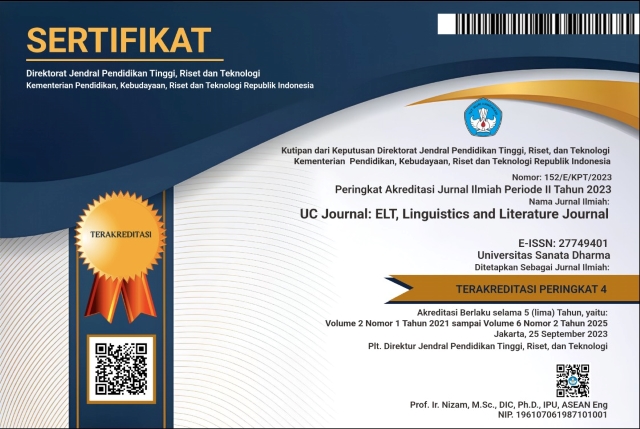
UC Journal Sinta 4 Certificate (S4 = Level 4)
We would like to inform you that UC Journal: ELT, Linguistics and Literature Journal, or UC Journal has been nationally accredited Sinta 4 by the Ministry of Education, Culture, Research and Technology of the Republic of Indonesia based on the decree No. Surat Keputusan 152/E/KPT/2023. Validity for 5 years: Vol 2 No 1, 2021 till Vol 6 No 2, 2025
DOI: https://doi.org/10.24071/uc
e-ISSN (validity starting Vol 1, No 2, November 2020): 2774-9401

This work is licensed under CC BY-SA.
Creative Commons Attribution-ShareAlike 4.0 International License
 UC Journal: ELT, Linguistics and Literature Journal, a scientific peer-reviewed journal, was established in 20 May 2020 and is published twice a year, namely in May and November, by the English Language Education Study Programme (S1/Sarjana PBI) in collaboration with the English Education Master's Programme (S2/Magister PBI) of Sanata Dharma University, Yogyakarta, Indonesia.