


 Email this article
 THE REPRESENTATION OF OBJECTS FUNCTION IN ANTI CORRUPTION COMMERCIAL VIDEO BASED ON PEIRCE’S SEMIOTICS
(1) State Islamic University of Sunan Gunung Djati Bandung, Indonesia
(2) State Islamic University of Sunan Gunung Djati Bandung, Indonesia
(*) Corresponding Author
Abstract
This research analyzes signs in the Anti-Corruption (Commercial Video)-Final Year Project uploaded by Muiz Hr, with a duration of 2 minutes and 9 seconds and 14 thousand viewers. A qualitative method was used to explore the visual meanings in the video based on Charles Sanders Peirce's semiotic theory. Primary data was obtained through random sampling from YouTube, while secondary data was sourced from literature related to semiotics and anti-corruption campaigns. The analysis focused on identifying icons, indexes, and symbols in five selected key scenes. The results of the study show a total of 9 icons, 5 indexes, and 5 symbols that were analyzed based on Peirce’s object-function theory. The combination of these signs proved effective in conveying an anti-corruption message. Icons provide real-life visualizations such as everyday social interactions, indexes reveal causal relationships with corrupt actions, and symbols reinforce the moral message through text and objects. The overall interpretation indicates that the video successfully raises audience awareness about the dangers of corruption, emphasizing that corruption can occur anywhere and anytime, thus requiring vigilance and preventive actions from society.
Keywords
Full Text:
PDFReferences
Aspers, P., & Corte, U. (2021). What is qualitative in research. Qualitative Sociology, 1–10.
Barbieri, M. (2009). Three Types of Semiosis (1st ed., Vol. 2). Biosemiotics.
Dilchert, S., & Ones, D. S. (2012). Application of preventive strategie: New perspectives on faking in personality assessment. Oxford University Press, 177–200.
Doig, A., & Riley, S. (1998). Corruption and anti-corruption strategies: Issues and case studies from developing countries . Corruption and Integrity Improvement Initiatives in Developing Countries, 45–62.
Eco, U. (1976). A Theory of Semiotics. Bloomington : Indiana University Press.
Farias, P., & Queiroz, J. (2006). Images, diagrams, and metaphors: Hypoicons in the context of Peirce’s sixty-six-fold classification of signs. Semiotica, 2006(162). https://doi.org/10.1515/SEM.2006.081
Fisman, R., & Golden, M. A. (2017). Corruption: What everyone needs to know. Oxford University Press.
Hammarberg, K., Kirkman, M., & de Lacey, S. (2016). Qualitative research methods: when to use them and how to judge them. Human Reproduction, 31(3), 498–501. https://doi.org/10.1093/humrep/dev334
Hr, M. (2015, May 16). Anti-Corruption (Commercial Video) - Final Year Project [Video recording]. https://www.youtube.com/watch?v=k7jzSTOI8qQ
Huang, S. Y. (2015). Video Commercial Image Preference Study Through The Web Analytical Tool. International Journal of Business Research and Management (IJBRM), 6(3), 71–85.
Kans, M. (2009). The advancement of maintenance information technology. Journal of Quality in Maintenance Engineering, 15(1), 5–16. https://doi.org/10.1108/13552510910943859
Kilstrup, M. (2015). Naturalizing semiotics: The triadic sign of Charles Sanders Peirce as a systems property. Progress in Biophysics and Molecular Biology, 119(3), 563–575. https://doi.org/10.1016/j.pbiomolbio.2015.08.013
Mattoni, A., & Chakraborty, A. (2023). Visual Memory in Grassroots Mobilizations : The Case of the Anti- Corruption Movement of 2011 in India. In The Visual Memory of Protest. Amsterdam University Press. https://doi.org/10.5117/9789463723275_CH07
Merrell, F. (2001). Charles Sanders Peirce’s concept of the sign (1st ed.). Routledge.
Olken, B. A., & Pande, R. (2012). Corruption in Developing Countries. Annual Review of Economics, 4(1), 479–509. https://doi.org/10.1146/annurev-economics-080511-110917
Peirce, C. S. (1991). Peirce on Signs: Writings on Semiotic (J. Hoopes, Ed.). University of North Carolina Press. https://www.jstor.org/stable/10.5149/9781469616810_hoopes
Peirce, C. S. (2006). THE SIGN: ICON, INDEX, AND SYMBOL (2nd ed., Vol. 5). A reader.
Peirce, C. S. , & B. J. (1902). Logic as semiotic: The theory of signs (Philosophical Writings of Peirce) (Buchler Justus, Ed.). Dover.
Ramsay, J. O., & Silverman, B. W. (2002). Applied functional data analysis: methods and case studies. . NY: Springer New York.
Richey, S. (2010). The Impact of Corruption on Social Trust. American Politics Research, 38(4), 676–690. https://doi.org/10.1177/1532673X09341531
Royce, J., & Kernan, F. (1916). Charles Sanders Peirce. The Journal of Philosophy, Psychology and Scientific Methods, 13(26), 701. https://doi.org/10.2307/2012319
Santaella, L. (2010). Theory of Indexicality: Peirce and Beyond. Semiotica.
Sharma, G. (2017). Pros and cons of different sampling techniques. International Journal of Applied Research, 3(7), 749–752.
Sumaryati, Suyadi, Nuryana, Z., & Asmorojati, A. W. (2022). Anti-corruption Action: A Project-Based Anti-corruption Education Model During COVID-19. Frontiers in Education, 7. https://doi.org/10.3389/feduc.2022.907725
Yan, T. W., & Garcia-Molina, H. (1996). Efficient dissemination of information on the Internet. IEEE Data Eng. Bull, 19(3), 48–54.
DOI: https://doi.org/10.24071/uc.v6i2.10940
DOI (PDF): https://doi.org/10.24071/uc.v6i2.10940.g4873
Refbacks
- There are currently no refbacks.
Copyright (c) 2025 Dalfa Fauziyah, R. Myrna Nur Sakinah

This work is licensed under a Creative Commons Attribution-ShareAlike 4.0 International License.
UC Journal is indexed in:







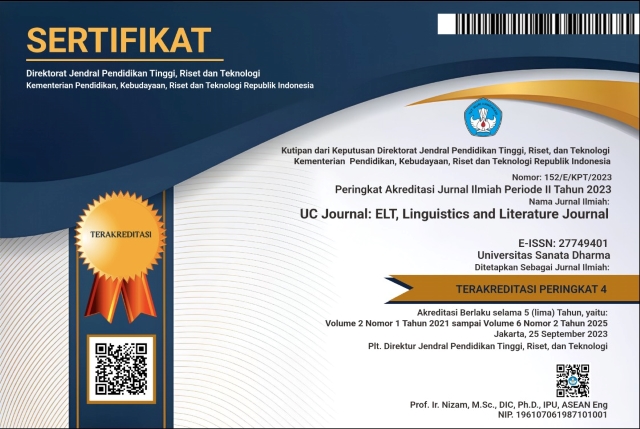
UC Journal Sinta 4 Certificate (S4 = Level 4)
We would like to inform you that UC Journal: ELT, Linguistics and Literature Journal, or UC Journal has been nationally accredited Sinta 4 by the Ministry of Education, Culture, Research and Technology of the Republic of Indonesia based on the decree No. Surat Keputusan 152/E/KPT/2023. Validity for 5 years: Vol 2 No 1, 2021 till Vol 6 No 2, 2025
DOI: https://doi.org/10.24071/uc
e-ISSN (validity starting Vol 1, No 2, November 2020): 2774-9401

This work is licensed under CC BY-SA.
Creative Commons Attribution-ShareAlike 4.0 International License
 UC Journal: ELT, Linguistics and Literature Journal, a scientific peer-reviewed journal, was established in 20 May 2020 and is published twice a year, namely in May and November, by the English Language Education Study Programme (S1/Sarjana PBI) in collaboration with the English Education Master's Programme (S2/Magister PBI) of Sanata Dharma University, Yogyakarta, Indonesia.