
Language of Wider Communication as a Propeller of Early Warning and Early Response in Yobe State
(1) Yobe State University, Nigeria
(*) Corresponding Author
Abstract
This work aims to establish the efficacy of language of wider communication (LWC) in coordinating early warning and early response in emergencies in Yobe State, a seemingly fragile state recovering from a fleeting insurgency. To achieve this, a researcher-made questionnaire and a semi-structured interview schedule were respectively administered to 110 and twenty-two 22 respondents who have been participating in Community Peace and Safety Partnership (CPSP) meetings – platforms supported by the British Council and funded by the European Union (EU) in 11 out of the 17 Local Government Areas (LGAs) in the state – to ascertain the use of Hausa language (which is an LWC in the state) in the coordination of the meetings and the implication of that in emergency and conflict management. Similarly, participatory observation was utilized by the researcher to find the language(s) used on the platforms to coordinate the meetings. It was found that the use of the LWC has not only made emergency and conflict management inclusive but also helped in reducing conflicts and risks in the LGAs the platforms are active. This work recommends that for early warning and early response to be effective in a fragile state, the LWC should be prioritized. However, other languages should be developed to enable them to actualize their linguistic rights to participate in public discourse and emergency management.
Keywords
Full Text:
PDFReferences
Ahumaraeze, C. I., & Agwuocha, U. A. (2019). My tongue seems to have failed me: Language as an exclusion parameter in trans-national migration. Journal of African Studies and Sustainable Development, 2(3), 148–165. https://acjol.org/index.php/jassd/article/view/2718/2678
Barnes, R. E. (1977, May 29–June 4). Communication anxiety: A psychotherapeutic perspective [Paper presentation]. International Communication Association Conference, Berlin, Germany.. U.S. Department of Education, Institute of Education Sciences, ERIC. https://files.eric.ed.gov/fulltext/ED137861.pdf
Dung, L. Q., & Hung, T. L. (2020) Speaking anxiety and language proficiency among EFL at a university in Vietnam. International Journal of Social Science and Human Research, 3(9), 124–133. https://doi.org/10.47191/ijsshr/v3-i9-01
Ferguson, K. (2016). Countering violent extremism through media and communication strategies: A review of the evidence. Partnership for Conflict, Crime and Security Research. https://cve-kenya.org/media/library/Ferguson_2016_Countering_violent_extremism_though_media_and_communication_strategies.pdf
Institute for Economics and Peace. (2021). Economic value of peace: Measuring the global economic impact of violence and conflict. Vision of Humanity https://www.visionofhumanity.org/wp-content/uploads/2021/01/EVP-2021-web-1.pdf
International Crisis Group. (2014). Curbing violence in Nigeria (II): The Boko Haram insurgency. https://www.crisisgroup.org/africa/nigeria/216-curbing-violence-nigeria-ii-boko-haram-insurgency
Leedy, P. D., & Ormrod, J. E. (2021). Practical research: Planning and design (12th ed.). Pearson Education Limited.
Lynn II, J. A. (2019). Another kind of war: The nature and history of terrorism. Yale University Press.
Mensah, E. (2019). The new language policy of the Nigerian Army: National integration or linguistic imperialism? Journal of Asian and African Studies, 54(3), 331–345. https://doi.org/10.1177/0021909618812912
Mitchell, M. L., & Jolley, J. M. (2010). Research design explained (7th ed.). Wadsworth.
National Bureau of Statistics. (2015). Nigerian gross domestic product report: Quarter two 2015 (Issue 06). https://www.nigerianstat.gov.ng/elibrary/read/315
National Bureau of Statistics. (2020). 2019 poverty and inequality in Nigeria: Executive summary. https://www.nigerianstat.gov.ng/elibrary/read/1092#:~:text=In%20Nigeria%2040.1%20percent%20of,below%20137%2C430%20Naira%20per%20year.
National Counterterrorism Center. (2014). Countering violent extremism: A guide to practitioners and analysts. Virginia Department of Criminal Justice Services. https://www.dcjs.virginia.gov/sites/dcjs.virginia.gov/files/cve_guide_for_practitioners_and_analysts.pdf
Office of the National Security Adviser (2015). Policy brief: Understanding the complex causes and processes of radicalization, violence and conflict. ONSA.
Okeke, F. A. (2012). Language can: Ensuring national security through effective use of language. African Research Review, 6(4), 216–233. https://doi.org/10.4314/afrrev.v6i4.15
Pally, A. E. (2021). Restructuring, national security and Nigeria’s relationship with the external world. UJAH: Unizik Journal of Arts and Humanities, 21(4), 34–52. https://doi.org/10.4314/ujah.v21i4.2
Petry, A. C. (2016). Communication apprehension affects performance (Master’s essay). John Carroll University. https://collected.jcu.edu/mastersessays/49/
Tang, C. (2022). ‘Amber alert’ or ‘heatwave warning’: The role of linguistic framing in mediating understandings of early warning messages about heatwaves and cold spells. Applied Linguistics, 43(2), 227–248. https://doi.org/10.1093/applin/amab020
Umar, A., Mohammed, A. A., & Sayed, U. M. (2019). Post-conflict peace-building and the way forward: The impact of insurgency of Boko Haram on the people of Yobe State, Nigeria. International Journal of Academic Research in Business and Social Sciences, 9(6), 393–406. https://dx.doi.org/10.6007/IJARBSS/v9-i6/5959
UN Office for Disaster Risk Reduction. (2021). Inclusive and accessible multi-hazard early-warning systems: Learning from women-led early-warning systems in The Pacific. UNDRR. https://wrd.unwomen.org/sites/default/files/2022-03/Inclusive%20And%20Accessible%20Multi-hazard%20Early-warning%20Systems.pdf
United Nations Office on Drugs and Crime (2011). Criminal intelligence: Manual for analysts. UNODC. https://www.unodc.org/documents/organized-crime/Law-Enforcement/Criminal_Intelligence_for_Analysts.pdf
United States Agency for International Development (2012). Conflict assessment framework. USAID.
World Organization for Resource Development and Education. (2016). Developing a community-led approach to countering violent extremism (CVE): An instructor’s manual. WORDE. https://www.cvereferenceguide.org/sites/default/files/resources/Developing%20a%20Community-Led%20Approach%20to%20Countering%20Violent%20Extremism%20%28CVE%29%20by%20WORDE.pdf
DOI: https://doi.org/10.24071/ijels.v11i2.9969
Refbacks
- There are currently no refbacks.

This work is licensed under a Creative Commons Attribution-ShareAlike 4.0 International License.
Indexed by








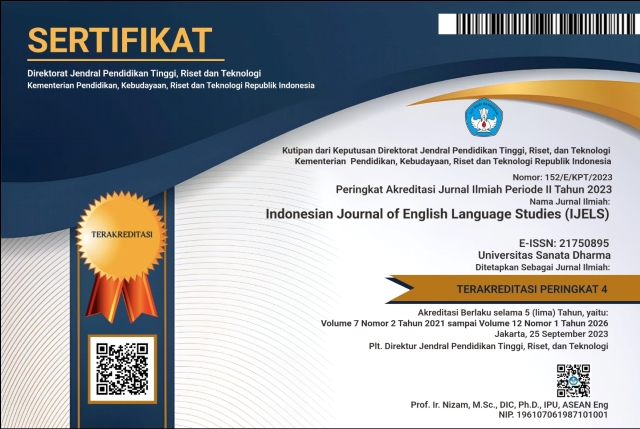
IJELS Journal Sinta 4 Certificate (S4 = Level 4)
We would like to inform you that Indonesian Journal of English Language Studies (IJELS) has been nationally accredited Sinta 4 by the Ministry of Education, Culture, Research and Technology of the Republic of Indonesia based on the decree No. Surat Keputusan 152/E/KPT/2023. Validity for 5 years: Vol 7 No 2, 2021 till Vol 12 No 1, 2026

This work is licensed under CC BY-SA.
Creative Commons Attribution-ShareAlike 4.0 International License

IJELS e-ISSN 2715-0895; IJELS p-ISSN 2442-790X
Indonesian Journal of English Language Studies (IJELS) is published twice a year, namely in March and September, by the English Language Studies (ELS) of the Graduate Program of Sanata Dharma University, Yogyakarta, Indonesia.