

Translanguaging for Transformation: Identity, Equity, and Pedagogical Resistance in Nepalese ELT Classrooms
(1) Tribhuvan University, Nepal
(*) Corresponding Author
Abstract
Translanguaging refers to the dynamic, natural, and purposeful mixing of multiple languages in communication. It has become popular among English language teachers in multilingual settings. It promotes learner agency and acknowledges individual identities and experiences. However, some teachers still mistakenly view multilingualism as a barrier rather than an asset in English Language Teaching (ELT). Despite the advantages of translanguaging in ELT, little empirical research has been done on its use in Nepalese ELT classrooms, especially when it comes to the teachers' perspectives. The study aims to investigate the roles of translanguaging in ELT classrooms and to analyze the teachers' experience of using translanguaging in ELT classrooms. Employing the phenomenological research design, the researcher purposively selected three English language teachers teaching in three different public schools in the Sunsari district for in-depth interviews. The interviews were recorded, transcribed, coded, categorized, and analyzed thematically. The study found that teachers affirm students' identities and promote an inclusive learning environment by using translanguaging as a transformative tool. The study additionally shows how teachers challenge the exclusive English and mix multiple languages to create a translingual space that empowers students and fosters equity in the classroom. The study concluded that translanguaging is a flexible approach to ELT that enhances student engagement and understanding of content. It implies that teachers in multilingual contexts adopt a translingual pedagogical approach to embrace diversity, promote social justice, and empower their students.
Keywords
Full Text:
PDFReferences
Almatrafi, B. (2023). Saudi EFL students’ perceptions of pedagogical translanguaging in English medium instruction. International Journal of Language and Literary Studies, 5(4), 172–191. https://doi.org/10.36892/ijlls.v5i4.1460
August, D., & Shanahan, T. (2006). Developing reading and writing in second-language learners: Lessons from the report of the National Literacy Panel on Language-Minority Children and Youth. Routledge.
Baker, C. (2011). Foundations of bilingual education and bilingualism (5th ed.). Multilingual Matters.
Bourdieu, P. (1986). The forms of capital. In J. G. Richardson (Ed.), Handbook of theory and research in the sociology of education (pp. 241–258). Greenwood Press.
Braun, V., & Clarke, V. (2006). Using thematic analysis in psychology. Qualitative Research in Psychology, 3(2), 77–101. https://doi.org/10.1191/1478088706qp063oa
Canagarajah, S. (2011). Translanguaging in the classroom: Emerging issues for research and pedagogy. Applied Linguistics Review, 2, 1–28. https://doi.org/10.1515/9783110239331.1
Cenoz, J. & Gorter, D. (2017). Translanguaging as a pedagogical tool in multilingual education. In J. Cenoz, D. Gorter, & S. May (Eds.), Language awareness and multilingualism (pp. 309–321). Springer. https://www.researchgate.net/publication/318019316_Translanguaging_as_a_Pedagogical_Tool_in_Multilingual_Education
Cenoz, J., & Gorter, D. (2020). Pedagogical translanguaging: An introduction. System, 92, Article 102269. https://doi.org/10.1016/j.system.2020.102269
Conteh, J. (2018). Translanguaging as pedagogy: A critical review. In A. Creese & A. Blackledge (Eds.), The Routledge handbook of language and superdiversity: An interdisciplinary perspective (pp. 473–487). Routledge.
Creese, A. & Blackledge, A. (2010). Translanguaging in the bilingual classroom: A pedagogy for learning and teaching? The Modern Language Journal, 94(1), 103–115. http://www.jstor.org/stable/25612290
Creese, A., & Blackledge, A. (2020). Translanguaging and language teaching. In Oxford research encyclopedia of education.
Cummins, J. (2007). Rethinking monolingual instructional strategies in multilingual classrooms. Canadian Journal of Applied Linguistics, 10(2), 221–240. https://www.researchgate.net/publication/228368309_Rethinking_Monolingual_Instructional_Strategies_in_Multilingual_Classrooms
Cummins, J. (2009). Multilingualism in the English-language classroom: Pedagogical considerations. TESOL Quarterly, 43(2), 317–321. https://doi.org/10.1002/j.1545-7249.2009.tb00171.x
Freire, P. (1970). Pedagogy of the oppressed. Continuum.
García, O. & Leiva, C. (2014). Theorizing and enacting translanguaging for social justice. In A. Blackledge & A. Creese (Eds.), Heteroglossia as practice and pedagogy (pp. 199–216). Springer. https://www.researchgate.net/publication/278664963_Theorizing_and_Enacting_Translanguaging_for_Social_Justice
García, O. & Lin, A. (2016). Translanguaging in bilingual education. In O. García, A. M. Y. Lin, & S. May (Eds.), Bilingual and multilingual education: Encyclopedia of language and education (pp.117–130). Springer. https://doi.org/10.1007/978-3-319-02258-1_9
García, O. (2009). Bilingual education in the 21st century: A global perspective. Wiley Black & Sons.
García, O., & Kleyn, T. (Eds.) (2016). Translanguaging with multilingual students. Learning from classroom moments. Routledge.
García, O., & Wei, L. (2014). Translanguaging: Language, bilingualism and education. Palgrave Macmillan.
Hammersley, M. (2013). What is qualitative research? Bloomsbury Academic.
Hornberger, N. H., & Link, H. (2012). Translanguaging in today’s classrooms: A biliteracy lens. Theory into Practice, 51(4), 239–247. https://doi.org/10.1080/00405841.2012.726051
Huang, X. & Chalmers, H. (2023). Implementation and effects of pedagogical translanguaging in EFL classrooms: A systematic review. Languages, 8(3), 194. https://doi.org/10.3390/languages8030194
Jenkins, J. (2007). English as a lingua franca: Attitude and identity. Oxford University Press.
Jørgenson, J. N. (2008). Polylingual languaging around and among children and adolescents. International Journal of Multilingualism, 5(3), 161–176. https://doi.org/10.1080/14790710802387562
Joshi, K. R. (2018). Translanguaging as a negotiated pedagogy in higher education: Classroom practices, experiences and implications [Unpublished MPhil dissertation]. Tribhuvan University.
Khairunnisa, K., & Lukmana, I. (2020). Teachers’ attitudes towards translanguaging in Indonesian EFL classrooms. Jurnal Penelitian Pendidikan, 20(2), 254–266. https://doi.org/10.17509/jpp.v20i2.27046
Makalela, L. (2015). Moving out of linguistic boxes: The effects of translanguaging strategies for multilingual classrooms. Language and Education 29(3), 200–217. https://doi.org/10.1080/09500782.2014.994524
Moll, L. C., Amanti, C., Neff, D., & Gonzalez, N. (1992). Funds of knowledge for teaching: Using a qualitative approach to connect homes and classrooms. Theory Into Practice, 31(2), 132–141. https://doi.org/10.1080/00405849209543534
Nambisan, K., (2014). Teachers' attitudes towards and uses of translanguaging in English language classrooms in Iowa [Doctoral dissertation]. Iowa State University. https://lib.dr.iastate.edu/etd/14230
National Statistics Office. (2021). National population and housing census 2021 results. Government of Nepal. https://censusnepal.cbs.gov.np/results
Norton, B., & Tembe, J. (2006). Teacher training and English language in Uganda. TESOL Quarterly, 40(4), 857–860. https://doi.org/10.2307/40264317
Otheguy, R., García, O. & Reid, W. (2015). Clarifying translanguaging and deconstructing named languages: A perspective from linguistics. Applied Linguistics Review, 6(3), 281– 307. https://doi.org/10.1515/applirev-2015-0014
Paudel, J. (2021). Translanguaging as a pedagogy of enacting social justice in a multilingual setting. In K. Shrestha & P. Phyak (Eds.), Teaching practices and language ideologies for multilingual classrooms (pp. 131–150). IGI Global. https://doi.org/10.4018/978-1-7998-3339-0.ch008
Pennycook, A. (2010). Language as a local practice. Routledge.
Phyak, P. (2013). Language ideologies and local languages as the medium of instruction policy: A critical ethnography study of a multilingual school in Nepal. Current Issues in Language Planning, 14(1), 127–143. https://doi.org/10.1080/14664208.2013.775557
Phyak, P. (2018). Translanguaging as a pedagogical resource in English language teaching: A response to unplanned language education policies in Nepal. In K. Kuchah, & F. Shamim (Eds.), International Perspectives on teaching English in difficult circumstances (pp. 49–70). Palgrave Macmillan. https://doi.org/10.1057/978-1-137-53104-9_3
Phyak, P. (2023). Translanguaging as a space of simultaneity: theorizing translanguaging pedagogies in English medium schools from a spatial perspective. Modern Language Journal, 107(1), 289–307. https://doi.org/10.1111/modl.12830
Phyak, P., Sah, P.K., Ghimire, N., & Lama, A. (2022). Teacher agency in creating a translingual space in Nepal’s multilingual English medium schools. RELC Journal, 53(2), 1–21. https://doi.org/10.1177/00336882221113950
Rauteda, K. R. (2022). Translanguaging as a pedagogical resource in multilingual ELT classrooms: Exploring perceptions and practices [Unpublished master’s Thesis]. Tribhuvan University. https://doi.org/10.13140/RG.2.2.26973.63208
Rauteda, K. R. (2024a). Use of EMI at secondary education: Exploring non-English Nepalese teachers’ ideologies. Siddhajyoti Interdisciplinary Journal, 5(1), 33–43. https://doi.org/10.3126/sij.v5i1.63596
Rauteda, K. R. (2024b). Unveiling pedagogical translanguaging: Investigating teachers’ translingual practices and purposes in ELT classrooms. English Language Teaching Perspective, 9(1-2), 51–66. https://doi.org/10.3126/eltp.v9i1-2.68719
Riswanto, R. (2022). Exploring translanguaging as a pedagogical strategy used by the English teacher in EFL classroom setting. JPGI (Jurnal Penelitian Guru Indonesia), 7(1), 96–103. https://doi.org/10.29210/021948jpgi0005
Sah, P. K. (2020). English medium instruction in South Asian’s multilingual schools: Unpacking the dynamics of ideological orientations, policy/practices, and democratic questions. International Journal of Bilingual Education and Bilingualism, 25(2), 742–755. https://doi.org/10.1080/13670050.2020.1718591
Salazar, M. (2013). A humanizing pedagogy: Reinventing the principles and practice of education as a journey toward liberation. Review of Research in Education, 37(1), 121–148. https://doi.org/10.3102/0091732X12464032
Saud, M. (2020). English medium public schools in Nepal: A new linguistic market in education. LLT Journal: A Journal on Language and Language Teaching, 23(2), 319–333. https://doi.org/10.24071/llt.v23i2.2571
Schulze, J., Ittner, A., & Marquez, E. (2019). Translanguaging in the multilingual classroom: From theory to practice. WAESOL Educators, Western Oregon University. https://www.academia.edu/39745252/Translanguaging_in_the_Multilingual_Classroom_From_Theory_to_Practice
Seidlhofer, B. (2011). Understanding English as a lingua franca. Oxford University Press.
Shi, L. & Rolstad, K. (2022). “I don’t let what I don't know stop what I can do”—How monolingual English teachers constructed a translanguaging pre‐K classroom in China. TESOL Quarterly, 57(4), 1490–1517. https://doi.org/10.1002/tesq.3204
Skutnabb-Kangas, T. (2009). Linguistic genocide in education–or worldwide diversity and human rights? Routledge.
Song, J., Howard, D., & Olazabal, W. (2022). Translanguaging as a strategy for supporting multilingual learners’ social emotional learning. Education Sciences, 12(7), 475. https://doi.org/10.3390/educsci12070475
Sutrisno, D. B. (2023). Multilingualism and translanguaging: A review of translanguaging practices in the linguistically diverse Indonesian EFL Classrooms. Journal of Languages and Language Teaching, 11(3), 547–554. https://doi.org/10.33394/jollt.v11i3.8265
Tollefson, J. W. (2013). Language policies in education: Critical issues (2nd ed.). Routledge.
Van Manen, M. (1990). Researching lived experience: Human science for an action sensitive pedagogy. State University of New York Press.
Vogel, S., & García, O. (2017). Translanguaging. In G. Noblit & L. Moll (Eds.). Oxford Research Encyclopedia of Education. Oxford University Press. https://doi.org/10.1093/acrefore/9780190264093.013.181
Wang, P. (2022). Relooking at the roles of translanguaging in English as a foreign language classes for multilingual learners: Practices and implications. Frontiers in Psychology, 13, Article 850649. https://doi.org/10.3389/fpsyg.2022.850649
Wei, L. (2011). Moment analysis and translanguaging space: Discursive construction of identities by multilingual Chinese youth in Britain. Journal of Pragmatics, 43(5), 1222–1235. https://doi.org/10.1016/j.pragma.2010.07.035
Wei, L. (2018). Translanguaging as a practical theory of language. Applied Linguistics, 39(1), 9–30. https://doi.org/10.1093/applin/amx044
Wei, L. (2024). Transformative pedagogy for inclusion and social justice through translanguaging, co-learning, and transpositioning. Language Teaching, 57(2), 203–214. https://doi.org/10.1017/S0261444823000186
Zhu, J. & Gu, Y. (2022). The effects of multimodal communication classroom on the learning performance of EFL learners from the perspective of translanguaging. International Journal of Education and Humanities, 4(3), 223–230. https://doi.org/10.54097/ijeh.v4i3.1812
DOI: https://doi.org/10.24071/ijels.v11i2.12202
Refbacks
- There are currently no refbacks.

This work is licensed under a Creative Commons Attribution-ShareAlike 4.0 International License.
Indexed by








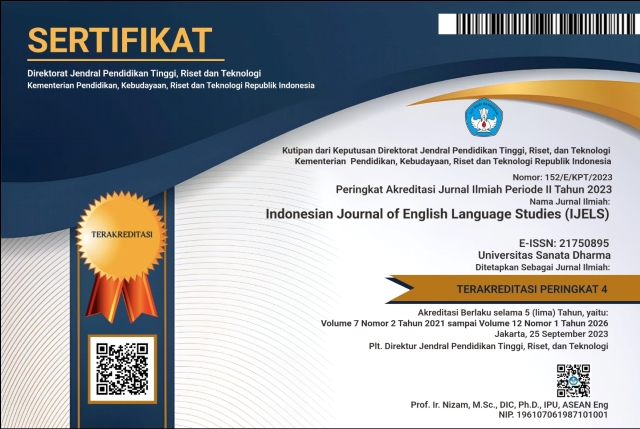
IJELS Journal Sinta 4 Certificate (S4 = Level 4)
We would like to inform you that Indonesian Journal of English Language Studies (IJELS) has been nationally accredited Sinta 4 by the Ministry of Education, Culture, Research and Technology of the Republic of Indonesia based on the decree No. Surat Keputusan 152/E/KPT/2023. Validity for 5 years: Vol 7 No 2, 2021 till Vol 12 No 1, 2026

This work is licensed under CC BY-SA.
Creative Commons Attribution-ShareAlike 4.0 International License

IJELS e-ISSN 2715-0895; IJELS p-ISSN 2442-790X
Indonesian Journal of English Language Studies (IJELS) is published twice a year, namely in March and September, by the English Language Studies (ELS) of the Graduate Program of Sanata Dharma University, Yogyakarta, Indonesia.