
Lecturers’ Feedback as a Tool of Power: A Critical Discourse Analysis of Lecturer Feedback in Classrooms
(1) Universitas Jenderal Soedirman
(2) Universitas Jenderal Soedirman, Indonesia
(*) Corresponding Author
Abstract
The types of conversations we hold or avoid with students determine the relationship that we design in our class. Lecturer feedback plays a central role in shaping the learning process, but it also functions as a site where power dynamics are enacted. This paper explores the power relations embedded in language used in lecturer feedback through the lens of critical discourse analysis (CDA). By analyzing how feedback positions students and constructs their identities, this study seeks to uncover the implicit hierarchies and authority structures present in the classroom discourse of the English Literature Study Program Class. The analysis relies on five power bases: referent, reward, expert, legitimate, and coercive. The data were collected by observing six classroom sessions during this time, and feedback instances were transcribed and compiled. In total, approximately 30 feedback examples were selected for in-depth analysis. These include both oral and written feedback that was considered representative of recurring discursive features. The finding shows that lecturer feedback not only reflects power dynamics but also influences the construction of student identity. Furthermore, the feedback that the lecturer provided negatively impacted the learning behavior due to overusing antisocial-based language, which included legitimate and coercive feedback. This feedback also built the students’ identity as incapable learners.
Keywords
Full Text:
PDFReferences
Abdullah, F. S., & Hosseini, K. (2012). Discursive enactment of power in Iranian high school EFL classrooms. GEMA Online Journal of Language Studies, 12(2), 375–392. https://ejournal.ukm.my/gema/article/view/646
Black, P., & William, D. (2009). Developing the Theory of Formative Assessment. Educational Assessment, Evaluation and Accountability, 21(1), 5-31. https://doi.org/10.1007/s11092-008-9068-5
Brookhart, S. M. (2017). How to give effective feedback to your students. ASCD.
Brooks, C. F. (2016). Role, power, ritual, and resistance: a critical discourse analysis of college classroom talk. Western Journal of Communication, 80(3), 348–369. https://doi.org/10.1080/10570314.2015.1098723
Carless, D., & Boud, D. (2018). The development of student feedback literacy: Enabling uptake of feedback. Assessment & Evaluation in Higher Education, 43(8), 1315–1325. https://doi.org/10.1080/02602938.2018.1463354
Carless, D., & Winstone, N. (2023). Teacher feedback literacy and its interplay with student feedback literacy. Teaching in Higher Education, 28(1), 150–163. https://doi.org/10.1080/13562517.2020.1782372
Chan, C. K. Y., & Luo, J. (2022). Exploring teacher perceptions of different types of feedback practices’ in higher education: Implications for teacher feedback literacy. Assessment and Evaluation in Higher Education, 47(1), 61–76. https://doi.org/10.1080/02602938.2021.1888074
Chanock, K. (2000). Comments on essays: Do students understand what tutors write? Teaching in Higher Education, 5(1), 95-105. http://dx.doi.org/10.1080/135625100114984
Evans, C. (2013). Making sense of assessment feedback in higher education. Review of Educational Research, 83(1), 70–120. https://doi.org/10.3102/0034654312474350
Fairclough, N. (1995). Critical discourse analysis: the critical study of language. Longman Group Limited.
Fairclough, N. (2001). Language and power (2nd ed.). Longman.
Foucault, M. (1980). Power/knowledge: Selected interviews and other writings, 1972-1977. Pantheon.
French, J. R. P., & Raven, B. (1959). The bases of social power. University of Michigan, Institute for Social Research.
Gamlem, S. M., & Munthe, E. (2013). Mapping the quality of feedback to support students’ learning in lower secondary classrooms. Cambridge Journal of Education, 44(1), 75–92. https://doi.org/10.1080/0305764X.2013.855171
Gee, J. P. (2014). An introduction to discourse analysis: Theory and method (4th ed.). Routledge.
Hattie, J., & Timperley, H. (2007). The power of feedback. Review of Educational Research, 77(1), 81-112. https://doi.org/10.3102/003465430298487
Henderson, M., Ryan, T., Boud, D., Dawson, P., Phillips, M., Molloy, E., & Mahoney, P. (2021). The usefulness of feedback. Active Learning in Higher Education, 22(3), 229–243. https://doi.org/10.1177/1469787419872393
Ivanic, R. (1998). Writing and identity: The discoursal construction of identity in academic writing. John Benjamins Publishing.
Mccroskey, J. C., & Richmond, V. P. (1983). Power in the classroom I: teacher and student perceptions. Communication Education, 32(2), 175–184. https://doi.org/10.1080/03634528309378527
Moser, A. (2020). Written corrective feedback: The role of learner engagement: A practical approach. Springer Nature.
Shei, C. (2019). The Routledge handbook of Chinese discourse analysis. Routledge.
Shute, V. J. (2008). Focus on formative feedback. Review of Educational Research, 78(1), 153-189. https://doi.org/10.3102/0034654307313795
Sultan, S., & Jufri, J. (2019). Teacher`s Control on students: representation of antisocial communication in an Indonesian language learning context. Humaniora, 10(2), 145. https://doi.org/10.21512/humaniora.v10i2.5531
Tai, J., Ajjawi, R., Boud, D., Dawson, P., & Panadero, E. (2018). Developing evaluative judgement: Enabling students to make decisions about the quality of work. Higher Education, 76(3), 467–481. https://doi.org/10.1007/s10734-017-0220-3
Van Der Kleij, F., & Adie, L. (2020). Towards effective feedback: An investigation of teachers’ and students’ perceptions of oral feedback in classroom practice. Assessment in Education: Principles, Policy and Practice, 27(3), 252–270. https://doi.org/10.1080/0969594X.2020.1748871
Winstone, N. E., Mathlin, G., & Nash, R. A. (2019). Building feedback literacy: Students’ perceptions of the Developing Engagement with Feedback Toolkit. Frontiers in Education, 4(39). https://doi.org/10.3389/feduc.2019.00039
Yang, M., & Carless, D. (2012). The feedback triangle and the enhancement of dialogic feedback processes. Teaching in Higher Education, 18(3), 285–297. https://doi.org/10.1080/13562517.2012.719154
DOI: https://doi.org/10.24071/ijels.v11i2.11602
Refbacks
- There are currently no refbacks.

This work is licensed under a Creative Commons Attribution-ShareAlike 4.0 International License.
Indexed by








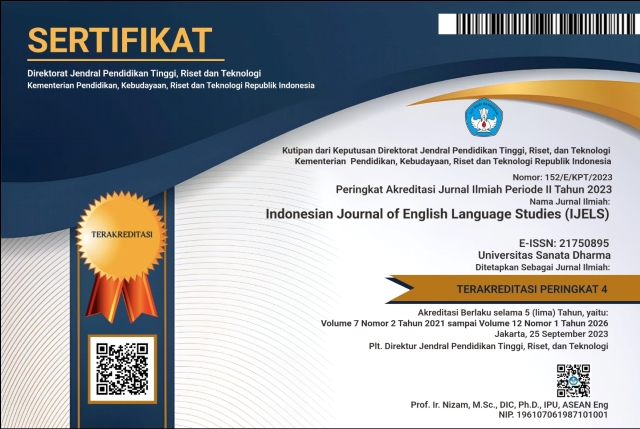
IJELS Journal Sinta 4 Certificate (S4 = Level 4)
We would like to inform you that Indonesian Journal of English Language Studies (IJELS) has been nationally accredited Sinta 4 by the Ministry of Education, Culture, Research and Technology of the Republic of Indonesia based on the decree No. Surat Keputusan 152/E/KPT/2023. Validity for 5 years: Vol 7 No 2, 2021 till Vol 12 No 1, 2026

This work is licensed under CC BY-SA.
Creative Commons Attribution-ShareAlike 4.0 International License

IJELS e-ISSN 2715-0895; IJELS p-ISSN 2442-790X
Indonesian Journal of English Language Studies (IJELS) is published twice a year, namely in March and September, by the English Language Studies (ELS) of the Graduate Program of Sanata Dharma University, Yogyakarta, Indonesia.