
Voice of America in the Classroom: Assessing Its Educational Value for Listening Comprehension in High School English Classes
(1) University Of Bengkulu, Indonesia
(2) University of Bengkulu, Indonesia
(*) Corresponding Author
Abstract
This study examines the relationship between the use of Voice of America (VOA) videos and students' listening comprehension in English language courses through a mixed-methods explanatory sequential design, addressing the ongoing debate on the effectiveness of authentic media in language learning. Given the increasing reliance on digital content for language acquisition, this study explores whether VOA videos offer measurable advantages over traditional listening materials in debating issues: why is it significant? The research includes quantitative data collection involving listening comprehension tests and surveys with Likert-scale questionnaires, followed by qualitative data gathered through structured interviews. Quantitative analysis using SPSS and Pearson correlation indicates a weak positive relationship between VOA video use and listening performance (r = 0.108, p = 0.651), which is statistically insignificant. Qualitative insights suggest that VOA videos provide exposure to authentic pronunciation, intonation, and accents, and may contribute to increased motivation for learning. Thematic analysis identifies challenges, such as the speed of speech and the presence of technical terminology. In general, the students' listening comprehension scores showed improvement, with a median score of 80/100. The findings suggest that integrating authentic video materials like VOA into language instruction may have pedagogical value while also highlighting limitations for broader applicability.
Keywords
Full Text:
PDFReferences
Abdi, S., & Makiabadi, H. (2019). Learning English listening and speaking through BBC VOA podcasts: An app review. Teaching English with Technology, 19(2), 101–108. https://tewtjournal.org/download/8-learning-english-listening-and-speaking-through-bbc-voa-podcasts-an-app-review-by-samaneh-abdi-and-hossein-makiabadi/.
Alharbi, M. A., & Al-Ahdal, A. M. H. (2022). Communication barriers in the EFL classroom: Is poor listening the culprit that obstructs learning? Interactive Learning Environments. https://doi.org/10.1080/10494820.2022.2098776.
Alzamil, J. (2021). Listening skills: Important but difficult to learn. Arab World English Journal (AWEJ), 12(3), 366–374. https://dx.doi.org/10.24093/awej/vol12no3.25.
Andasari, D. R., Lindawati, R., & Ganinda, N. (2021). The use of VOA special English: A review of studies on benefit and development of students’ listening skill. Majapahit Journal of English Language Teaching Studies, 2(1). https://ejurnal.unim.ac.id/index.php/majelis/article/view/1015.
Astrid, A., Khodijah, N., Zuhdiyah, Z., & Yuliyanti, A. Y. (2024). Indonesian EFL students’ anxiety factors and solutions for listening comprehension: Multiple case study. SiELE: Studies in English Language and Education, 11(1), 41–58. https://doi.org/10.24815/siele.v11i1.30976.
Astuti, D., Zuhri, M., & Musfirah, M. (2020). Developing students’ listening skill through VoA (Voice of America) learning English video. Didaktika: Jurnal Kependidikan, 13(2), 146–158. https://doi.org/10.30863/didaktika.v13i2.954.
Azizah, M., & Sholikhah, H. A. (2023). Improving listening comprehension by using (VOA) English broadcast students of SMK Negeri 3 Kayu Agung. Jurnal Ilmiah Bina Edukasi, 16(1), 68–78. https://journal.binadarma.ac.id/index.php/jurnalbinaedukasi.
Chang, A., Millett, S., & Renandya, W. A. (2019). Developing listening fluency through supported extensive listening practice. RELC Journal, 50(3), 422–438. https://doi.org/10.1177/0033688217751468.
Chapelle, C. A. (2018). Technology-mediated language learning. In J. W. Schwieter & A. Benati (Eds.), The Cambridge Handbook of Language Learning (585–606). Cambridge University Press.
Creswell, J. (2011). Planning, conducting, and evaluating quantitative and qualitative research. New York: Pearson.
Creswell, J., & Clark, V. (2017). Designing and conducting mixed methods research (3rd ed.). SAGE.
Fitria, T. N. (2021). An analysis of the students’ difficulties in TOEFL prediction test of listening section. ENGLISH FRANCA : Academic Journal of English Language and Education, 5(1), 95–110. https://doi.org/10.29240/ef.v5i1.2212.
Graham, S. (2017). Research into practice: Listening strategies in an instructed classroom setting. Language Teaching, 50(1), 107–119. https://doi.org/10.1017/S0261444816000306.
Guest, G., MacQueen, K. M., & Namey, E. E. (2012). Applied thematic analysis. Los Angeles: SAGE. https://doi.org/10.4135/9781483384436.
Harianja, R. N., Lumbantoruan, N. R., Sinaga, A., Purba, M., & Napitupulu, S. (2022). The students’ listening problems for senior high school in Pematangsiantar. Jurnal Ilmiah Pendidikan, 3(2), 2722–5194. https://doi.org/10.51276/edu.v3i2.244.
Hayati, A., Hadi, M. S., & Izzah, L. (2022). Online-based innovative education (VOA Learning English) to build English students' listening skills. Jurnal UMPWR, 44(1), 44-54. https://jurnal.umpwr.ac.id/index.php/scripta/article/view/2159.
Krashen, S. (1982). Principles and practice in second language acquisition. Pergamon.
Kurniawan, C., & Kuswandi, D. (2021). Pengembangan e-modul sebagai media literasi digital pada pembelajaran abad 21. Academia Publication.
Laeli, A. F. (2021). VOA video adopted instruction: An attempt to engage EFL students’ active participation in listening activities. RIIL (Research and Innovation in Language Learning), 4(1), 18–30. https://doi.org/10.33603/rill.v4i1.3980.
Ly, N. N., & Nga, N. T. (2020). An investigation into the effects of extensive listening on pre-intermediate learners’ English vocabulary learning at the Asian International School. Social Sciences, 10(1), 3–17. http://dx.doi.org/10.46223/HCMCOUJS.soci.en.10.1.552.2020.
Masrai, A. (2020). Can L2 phonological vocabulary knowledge and listening comprehension be developed through extensive movie viewing? The case of Arab EFL learners. International Journal of Listening, 34(1), 54–69. https://doi.org/10.1080/10904018.2019.1582346.
Mayer, R. E. (2021). Multimedia Learning (3rd ed.). Cambridge University Press.
Prabawati, A., AM, S. A., & AM, S. A. (2021). The students’ perception of the online media used by teacher in learning English. English Language Teaching Methodology, 1(3), 169–181. https://jurnal.fkip.unismuh.ac.id/index.php/eltm/article/view/49.
Rahmaningtyas, H., & Mardhiyyah, S. A. (2021). Integrating VOA learning English into an English listening classroom. Bahasa dan Seni: Jurnal Bahasa, Sastra, Seni, dan Pengajarannya, 48(2), 91–102. dx.doi.org/10.17977/um015v48i22020p091.
Ramli, H. (2020). Improving vocabulary through audio visual by using YouTube videos to SMP students: A pre-experimental research. Universitas Muhammadiyah Makassar.
Risawati, U. (2020, December 23). The use of Voice of America (VOA) learning English application to improve student’s speaking ability for the eighth graders of MTsN 2 Tulungagung (Undergraduate Thesis). IAIN Tulungagung. http://repo.uinsatu.ac.id/18924/.
Rost, M. (2016). Teaching and Researching Listening (3rd ed.). Routledge.
Saunders, M. N., Lewis, P., Thornhill, A., & Bristow, A. (2019). Research methods for business students (8th ed.). Pearson.
Surayya, S. A., Prasetyaningrum, A., Usuludin, U., & Khatami, A. (2024). Unlocking oral proficiency through the shadowing technique combined with VOA: The experimental impact on undergraduate speaking abilities. Journey: Journal of English Language and Pedagogy, 7(2), 208–218. https://doi.org/10.33503/journey.v7i2.832.
Tasya, M. B., Tohidin, & Priajana, N. (2018). The effectiveness of VOA news video as the teaching media in increasing the listening skill. ELT-Echo, 3(2), 159-168. http://download.garuda.kemdikbud.go.id/article.php?article=868903&val=9454&title=THE%20EFFECTIVENESS%20OF%20VOICE%20OF%20AMERICA%20NEWS%20VIDEO%20AS%20THE%20TEACHING%20MEDIA%20OF%20LISTENING%20ABILITY%20AT%20FIRST%20GRADE%20OF%20SMAN%201%20BABAKAN.
Vaishnavi, P., & Gandhi, M. G. (2020). Focusing on the development of listening skills of collegiate students using VOA application with special reference to Sathyabama Institute of Science and Technology. Research Journal of English Language and Literature (RJELAL), 8(2), 295–300. http://www.rjelal.com/8.2.20/295-300%20PUDURU%20VAISHNAVI.pdf.
Vandergrift, L., & Goh, C. C. M. (2012). Teaching and learning second language listening: Metacognition in action. Routledge.
Abdi, S., & Makiabadi, H. (2019). Learning English listening and speaking through BBC VOA podcasts: An app review. Teaching English with Technology, 19(2), 101–108. https://tewtjournal.org/download/8-learning-english-listening-and-speaking-through-bbc-voa-podcasts-an-app-review-by-samaneh-abdi-and-hossein-makiabadi/.
Alharbi, M. A., & Al-Ahdal, A. M. H. (2022). Communication barriers in the EFL classroom: Is poor listening the culprit that obstructs learning? Interactive Learning Environments. https://doi.org/10.1080/10494820.2022.2098776
Alzamil, J. (2021). Listening skills: Important but difficult to learn. Arab World English Journal (AWEJ), 12(3), 366–374. https://dx.doi.org/10.24093/awej/vol12no3.25
Andasari, D. R., Lindawati, R., & Ganinda, N. (2021). The use of VOA special English: A review of studies on benefit and development of students’ listening skill. Majapahit Journal of English Language Teaching Studies, 2(1). https://ejurnal.unim.ac.id/index.php/majelis/article/view/1015.
Astrid, A., Khodijah, N., Zuhdiyah, Z., & Yuliyanti, A. Y. (2024). Indonesian EFL students’ anxiety factors and solutions for listening comprehension: Multiple case study. SiELE: Studies in English Language and Education, 11(1), 41–58. https://doi.org/10.24815/siele.v11i1.30976.
Astuti, D., Zuhri, M., & Musfirah, M. (2020). Developing students’ listening skill through VoA (Voice of America) learning English video. Didaktika: Jurnal Kependidikan, 13(2), 146–158. https://doi.org/10.30863/didaktika.v13i2.954
Azizah, M., & Sholikhah, H. A. (2023). Improving listening comprehension by using (VOA) English broadcast students of SMK Negeri 3 Kayu Agung. Jurnal Ilmiah Bina Edukasi, 16(1), 68–78. https://journal.binadarma.ac.id/index.php/jurnalbinaedukasi
Chang, A., Millett, S., & Renandya, W. A. (2019). Developing listening fluency through supported extensive listening practice. RELC Journal, 50(3), 422–438. https://doi.org/10.1177/0033688217751468.
Chapelle, C. A. (2018). Technology-mediated language learning. In J. W. Schwieter & A. Benati (Eds.), The Cambridge Handbook of Language Learning (585–606). Cambridge University Press.
Creswell, J. (2011). Planning, conducting, and evaluating quantitative and qualitative research. New York: Pearson.
Creswell, J., & Clark, V. (2017). Designing and conducting mixed methods research (3rd ed.). SAGE.
Fitria, T. N. (2021). An analysis of the students’ difficulties in TOEFL prediction test of listening section. ENGLISH FRANCA : Academic Journal of English Language and Education, 5(1), 95–110. https://doi.org/10.29240/ef.v5i1.2212
Graham, S. (2017). Research into practice: Listening strategies in an instructed classroom setting. Language Teaching, 50(1), 107–119. https://doi.org/10.1017/S0261444816000306.
Guest, G., MacQueen, K. M., & Namey, E. E. (2012). Applied thematic analysis. Los Angeles: SAGE. https://doi.org/10.4135/9781483384436
Harianja, R. N., Lumbantoruan, N. R., Sinaga, A., Purba, M., & Napitupulu, S. (2022). The students’ listening problems for senior high school in Pematangsiantar. Jurnal Ilmiah Pendidikan, 3(2), 2722–5194. https://doi.org/10.51276/edu.v3i2.244.
Hayati, A., Hadi, M. S., & Izzah, L. (2022). Online-based innovative education (VOA Learning English) to build English students' listening skills. Jurnal UMPWR, 44(1), 44-54. https://jurnal.umpwr.ac.id/index.php/scripta/article/view/2159.
Krashen, S. (1982). Principles and practice in second language acquisition. Pergamon.
Kurniawan, C., & Kuswandi, D. (2021). Pengembangan e-modul sebagai media literasi digital pada pembelajaran abad 21. Academia Publication.
Laeli, A. F. (2021). VOA video adopted instruction: An attempt to engage EFL students’ active participation in listening activities. RIIL (Research and Innovation in Language Learning), 4(1), 18–30. https://doi.org/10.33603/rill.v4i1.3980.
Ly, N. N., & Nga, N. T. (2020). An investigation into the effects of extensive listening on pre-intermediate learners’ English vocabulary learning at the Asian International School. Social Sciences, 10(1), 3–17. http://dx.doi.org/10.46223/HCMCOUJS.soci.en.10.1.552.2020.
Masrai, A. (2020). Can L2 phonological vocabulary knowledge and listening comprehension be developed through extensive movie viewing? The case of Arab EFL learners. International Journal of Listening, 34(1), 54–69. https://doi.org/10.1080/10904018.2019.1582346.
Mayer, R. E. (2021). Multimedia Learning (3rd ed.). Cambridge University Press.
Prabawati, A., AM, S. A., & AM, S. A. (2021). The students’ perception of the online media used by teacher in learning English. English Language Teaching Methodology, 1(3), 169–181. https://jurnal.fkip.unismuh.ac.id/index.php/eltm/article/view/49
Rahmaningtyas, H., & Mardhiyyah, S. A. (2021). Integrating VOA learning English into an English listening classroom. Bahasa dan Seni: Jurnal Bahasa, Sastra, Seni, dan Pengajarannya, 48(2), 91–102. dx.doi.org/10.17977/um015v48i22020p091
Ramli, H. (2020). Improving vocabulary through audio visual by using YouTube videos to SMP students: A pre-experimental research. Universitas Muhammadiyah Makassar.
Risawati, U. (2020, December 23). The use of Voice of America (VOA) learning English application to improve student’s speaking ability for the eighth graders of MTsN 2 Tulungagung (Undergraduate Thesis). IAIN Tulungagung. http://repo.uinsatu.ac.id/18924/.
Rost, M. (2016). Teaching and Researching Listening (3rd ed.). Routledge.
Saunders, M. N., Lewis, P., Thornhill, A., & Bristow, A. (2019). Research methods for business students (8th ed.). Pearson.
Surayya, S. A., Prasetyaningrum, A., Usuludin, U., & Khatami, A. (2024). Unlocking oral proficiency through the shadowing technique combined with VOA: The experimental impact on undergraduate speaking abilities. Journey: Journal of English Language and Pedagogy, 7(2), 208–218. https://doi.org/10.33503/journey.v7i2.832.
Tasya, M. B., Tohidin, & Priajana, N. (2018). The effectiveness of VOA news video as the teaching media in increasing the listening skill. ELT-Echo, 3(2), 159-168. http://download.garuda.kemdikbud.go.id/article.php?article=868903&val=9454&title=THE%20EFFECTIVENESS%20OF%20VOICE%20OF%20AMERICA%20NEWS%20VIDEO%20AS%20THE%20TEACHING%20MEDIA%20OF%20LISTENING%20ABILITY%20AT%20FIRST%20GRADE%20OF%20SMAN%201%20BABAKAN.
Vaishnavi, P., & Gandhi, M. G. (2020). Focusing on the development of listening skills of collegiate students using VOA application with special reference to Sathyabama Institute of Science and Technology. Research Journal of English Language and Literature (RJELAL), 8(2), 295–300. http://www.rjelal.com/8.2.20/295-300%20PUDURU%20VAISHNAVI.pdf.
Vandergrift, L., & Goh, C. C. M. (2012). Teaching and learning second language listening: Metacognition in action. Routledge.
DOI: https://doi.org/10.24071/ijels.v11i1.11540
Refbacks
- There are currently no refbacks.

This work is licensed under a Creative Commons Attribution-ShareAlike 4.0 International License.
Indexed by








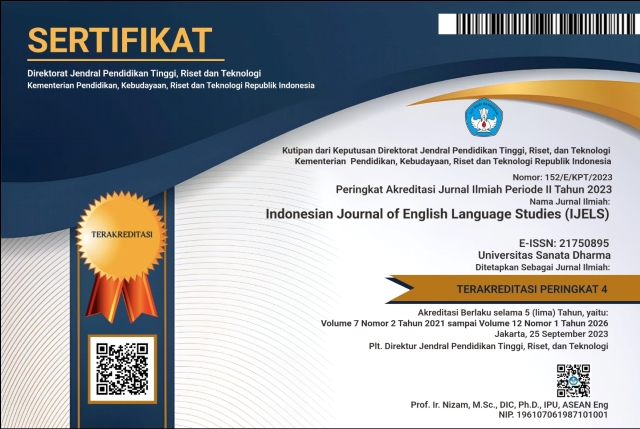
IJELS Journal Sinta 4 Certificate (S4 = Level 4)
We would like to inform you that Indonesian Journal of English Language Studies (IJELS) has been nationally accredited Sinta 4 by the Ministry of Education, Culture, Research and Technology of the Republic of Indonesia based on the decree No. Surat Keputusan 152/E/KPT/2023. Validity for 5 years: Vol 7 No 2, 2021 till Vol 12 No 1, 2026

This work is licensed under CC BY-SA.
Creative Commons Attribution-ShareAlike 4.0 International License

IJELS e-ISSN 2715-0895; IJELS p-ISSN 2442-790X
Indonesian Journal of English Language Studies (IJELS) is published twice a year, namely in March and September, by the English Language Studies (ELS) of the Graduate Program of Sanata Dharma University, Yogyakarta, Indonesia.