
Persuasion, Face-Threatening Acts, and Mitigation Strategies in Southeast Nigeria Haggling Encounters
(1) Enugu State University of Science and Technology, Nigeria
(2) University of Nigeria, Nigeria
(3) Enugu State University of Science and Technology, Nigeria
(*) Corresponding Author
Abstract
Given the fact that haggling could provide the opportunity for deceit,the seller employs different persuasive strategies to convince the, already alerted, buyer to patronise them. However, despite such persuasive strategies, there could be communication breakdown because of distrust and suspicion among the interactants. Such communication breakdown requires a repair for a successful haggling encounter.This study looks at the main artistic modes and pragmatic strategies of persuasion used in southeast Nigerian markets to identify the pragmatic techniques that are used to mitigate threatened face in market encounters. The data consist of ninety sampled haggling experiences involving wholesalers (15), retailers (15), apprentices (15), and customers (45), taken from the five states that comprise Southeast Nigeria. The data analysis draws on Aristotle's threefold method of persuasion, paying close attention to the pathos and logos of his rhetorical appeals, and Mey’s (2001) theory of pragmatic acts. The analysis shows that there is strong presence of logos in the data, with a predomination of the pathos component of the rhetorical appeals. The research also indicates that while face-threatening acts are practed through questioning, comparing, and doubting, it is also mitigated through apologising, euphemising and blame transfer.
Keywords
Full Text:
PDFReferences
Adebayo, M., Aremu, A. & Babatunde, S. (2020). Face acts and impoliteness strategies in Olusegun Obasanjo’s Before it is too late. International Journal of English Language and Linguistics. 8 (1), 54-71. https://eajournals.org/ijellr/vol-8-issue-1-january-2020/face-acts-and-impoliteness-strategies-in-olusegun-obasanjos-before-it-is-too-late/
Adegbite, W. & Odebunmi, A. (2010). Face threats in conversational interactions in orthodox and traditional medicines among the Yoruba in South western Nigeria. In A. Ogunsiji, A. Kehindem & A. Odebunmi (Eds), Language, literature and discourse (pp. 295-320). Lincom.
Adekunle, O. & Adebayo, O. (2017). Politeness in selected independence anniversary speeches of Nigerian heads of government. Open Journal of Modern Linguistics, 7, 290-310. https://doi.org/10.4236/ojml.2017.76021Ahmad, A. (2013). Language use at the Funtua main market. Awka Journal of English Language and Literary Studies, 4(1), 116-127. https://journals.ezenwaohaetorc.org/index.php/ajells/article/view/4-1-2013-008
Al-khatib, M. A. (2015). A sociolinguistic view of the language of persuasion in Jordanian society. Language, Culture and Curriculum, 7(2), 161-174. https://doi.org/10.1080/07908319409525174
Alo, M. & Soneye, T. A. (2014). Haggling as a socio-pragmatic strategy in selected urban markets: An amalgam of English and Nigerian languages. Marang: Journal of Language and Literature, 24, 43-62. https://journals.ub.bw/index.php/marang/article/view/260
Arakelyan & Muradyan, G. (2016). Language as an influential tool for persuasion. Armenina Folia Anglistika, 12(1), 39-45. https://doi.org/10.46991/AFA/2016.12.1.039
Ayoola, K. (2009). Haggling exchanges at meat stalls in some markets in Lagos, Nigeria. Discourse Studies, 11(4), 387-400. https://doi.org/10.1177/1461445609105215
Blankenship, K. L., & Holtgraves, T. (2005). The role of different markers of linguistic powerlessness in persuasion. Journal of Language and Social Psychology, 24(1), 3-24. https://doi.org/10.1177/0261927X04273034
Borchers, T. A. (2002). Persuasion in the media age. McGraw-Hill.
Bousfield, D. (2008). Impoliteness in Interaction. John Benjaimins.
Brown, P. & Levinson, S. (1978). Universals in language usage: Politeness phenomena. In E. N. Goody (Ed.), Questionsand and politeness: Strategies in social interactions (pp. 56-331). Cambridge University Press.
Capone, A. (2005). Pragmemes: A study with reference to English and Italian. Journal of Pragmatics, 37(9), 1355-1371. https://doi.org/10.1016/j.pragma.2005.01.013
Chakrani, B. (2007). Cultural context and speech act theory: A socio-pragmatic analysis of bargaining exchanges in Morocco. Texas Linguistics Forum, 51, 43-53. University of Texas at Austin. https://asol.ling.utexas.edu/salsa/proceedings/2007/index.html
Craver, C. B. (2003). Negotiation styles: The impact on bargaining transactions. Dispute Resolution Journal, 58(2), 48-57. https://www.researchgate.net/publication/228192713_Negotiation_Styles_The_Impact_on_Bargaining_Transactions
Craig, R. T., Tracy, K., & Spisak, F. (1986). The discourse of requests: Assessment of a politeness approach. Human Communication Research, 12(4), 437- 468. https://doi.org/10.1111/j.1468-2958.1986.tb00087.xCupach, W. R., & Metts, S. (1994). Facework. Sage Publications.
Dillard, J. P. (2014). Language, style, and persuasion. In T. M. Holtgraves (Ed.), The Oxford Handbook of Language and Social Psychology (pp. 177–187). Oxford University Press. https://doi.org/10.1093/oxfordhb/9780199838639.001.0001Goffman, E. (1955). On face-work: An analysis of ritual elements in social interaction. Psychiatry: Journal for the Study of Interpersonal Processes, 18(3), 213-231. https://doi.org/10.1080/00332747.1955.11023008
Grice, H. P. (1975). Logic and Conversation. In P. Cole & J. L. Morgan (Eds.), Syntax and Semantic, Vol. 3: Speech Acts (pp. 41-58). Academic Press. https://doi.org/10.1163/9789004368811_003
Huang, D. (2019). A study on persuasive language in personal selling. International Journal of English Linguistics, 9(2), 353-369. https://doi.org/10.5539/ijel.v9n2p353Humă, B. (2023). Language and persuasion: A discursive psychological approach. Social and Personality Pyschology Compass, 17(6), 1-14. https://doi.org/10.1111/spc3.12755
Idowu, F. O. (2012). Transactional speech act in Ojo Iyana Iba market [Manuscript]. Academia. https://www.academia.edu/36948364/Idowu_Florence_Omolade_Transactional_Speech_ActsIonica, A. (2011). Reasoning, argumentation, and persuasion with special application to Hebrew Wisdom Literature and Hebrew Wisdom Scholarship (Unpublished doctoral thesis, University of Toulouse II). https://theses.fr/2011TOU20142
Kassaye, W. (1990). The role of haggling in marketing: An examination of buyer behavior. Journal of Consumer Marketing, 7(4), 53-62. https://doi.org/10.1108/EUM0000000002589
Kennedy, G. A. (Ed. & Trans.). (2007). Aristotle: On rhetoric: A theory of civic discourse (2nd ed). Oxford University Press.
Lau, Y. L., & Ting, S. H. (2015). Generic analysis of bakery service encounters in Malaysia. International Journal of Language and Culture, 3(2), 280-311. https://doi.org/10.1075/ijolc.3.2.06lau
Macaulay, M. (2017). The question of politeness in political interviews. Pragmatics, 27(4), 529-552. https://doi.org/10.1075/prag.27.4.03macMey, J. (2001). Pragmatics: An introduction (2nd ed.). Blackwell.
Miller, G. R. (1987). Persuasion. In C. R. Berger & S. H. Chaffee (Eds.), Handbook of Communication Science (pp. 446-463). Sage Publications.Odebunmi, A. (2009). Politeness in print media political interviews in Nigeria. California Linguistic Notes, 34(1), 1-26. https://english.fullerton.edu/publications/clnArchives/pdf/Odebunm-ipoliteness.pdf
Sinha, C. (2017). Culture in language and cognition. In S. Wen & J. R. Taylor (Eds.), The Routledge handbook of cognitive linguistics (pp. 387-407). Routledge.
Tala'a, S. M. (2015). A linguistic study of persuasive strategies in English religious sermons [Unpublished Masters Dissertation]. Department of English, College of Education for Human Sciences, University of Baghdad.
Ugoala, B. (2020). Face mitigation strategies in former Nigeria president Goodluck Ebele Jonathan's memoir My transition hours. International Journal of Humanitatis Theoreticus, 3 (2), 92-108. https://www.researchgate.net/publication/347764859_Face_Mitigation_Strategies_in_Former_Nigeria_President_Goodluck_Ebele_Jonathan's_Memoir_My_Transition_HoursWatts, R. J. (1992). Linguistic politeness and politic verbal behaviour: Reconsidering claims for universality. In R. J. Watts, S. Ide, S. & K. Ehlich (Eds.), Politeness in language: Studies in its history, theory and practice (pp. 43–69). Mouton de Gruyter.
DOI: https://doi.org/10.24071/ijels.v11i2.10833
Refbacks
- There are currently no refbacks.

This work is licensed under a Creative Commons Attribution-ShareAlike 4.0 International License.
Indexed by








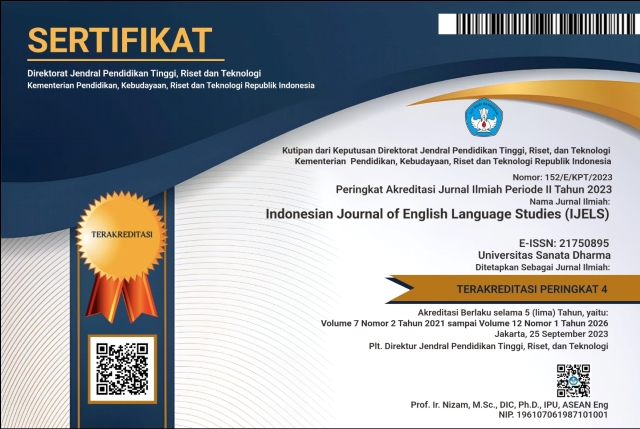
IJELS Journal Sinta 4 Certificate (S4 = Level 4)
We would like to inform you that Indonesian Journal of English Language Studies (IJELS) has been nationally accredited Sinta 4 by the Ministry of Education, Culture, Research and Technology of the Republic of Indonesia based on the decree No. Surat Keputusan 152/E/KPT/2023. Validity for 5 years: Vol 7 No 2, 2021 till Vol 12 No 1, 2026

This work is licensed under CC BY-SA.
Creative Commons Attribution-ShareAlike 4.0 International License

IJELS e-ISSN 2715-0895; IJELS p-ISSN 2442-790X
Indonesian Journal of English Language Studies (IJELS) is published twice a year, namely in March and September, by the English Language Studies (ELS) of the Graduate Program of Sanata Dharma University, Yogyakarta, Indonesia.